
Gender talk
an update on Trans-ideology

Attention: some surgical photographs that may be disturbing.
Also: pop quizes.

“I don’t want Trump in the White House. I don’t want men in women’s communal changing spaces or women’s prisons. I oppose the use of puberty blockers for adolescents. I’ll never vote for the Far Right. These are all perfectly consistent positions to hold.”
—Tina Beattie
Before We Begin
I neither hate nor fear people who consider themselves to be “transgendered,” any more than I hate people who think quartz crystals have magical curative properties, that Donald Trump was God’s instrument, or that climate change isn’t real. I once believed Ayn Rand, so I’m a firm believer in overlooking one another’s errors and flaws (who is without sin, cast the first stone) and treating people with mutual respect and common decency. There are certainly deluded premises at work in many of these cases, but people believe all sorts of things with which I disagree and for which I bear them no malice. Live and let live, I say.
I have never abused or condoned the abuse of anyone because he or she calls themselves transgendered or gender-diverse or any other fashionable appellation. I am a Christian, who subscribes to the universalist notion that all shall be saved, and a pacifist. I believe we are all God’s creatures. While we’re here, though, in this postlapsarian cosmos, we sometimes have to struggle with one another over how we live together.
This is a socio-political issue, an issue of medical ethics, and an issue about a pernicious ideology, and it against this ideology and its profiteers that I’m making my argument. When I denounce certain people here, those denunciations are not based on their beliefs per se, but on actions that produce actual harms. I believe this ideology has outworking consequences that are destructive of persons and inimical to the common good.
Trumping
A bad person can still say or do something that is right.
Two related events have hit the news lately.
First, the Pussy-Grabber-in-Chief moved back into the Oval Office.
Second, he was given a Nathan-to-David rebuke at the National Cathedral by Bishop Mariann Edgar Budde.
In his inauguration speech, he tossed raw tenderloin to his base, which included mentioning his executive order regarding gender and the Federal government.
In Bishop Budde’s homily, she reminded the President and his cohort of our shared humanity and some pretty basic Christian teaching, wherein she mentioned “trans” people and immigrants.
Tina Beattie has since published a short piece on how the liberal media is modifying Bishop Budde’s remarks to suit their own ideological agendas (here).
(On the other hand, as Margaret Kimberley, of Black Agenda Report, asked, “For the past year Joe Biden carried out a genocide. Why was he able to sit in church without being scolded by clergy?” Kind of a good question.)
I agree with what Tina said in the quote above.
I despise Trump.
By the same token, neither my disapproval of him nor his record as a terrible human being, means everything he says or does is wrong. This is a pretty simple and logical statement. A bad person can still say or do something that is right. Or, if you like the old metaphors, a busted clock is right twice a day.
Having read Trump’s actual executive order regarding gender, and in spite of my too-human reluctance to admit someone I loathe might get it right from time to time, I agree with that executive order. From Trump’s executive order:
“Across the country, ideologues who deny the biological reality of sex have increasingly used legal and other socially coercive means to permit men to self-identify as women and gain access to intimate single-sex spaces and activities designed for women, from women’s domestic abuse shelters to women’s workplace showers. This is wrong. Efforts to eradicate the biological reality of sex fundamentally attack women by depriving them of their dignity, safety, and well-being. The erasure of sex in language and policy has a corrosive impact not just on women but on the validity of the entire American system. Basing Federal policy on truth is critical to scientific inquiry, public safety, morale, and trust in government itself. Invalidating the true and biological category of ‘woman’ improperly transforms laws and policies designed to protect sex-based opportunities into laws and policies that undermine them, replacing longstanding, cherished legal rights and values with an identity-based, inchoate social concept. ‘Gender identity’ reflects a fully internal and subjective sense of self, disconnected from biological reality and sex and existing on an infinite continuum, that does not provide a meaningful basis for identification and cannot be recognized as a replacement for sex.
. . . Within 30 days of the date of this order . . . Each agency and all Federal employees shall enforce laws governing sex-based rights, protections, opportunities, and accommodations to protect men and women as biologically distinct sexes. Federal employees acting in an official capacity on behalf of their agency shall use the term ‘sex’ and not ‘gender’ in all applicable Federal policies and documents. The Secretaries of State and Homeland Security, and the Director of the Office of Personnel Management, shall implement changes to require that government-issued identification documents, including passports, visas, and Global Entry cards, accurately reflect the holder’s sex. The prior Administration argued that the Supreme Court’s decision in Bostock v. Clayton County (2020), which addressed Title VII of the Civil Rights Act of 1964, requires gender identity-based access to single-sex spaces under, for example, Title IX of the Educational Amendments Act. This position is legally untenable and has harmed women.”
Of course, Donald Trump didn’t write this order. He’s borderline illiterate. It’s my understanding that it was penned by May Mailman, a Harvard Law Grad; but whoever the author, and whatever else those who support it believe, there is not one line of the order itself that is either erroneous or unreasonable. In fact, it protects feminist advances (that Democrats undermined).
Tina Beattie, quoted at the beginning of this piece, who is a left of center feminist, anti-Trump to her core (like me), could have written this, because it actually does defend the gains made by women. Liberals, who’ve adopted gender ideology as a dogma, passed the ball to their opposition so they could make the easiest political dunk in recent history.


H. L. Mencken once counseled a friend, who was agitated that the local communists had organized an interracial tennis couples team (possibly as a political provocation) . . . “don’t fight them when they’re right.”
Obviously, I’m not saying that a claim can be confirmed by its popularity. But sometimes, the majority are also right. At any rate, this isn’t the conclusion of my argument, but a preface.

In 2023, I wrote a book-length monograph on transgender ideology, which included in-depth side tours through things like Judith Butler’s obtuse philosophy. It was not a widely accessible piece, but an elaborate combined arms assault. I stand by it, but not everyone was or is ready or willing to wade through such a piece. This somewhat abbreviated version—hopefully—will lay out the main points in plainer language and in less time. (It’s still kind of long; real arguments, unlike “memes” and unsupported assertions, take time.)
Okay. Let’s start.
Before we use the term “gender,” we need to define the term. It has multiple meanings, like the words model, tank, bank, light, or dark, you get it. You need the full list of definitions and the context.
Defining “Gender”
Men and women can step outside the norms and expectations of masculinity or femininity without changing their sex.
There are five ways to define this term.
Anyone who has passing familiarity with other languages has run across gendered nouns (1), with which the modifiers must agree in gender and number. In Spanish, for example, a house is feminine, as signified by the a ending: casa. Caso, the masculine noun, means “case,” as one might say, “in this case,” or in este caso. A red house is una (feminine article) casa (feminine noun, singular) roja (feminine modifier, singular). Several red houses would be unas casas rojas. English is far less gendered, even though we still refer to ships as feminine, for example. That’s one kind of “gender”—Gender number 1.
“Gender” is historically related to the idea that the world is held in balance and tension between two forces (2). In another culture, this duality might be expresses as yin and yang. which maps onto our experience of humans as—like other mammals—sexually dimorphic, we procreate via two sexes (or genders, another definition (3), a synonym of sex). Gender number 2, and Gender number 3.
In yet another much more modern context, “gender” came to mean social expectations and expressions associated with males and females (4)—Gender number 4.
The terms masculinity and femininity, for example, have traditionally referred to a set of sex-aligned forms of responsibility, dress, mannerism, speech, tools, jobs, interests, and so forth. Feminists in the sixties and seventies criticized Gender number 4, because they said girls were too often trained to be weak, immobile, silent, and submissive, and boys too often trained to be aggressive, domineering, and even violent.
In this last instance, those feminists weren’t saying boys and men who didn’t meet typical male expectations weren’t males, or that girls and women who were “tomboys” weren’t still females. They opposed Gender number 4, because it too often set girls and women up to be mistreated and controlled by boys and men. It doesn’t always work that way, but they had a lot of good points and truckloads of real-life examples.
Now, in most human societies, there’s always been an acknowledgement that some women will sometimes dress, speak, have interests, and take actions that are more commonly associated with men, and vice-versa — men who might exhibit “feminine” behavior, affect, and so forth. In none of these cases where men or women step outside the norms and expectations of masculinity or femininity did people assume that these atypical actions somehow changed the actual physical sex of the person involved.
“Gender identity” (5) is defined as “a person’s internal sense of being male, female, some combination of male and female, or neither male nor female.” Gender number 5.
POP QUIZ
Assign the correct number to the following definitions of “gender.”
( ) social expectations and expressions associated with males and females
( ) another word for sex
( ) an analogy for some cosmic duality, like yin and yang
( ) an “internal sense” of one’s “identity”
( ) language with masculine and feminine nouns and modifiers
True or False
( ) A bad person can still say or do something that’s right.
The History of Gender Number 5
Gay men and lesbians were fighting to be removed from medical manuals as defective, whereas “transsexuals” were fighting to be added to the list of medical defects.
Gender number 5, or “gender identity,” wasn’t discovered like a protozoa or an Amazonian beetle; it was invented. Then it was modified and developed over four decades by academics and ideologues. Prior to that gender was synonymous with sex, and everyone knew that neither masculinity nor femininity were synonymous with sex. The sex/gender division came along at Johns Hopkins University.
In 1958, physicians at Johns Hopkins University were trying to reconcile medical experiments with cases of “intersexuality” and trying to determine which was the “best sex” for patients who wanted surgical/endocrinological interventions to establish some sense of normalcy. What criteria might be used? And so, speculation turned to the association of an internally experienced sense of sexual “identity” and outward “performances” that might be classified as (according to the popular American folkways of 1958) masculine or feminine.
Bear in mind, now, that these were experiments with people who suffered from a birth defect affecting two of every one thousand people, born with aspects of both male and female anatomy (“hermaphroditism”). The John Hopkins experiments were to find some corrective, much as we do for people born with cleft palates. They had no guidance on how to determine whether to “reconstruct” with male or female appearance (employing both hormones and surgery), and so they went with what society then thought were the proper secondary characteristics of male and female—what we called gender number 4—but determined, in this case, by how the patient felt.
Note, reconstruction didn’t change the basic fact of the congenital defect, which in any case meant the patient was sterile, but did a cosmetic change (with added hormones) so the patient could walk around in public without people gawking at him or her. Patients were given one or another quasi-normal appearance, based on gender number 4, or social expectations associated with men and women in the latter 1950s.
These experiments weren’t motivated purely by compassion. There was also an element of plain medical ambition; and for doctors, this was an excuse to start experimenting on human subjects with endocrine drugs (hormones) and new plastic surgeries developed as restorative measures for the war-wounded.
With the publication of these new medical procedures, some people—whatever their motivations—decided they wanted to undergo these surgical-endocrine interventions, too, even though they had normal, non-pathological bodies. A case of “if you build it, they will come.”
In keeping with some semblance of medical ethics, however, before doctors could perform these risky procedures, with all their side effects, the doctors had to be “convinced” (or have their asses covered) that there was something wrong that needed to be fixed. That is, the patient had to convince the physician that they suffered from a pathology: “a departure or deviation from a normal condition.”
A diagnosis had to be created to justify access to the healthcare and treatment that they wanted. (See the Mayo Clinic definition below for “gender dysphoria.)
The term “transsexualism” came into use specifically in response to these developments. (Bernice Hausman wrote a very good book on this history.) “Transsexualism” became the diagnosis of a pathology just as the medical technology came on board to perform something new in history: “sexual reassignment.”
We’ll leave aside the motivations for seeking these medical interventions, and just note that before a patient could access them, he or she had to “prove” they had a DIS-order, “a departure or deviation from a normal condition.” In fact, those seeking these procedures would often study the medical protocols to memorize the right answers to get what they wanted. Doctors, likewise, were perfectly content to play this game, as long as it kept the lawyers off of them and they got paid.
This was a huge difference between transsexuals and “homosexuals” then, well before today’s alphabet soup of “identities” tried to homogenize them.
Gay men and lesbians were fighting to be removed from medical manuals as defective, whereas “transsexuals” were fighting to be added to the list of medical defects.
In 1973, gay men and lesbians succeeded in being removed from the manual of disorders; and in 1980, “transsexuals” succeeded in being added.
The main reason for these diametrically opposite objectives was that same-sex attracted people required no medical intervention (and wanted clinicians to butt out), whereas “sexual reassignment” required the newly emergent medical technologies. Transsexual discourse, in fact, was often highly homophobic, because homophobia was built into the medical understanding of “transsexualism.”
To justify “sexual reassignment,” there had to be some identifier for the disorder, so when “transsexuals” succeeded in putting their “disorder” into the diagnostic manuals, the disorder was eventually named “gender dysphoria.” We’ll unpack the definition of this term in the next section.
In 1990, an academic named Judith Butler published a book called Gender Trouble, which further modified and developed Gender number 5, in which she—long story short—said that gender is a performance (something in common with Gender number 4), and that sex (in the biological sense) is not biological at all, but a construction of language and power (the very opposite of Gender number 4).
Butler’s theory that language constructs reality became very popular with certain sets within academia, and eventually took hold (in yet another modified version) outside of academia, as what I’ll call “gender ideology” (which we’ll also unpack further down).
Gender number 5 (Butler) and 5a (popular conceptions derived from Butler) were called “gender identity,” and this “identity” was based on how someone “felt,” or claimed they felt (there is no way to discern the difference).
This flipped the script on pathologization, and “gender identity” was then de-pathologized in public discourse, even as the same advocates sought greater access to the medical procedures, as if medical procedures were perfectly fine even in the absence of a pathology. (Further down, we’ll study this contradiction in greater detail. Long story short, the “identity” isn’t pathological, but a normal, healthy body may be.)
In a final note, before going to the next section, we need to point out another contradiction in the current popular understanding of “gender identity.”
In the past, as earlier feminists pointed out, a girl who didn’t like dresses and enjoyed more adventurous pastimes than most girls might have been called a tomboy. The problem was not her perfectly healthy female body, but the social expectations that might seek to shame or ostracize her based on her personality.
The problem, in other words, wasn’t the girl, but a certain construction of femininity. The basis of the problem was a socially-constructed confusion between her preferences in dress and activity with her actual embodiment as a human female.
We who cared for her told her, “Don’t listen to that nonsense, you’re fine just the way you are.”
Now, that same girl can go on the internet and find thousands of people who are telling her—because she likes “boy” things—that there is something very wrong with her, that she’s been “born into the wrong body.” That she needs hormones that could interrupt her normal development, that could sterilize her, that could reduce her bone density, and that could cause permanent mental impairment.
This predictably alarms many parents, and a critical fraction of them voted against a party that endorsed drugging physically healthy kids, allowing males into their daughters’ toilets and changing rooms, and allowing boys to “compete” with girls who have worked their asses off to excel at a sport. Don’t mess with people’s kids!
POP QUIZ
True or False
( ) Some girls enjoy the activities more often associated with boys.
( ) One’s procreative potential (whether one is male of female) is determined by the types of things one enjoys.
( ) Reality doesn’t exist prior to our perception of it, and consciousness is reducible to language.
Gender Dysphoria
“The diagnosis was created to help people with gender dysphoria get access to the healthcare and treatment that they need.”
The word dysphoria, when referring to pathologies, means a state of dissatisfaction or unease. Gender dysphoria means unease with one’s gender, though in this sense the modifier “gender” reverts to its older correspondence with physical sex. The block quote below is taken from the Mayo Clinic’s website:
Gender dysphoria is a feeling of distress that can happen when a person's gender identity differs from the sex assigned at birth.
Some transgender and gender-diverse people have gender dysphoria at some point in their lives. Other transgender and gender-diverse people feel at ease with their bodies and gender identities, and they don't have gender dysphoria.
A diagnosis for gender dysphoria is included in the Diagnostic and Statistical Manual of Mental Disorders (DSM-5). The DSM-5 is published by the American Psychiatric Association. The diagnosis was created to help people with gender dysphoria get access to the healthcare and treatment that they need. A diagnosis of gender dysphoria focuses on the feeling of distress as the issue, not gender identity.
Let’s read this closely this a step a time.
“… a feeling of distress that can happen when a person's gender identity differs from the sex assigned at birth.”
It doesn’t say, “from the sex identified at birth.” It says, “from the sex assigned at birth.”
This is a purely ideological term that has infiltrated the medical profession. This idea that sex is assigned, that is, designated arbitrarily, is based on the philosophical assumptions of Butler and the Gender number 5b (popular version) that not only Gender number 4 (social expectations for the two sexes), but sex itself (as with all mammals, for example) is a “social construction.”
That baby boy wasn’t a boy until we assigned him that sex. In the more rational past, we knew very well from looking at any normal, healthy baby, whether that child was male or female. It was identified, not assigned.
This is particularly weird (though lucrative) for medical practitioners, who would never observe a Neisseria gonorrhoeae under a microscope and claim that they assign it as the pathogen for gonorrhea. They identify the organism, based on its morphology and activity, its reaction to certain reagents, etc. A healthy child’s sex is obvious, and identification is based on conforming our pronouncements to the physical reality which exists prior to our observation.
“Some transgender and gender-diverse people have gender dysphoria at some point in their lives.”
Again, there is a questionable conclusion already smuggled into the declarative. An acceptance of “transgender and gender-diverse” not only as popular categories, but as medical categories. The other sly insertion is “gender-diverse,” which radically expands the category from “trans,” which means a male thinking he’s female or vice versa. Gender-diverse includes anyone who deviates in any respect from masculine or feminine expectations or who has same-sex erotic attractions. Somewhere in the vicinty of 5-6 percent of people worldwide are same-sex attracted, for example, whereas “trans” is consistently less than .5 percent (1.6 percent now in the US, but only if you add “non-binary” to “trans”). (Further down, we’ll show how this expansion is used to juggle “trans” statstics.)
“The diagnosis was created to help people with gender dysphoria get access to the healthcare and treatment that they need.”
They just said the quiet part out loud. The invented “diagnosis” opens the door to what the patient wants (redefined as a “need,” otherwise we’d have to acknowledge that this is elective—language constructs reality, eh).
The problems with “transgender,” as well as “gender dysphoria” as a “diagnosis,” are as follows.
The former is not discernible by any actually objective scientific observation or measure, but only through self-reporting (and performance).
The latter is not and cannot be a legitimate “diagnosis,” because it has no objective criteria by which it can be proven or disproven, and because this discomfort might be caused by any number of prior problems or morbidities.
This is not restorative or precautionary-principled medicine; it’s a highly profitable business model.
POP QUIZ
Match “identify” and “assign” to their appropriate definitions
Definition A: to select, allocate, or appoint
Definition B: to recognize a characteristic or feature based on its form
How many objective medical criteria are there for the diagnosis, gender dysphoria?
What causes gender dysphoria?
What girl, at some point, when encountering the issues confronting women, hasn’t imagined how much easier (and safer) it might be to become a boy?
This is the question the gender industrial complex never asks, because there are quite a few answers, and one of them is that it’s a social contagion.
Let’s begin by noting that not all elective body modification is based on dysphoria, but is motivated by trends and fashions, as well as paraphilias. If people, for whatever reasons some insightful psychoanalyst might discern, are willing to have surgically-created elf ears or split their tongues or have fake horns implanted on their scalps, they’ll seek out “gender reassignment” as well. We live in a fragmenting society, where people turn their confusion, alienation, and aimlessness in on themselves, and in ways that afford them attention and even belonging (no matter how bizarre the group).

As to those who do experience “dysphoria,” dysphoria means discomfort, or in this case, “feeling” that one’s body is “wrong.” I hope we can all agree that “feelings” are a category a bit too broad to use as the basis of a medical diagnosis.
(Everyone is entitled to their feelings—as if we could somehow take them away); but no one is entitled to the validation of those “feelings” by others. People “feel” things all the time that are irrational.)
More to the point, though, if we take the feeling of sadness as an example, sadness, generally speaking, can manifest itself in various persons for different reasons. The cause of that sadness might be the death of a loved one, a romantic breakup, the loss of a job, alienation from one’s children, an emotional film, something one saw on the news, and so forth.
Calling discomfort with one’s sexed body (gender dysphoria) a “diagnosis” is not the same as a diagnosis of, say, malaria, where a blood test will reveal a parasitic Plasmodium, one that research shows has been introduced into the circulatory system by a female Anopheles mosquito.
Gender dysphoria is a result, a symptom, but of what? Just as a headache might indicate dehydration, caffeine withdrawal, bad posture, the flu, a brain tumor . . . gender dysphoria might have any number of causes. But with GD, we don’t do differential diagnosis of the possible or probable causative factors now. We far too frequently “affirm,” drug, and cut. (More on this “affirmation” below.)
The causative factors for GD are likely numerous and sometimes not well-understood, but there’s an ideological reluctance to even study this question (because “affirmation” ideologues come down on their enemies like a ton of bricks, and now “affirmation” has been given the force of law). Much of the “research” has been steered by this ideology, and so when doing “studies” of GD, which are barren of causal research designs, there are few if any controls for prior mental health conditions.
Say it again for the folks in back. Gender dysphoria is a symptom, not a diagnosis. Perhaps we should treat the causative conditions instead of using powerful hormones and irreversible surgeries.
Autism is just one (starkly illuminating) example of a corresponding/causative morbidity for juvenile gender dysphoria. There is a very substantial overlap between youngsters with autism and reports of gender dysphoria.
Autism is not “neurodiversity,” it’s a neurological abnormality which, like other major health problems, causes suffering; and as with other health problems, there are therapeutic interventions that can alleviate that suffering. The suffering is apart from “stigma.” Bullying and the like can accompany the pathology, but it’s still based on some organic dysfunction.
Yes, the category itself is still protean, the last amendment to autism’s definition in the DSM posted in 2013; and it does include a somewhat imprecise array of sub-categories. Setting that aside, though, what is known — what makes autism a problem for people who suffer from it (and they do suffer) — is that it entails a range of developmental disconnects.
Over-development of some skills and under-development of others, sensory deprivations, sensory and social developmental anomalies, developmental paths that are not integrated in the normal way, over- and under-connectivities, with strange attractions and aversions (I know an autistic kid who gets extremely agitated by the color green), and so on. These anomalies lead early on to difficulties with social interaction, which leads to social “mis-judgements” — especially with regard to male-female interactions (gender) — which can in turn give rise to social anxiety, depression, self-harm, etc.
It’s very easy, it turns out, to mislead these kids into believing their problem is “gender dysphoria,” because it gives this imprecise name to the mis-cues and confusions growing out of their autism.
Autistic kids have difficulty recognizing (intuiting) which people are and are not trustworthy, leaving them particularly vulnerable to exploitation, manipulation, and abuse. This sets a kid up, especially one with signs of autism, to be sucked into ideological “online communities” with a superficially plausible ideology, one that tells them the root cause of all their confusion and anxiety can be cured by “changing sex” — meaning not a real change, but taking dangerous endocrine drugs and doing things like being sterilized and having one’s breasts amputated.
(For a good discussion by two women with autism, click here.)
Most autism support groups and advocacy NGOs are unfortunately now fully bought into trans-ideology. This means that not only is this pernicious ideology lying in ambush for those seeking relief, but so is an entirely unethical corporate and medical establishment, ready to reap the profit from drugged and cut living bodies. Only the victims will be left in the future to bear the regrets. The prescribers and cutters will be sipping mojitos on the beach, while they monitor their portfolios on smart phones.
Consider for a moment the many ways in which gendered expectations for girls, in particular, are accompanied by confusion and anxiety, beginning with the fact that when a girl begins to develop adult physical qualities, she experiences dramatic differences in how she is perceived by both males and other females. It’s also a phase when girls become aware that with maturity, they begin to be sexually objectified, which carries real dangers that exacerbate natural female vulnerability vis-à-vis stronger, more aggressive males.
What girl, at some point, when encountering the issues confronting women, hasn’t imagined how much easier (and safer) it might be to become a boy?
Anorexia, depression, and autism, three “diagnoses” often co-located with GD, are not considered as possible causative conditions for GD, but are automatically (and ideologically) presumed to be caused by GD. And yet we know that anorexia nervosa itself is often preceded by family dysfunction, social attitudes about weight, loss of control in other areas of life, and abuse. We know there are a host of prior determinants for the generalization “depression.” How is it that these same conditions, however instantiated in the past, were not associated with, or attributed to GD?
There are two answers to that question ready at hand. First, GD is monetizable. Second, ideological social and peer contagion.
POP QUIZ
If “gender” (number 5) is an “internal sense,” how can gender be “reassigned” using cosmetic surgery?
Are all “feelings” rational?
Why is an infant not disgusted by feces, whereas an adult is?
Social Contagion
There is no corresponding rise in reports of gender dysphoria among other age cohorts alongside the surge in adolescent girls over the last decade.
In the last decade and a half, there’s been a steep rise in child/adolescent self-reports of gender dysphoria, especially among girls. Adolescent girls and young women have always been more susceptible to social contagion. We need not delve too deeply to get a glimmer of understanding as to why this is so. We covered a few above.
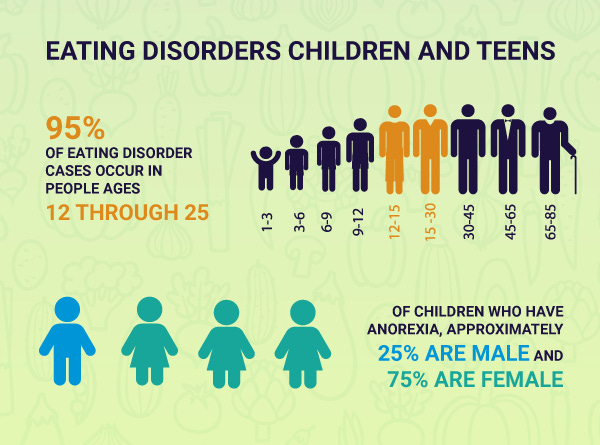

The trans-ideological claim that the dramatic rise of self-reported gender dysphoria among pre-teens and teens (especially girls) is merely a case of having the diagnosis available for something that was already there, “like ADHD and autism,” fails on three accounts.
First of all, these are dissimilar “conditions.” Autism, for example, can be diagnosed using criteria external to “self-reporting.”
Second of all, the “diagnosis” neither rules out nor necessarily identifies possible or probable (prior) co-morbidities.
Finally, there is no corresponding rise in other age cohorts alongside the adolescent/young adult surge (especially among females) over the last decade. Among the general population of the US, 1.6 percent now claim to be “non-binary/trans.” Under 30, and the number goes up to 5 percent. Over 50, and the number is 0.3 percent. The claim to be “non-binary” has become so fashionable that 6.5 percent of Gen-college students are now classifying themselves thus. In part, this is because “non-binary” is a capture category for the entire alphabet soup of gender minorities.
The younger the person, the more susceptible to suggestion, and the more likely that this person is perpetually online. It’s a dreadful reality, in my view, but there it is. The risks are manifold. Scams, predators, commercial surveillance, malicious trolls, unwanted publication, the porn epidemic, virtual mobs, misinformation, it’s all out there, waiting . . . then there’s media/online “contagion.”
Do readers remember the social contagions (“epidemic modeling,” of which an important subset is “peer contagion”) associated with eating disorders and self-cutting? While it’s not “disordered” in itself, one social contagion phenomenon was teen girls competing to get pregnant. Kids were sucked into these “communities,” where carrying their disordered behaviors to greater extremes netted them higher esteem and status within these cult-like online formations. In these cases (eating disorders, cutting, getting pregnant), most of us were pretty clear that one factor which played into these destructive social relations was cognitive and psychological immaturity — developmental realities that we routinely consider in education, social policy, law, and parenting. Pre-adolescents and adolescents (and often enough young adults, though they’ve now passed beyond the eyes of the law) quite simply lack the native as well as experiential capacity to make sound decisions. This is not an ideological claim, but a developmental one.
In the 1990s, after spates of mimetic suicide (especially among young people) following lurid and detailed reports of celebrity suicides, the mainstream media agreed to stop detailed reporting about celebrities who took their own lives. The rates of mimetic suicide fell in response.
Since then, ideology and profit have trumped this responsible decision. The proliferation of the internet has made things far worse, because it renders users susceptible to cognitive corraling, and because the algorithms serve as a kind of social contagion force-multiplier.
One of the metastasizing phenomena in the United States is mass shootings.
Zeynep Tufekci, writing for Scientific American in 2019, noted that 20 percent of all mass shootings in the US over the last fifty years had occurred in the last five years. Yes, he wrote, we have a gun problem in America; and yes, we have a mental health crisis and the proliferation of violent ideology; but there’s another variable at work in the increasing frequency of mass shootings — media and social media. These shooters are modeling on the shooters who came before, seeking to share in their infamy (all hail the new attention economy). Any recognition is better than none. Would that mass media take some responsibility as old media did with celebrity suicides!
The point, of course, is that it is as obvious as it is ideologically inconvenient that media-fueled imitation is a real thing. I’m reminded of porn apologists who refuse to engage (and even disingenuously deny) the fact that men are ever more — as reported by women — asking their sexual partners to do painful, degrading, and sometimes dangerous things during sex, things which these men have picked up from online pornography. And yes, some people have become impotent for actual sexual encounters as a result of porn saturation. And yes, some violent sexual criminals feed on ever more extreme porn. But to merely state these truths is tantamount — in the minds of ideologues — to “promoting censorship.”
Free speech should include discussions of these problems, but ideologues create a no-fly zone around these discussions by claiming the supreme, slippery-slope peril is “censorship.” Censorship to prevent censorship. The specter of censorship becomes a protective shell for ideology, sealing it off from the threat of awkward questions. We’re going there now, though—uncensored — to discuss the internet.
We know that the internet is more than merely some public forum. We know we have to protect children from predators there. We know it’s a highly secretive and manipulative marketplace. We know it’s populated by thieves and hucksters. We know that it’s a site for peer contagion.
One recent hypothesis about the explosion in the numbers of adolescents who are suddenly claiming to be gender dysphoric is that of Rapid Onset Gender Dysphoria (ROGD).
ROGD was first hypothesized by Dr. Lisa Littman, of Brown University, who developed her hypothesis based on a study she published with PLOS One in August 2018, called “Parent reports of adolescents and young adults perceived to show signs of a rapid onset of gender dysphoria.” 256 families were involved with the study of adolescents/young adults (AYA) who had declared themselves gender dysphoric after immersion with “online communities.” The mean age was 16 years, and eight out of ten of the AYA reported were natal females. The signature presentation of ROGD is an AYA, with no childhood history of gender dysphoria, suddenly claims to suffer from it and identifies as transgendered as a result. Littman emphasizes that this is a working hypothesis and not yet a clinical diagnosis.
Speaking for myself on the responses it has received from other parents, on the observable dynamic of social/peer contagion, especially with the introduction of social media, on the existing science of human development, on my own experience as an adolescent and with other adolescents, having raised four of them, and having observed (at least) hundreds of them . . . is that this is a very plausible hypothesis, which will likely be borne out — even in the face of ideological resistance — by further study as well as reporting from other families and by adults who come to regret their adolescent experience of it after often having mutilated themselves while in the throes of psycho-affective discomfort, peer contagion, and ideology.
In March, 2023, Archives of Sexual Behavior published a further study by Suzanna Diaz and J. Michael Bailey, entitled “Study of 1,655 Cases Supports the “Rapid-Onset Gender Dysphoria” Hypothesis,” in which 1,655 AYA between the ages of 11 and 21 years, which strongly supported the findings of the Littman report. Littman explained her interest and concerns in a 2019 interview:
I was surprised that no one had yet explored potential contributors to the recent dramatic demographic and clinical changes in adolescents seeking care for gender dysphoria. I believe that when a population seeking care for a condition drastically changes, it is the responsibility of the clinicians and researchers to start asking questions. Why is this change happening? Is the condition in the new population different from the condition in past populations? Without research to explore these questions, we don’t know if the treatments used for previous populations will be helpful or harmful to this new population. In other words, given that these changes are occurring, we should be working to figure out how best to treat this new population. Unfortunately, I’ve heard a few clinicians take the opposite approach — rationalizing these demographic changes in a way to assume the changes are irrelevant and that transition is the treatment regardless. I find this concerning because it seemed that these assumptions were being made in the absence of systematic study. This approach is bound to lead to confirmation bias that can mask clinically relevant phenomena.
“confirmation bias that can mask clinically relevant phenomena” (hello-o-o-o-o?!)
The ROGD hypothesis was swiftly and comprehensively attacked by transgender ideologues and activists, as well as medical “professionals” who specialize in the highly lucrative field of “gender medicine.” Their main rebuttal to the surge in AYAs reporting gender dysphoria was the claim that this surge — which is well-documented — was not an actual increase in gender dysphoria, but a response to the lifting of a stigma; that young people have been gender dysphoric at these rates all along, but for various reasons — including the lack of “affirmative” care — had “closeted” themselves.
As we saw above, though, no corresponding surge has been observed in other age groups (and the rise in numbers is driven overwhelmingly by young females). Every attack on the ROGD hypothesis which I have read — and I have scoured the internet — has in some manner misrepresented Littman’s publication and-or (more recently) the Diaz-Bailey study. The censorship-ideology complex has gone into hyperdrive. Every deviation from this ever more hegemonic PMC-culture ideology has to be ruthlessly stamped out.
Excluded from this ideology is the way in which people seeking a diagnosis (for whatever reason, including to fit themselves to an in-group) can and do study the diagnosis in advance of seeking medical intervention. (When I was a teenager, and my own in-group wanted amphetamines to party with, we’d have our friends who were fat girls go to the doctor to get a “diet pill” prescription. Spinning the medical profession is nothing new.)
Richard Docter (yep, his name, with the e) studied gender dysphoria back in 1988 after being asked, as a Doctor of Psychology, to assess “transsexual” patients seeking surgical intervention. The problem with “affirmation,” he pointed out, was that these patients were studying for their interviews like they were studying for the Bar exam to have the “right answers” at hand.
Confounding the problem of assessing gender dysphoria is the fact that transsexual applicants are typically very much aware of the gender dysphoria thesis and seize upon this as a causal attribution to explain their own behavior. Their proclamations, if accepted at face value without external validation, may constitute misleading statements in the gender history. It’s obvious that the clinician as well as the researcher must be sensitive to this potential distortion. (Docter, Transvestites and Transsexuals, p. 32)
Consider the contradictions when “medical professionals,” who we’d think should be hard-boiled, effective-cause materialists, at least in their own fields, take vulgar-essentialist atypicality in “gender preferences” (a girl who likes to wear “male” clothes, e.g.) as “evidence” that some kid is “inhabiting the wrong body,” based on the kid’s (now, often coached) self-reporting of “unease”!
Is there a diagnostic “ruling out” protocol? No.
This is a kid who has social anxiety in most cases, and who’s been shut up in her room with a laptop. She’s been hooked into a kind of online grooming cult. By the time she shows up at the doctor’s office, she’s been advised on how to describe her symptoms to the doc, and likewise coached on how to make veiled (or open) threats of suicide if she doesn’t get what she wants. No one is any longer investigating the host of factors — not the least of which is internet grooming — that might lead an adolescent, oftentimes a prepubescent (!) kid, to “present” (or describe in an obviously [online] entrained language) with something as vague as “gender dysphoria.” I wrote a whole book based on my discomfort with a particular construction of masculinity (as violence and conquest), one which I’d pursued earnestly for decades and come to reject. Was I experiencing “gender dysphoria”? Uhhh, nope.
In the name of “affirming” (reflexively co-signing the self-diagnosis of a patient — which should just be called “criminal malpractice”), all other lines of investigation are closed. No one is trying to determine where this “dysphoria” came from.
Trauma? Sexual abuse? Physical or psychological co-morbidities? Being bullied? Dysfunctional families? Ad propaganda? Internet contagion? Some kid’s favorite television series? The desire to be cool? Maladaptive socialization in a sick society (what girl hasn’t been subjected to body image bullshit . . . nowadays, in the gym rat era, what boy?)?
None of the above!
The MD now more-or-less “affirms,” by immediately referring this troubled kid along to a “gender clinic,” the on-ramp for the autobahn to irreversible endocrine and surgical interventions by a “medical” establishment which is simultaneously the captive of and parasitic profiteer upon gender ideology. What the hell ever happened to a precautionary principle in medicine?!
Without “affirmation,” according to one study, by the time these kids reach adulthood, only two percent will continue to insist they are transgendered, while most will come to understand themselves as either atypical (“feminine” male/“masculine” female) or gay.
They’re the lucky ones, whose parents didn’t bend to emotional blackmail and put them on puberty blockers (which can sterilize them, compromise their skeletal systems, and cause permanent cognitive damage).
POP QUIZ
True or False
Neither children nor adolescents nor adults are susceptible to misinformation, peer pressure, provocation, or ideological tribalism online.
No one has ever studied symptoms before visiting a physician in order to gain access to drugs or treatments.
A thirteen-year-old is sufficiently developed to give informed consent (to sex with an adult) (to get sleeve tattoos) (to get cosmetic surgery).
All physicians and clinicians are paragons of virtue.
The Suicide Gambit
“So what you need,” he said in one presentation, “is, you know what? Pull a stunt. Suicide, every time, [then] they will give you what you need.”
Perhaps the most egregious aspect of online gender ideology cults is what I’ll call “suicide extortion.” As someone whose own family has a history of suicide, as well as mental conditions out of which we extorted one other with threats of suicide, I find the well-rehearsed and ready-at-hand claim that failing to “affirm” youth gender dysphoria (as “being born the wrong sex”) will lead them to kill themselves to be an especially reprehensible ideological gambit.
Suicide extortion converts “gender affirmative” medicine from a discussion and debate into a “tempo task.” I wrote a good deal about the tempo task as it was employed in the early 2000s to grease the wheels for the “global war on terror.” The term tempo task was first used by film director Sergei Eisenstein in an article called “Film Form”: “the ‘tempo task’ is a film convention in which the protagonist is forced by impending peril to forego the rules (and all deliberative thought) to get the job done and save lives.”
“You’re with us, or you’re with the terrorists” has transubstantiated into “You ‘affirm,’ or you’re killing teenagers.”
There are two assumptions underwriting this extortion racket: (a) that suicidal tendencies and gender dysphoria are linked in some singular causative sense (which excludes comorbidities), and (b) that “transition” is preventative or curative of suicidal thoughts. Neither of these assumptions can be confirmed by evidence.
We have heard repeatedly that “48 percent of trans youth have attempted suicide.” This “fact” came from one source, the RaRE Study, promoted dishonestly by the scandal-ridden British “transgender children’s charity,” Mermaids, that involved nothing but self-selecting subjects. How many were youth identifying as trans?
Buckle your seat belts: 27.
Solicitation for the study was done in such a way as to attract the most troubled people in the self-selecting group. Thirteen reported — without specifics, histories, or co-comorbidities — having attempted suicide at least once. We don’t even know if the suicide attempts occurred, or if they occurred before or after social or medical transition! We do know that gay, lesbian, and bisexual people — as determined by more robust studies — also have higher than average suicidality (34%); and even then again, there is no account for co-morbidities, family dynamics, social situations, etc.
A similar recent media phenomenon involved the “lab leak” hypothesis with regard to the Covid-19 pandemic, when on March 17, 2021, “The proximal origin of SARS-CoV-2,” co-authored by Kristian Andersen, Andrew Rambaut, Ian Lipkin, Edward Holmes, and Robert Garry, was published in NatureMedicine; and it quickly became the go-to technocrat-media reference driving the slander that anyone proposing the lab-leak hypothesis was guilty of promoting “conspiracy theories.” One article — now shown to have been a bald piece of propaganda contradicted by its own authors’ private communications — which then spawned an ideological “fact” repeated henceforth uncritically in thousands of subsequent articles.
Exactly what happened with the RaRE study on trans suicidality. One highly questionable “source” was replicated through media meshworks far beyond that one source, whereupon it took on the aspect of offcially-sanctioned, indisputable proof — a truism that was very far from having been established as true.
Kids with anorexia, depression, and autism — three frequent co-comorbidities with youth GD and probable cases of ROGD — have similar rates of sucidality apart from GD. Yes, any threat of suicide has to be taken seriously; but with no other medical presentation besides GD would physicians allow any suicidal patient to dictate his or her “treatment”?
The more expansive sampling in the 2016 University of Cambridge/Stonewall report, reported similar “trans-suicide” findings, albeit with even less precision about who qualified as “transgendered,” and with no identification of respondents natal sex, even though there are substantial differences in results of similar sampling between natal females and natal males. A 2018 study published in Pediatrics included natal sex and found that girls had substantially higher rates of suicidality than boys (though adult men have substantially higher suicide rates than adult women).
I have two close relatives who shall remain anonymous — lesbians — who between them have mental health problems associated with childhood sexual abuse, bipolarity, and addiction, any one of which can be correlated with suicidality (not speaking here of them specifically). If a lesbian is counted as a lesbian in a study of suicidality, she will be included in that 34 percent, even if and when her sexual orientation (both these women are elderly now and asexual in practice) has absolutely nothing to do with her report of having at some point had suicidal ideas.
My problems with these studies are not the ways in which they have limitations (some similar to the Littman study); but in the difference between the way that the Littman study was represented in the media (emphasizing so-called limitations that the author herself cited) and the way the RaRE and Stonewall studies were represented (as scientific gospel). Littman is always identified as the source, and all the limitations are most often presented “proof” of the study being “fatally flawed.” But Littman herself has never made anything beyond hypothetical claims and has been scrupulous in reminding readers when and how her ideas are still scientifically speculative. Transgender ideologues repeats the RaRE/Stonewall “results,” generally without attribution, as if they were proven, scientifically sound, unadulterated facts, usually in support of “transition” whether social or endocrinological/surgical, as prophylaxis against suicidality —an absolute non sequitur.
Since it’s a life or death issue, a tempo task, all professional prudence and all ethical concerns can be abandoned to “save lives.” The fact that there is no reduction in suicidality after transition doesn’t seem to merit consideration. That’s ideology!
The propaganda is only one half of the gender ideology two-step. Its promotion by “influencers,” the PMC, entertainment media, et al, is being backed up now by medical institutions and governments. And yes, they are propagandizing children in public schools behind their parents’ backs.
He had one patient who, according to him, “presented with gender dysphoria” at the ripe old age of 2 years and 9 months.
An especially horrifying account is that of Doctor Wallace Wong, who I’ve come to think of as the Josef Mengele of British Columbia. Wong is not an MD, but a psychologist licensed in BC and California, with a “gender therapy practice.” (Hat tip to Stuart Parker for alerting me to this character.)

To begin with on Wong, this charlatan has counseled children and “affirming” parents — per Richard Docter’s symptom-manipulation descriptions — to exaggerate their symptoms to move further ahead of the line for puberty blockers, cross-sex hormones, and life-altering surgery . . . including rehearsed threats of suicide.
“So what you need,” he said in one presentation, “is, you know what? Pull a stunt. Suicide, every time, [then] they will give you what you need.” He added that trans-identified kids “learn that. They learn it very fast,” not in a cautionary, but in an approving tone.
Wong began his “gender practice” quackery in 2000 with four kids. Now, he is “treating” well over a thousand. The boost in numbers was largely down to his convincing the Canadian government to pass kids along to him from the foster care system; that is, kids who are already confused, often depressed, and always vulnerable, especially to suggestion. The lion’s share of these kids in Canada are, of course, poor and indigenous. In my book, the man is a predator. He admits — with ghoulish pride — that his “patients” are getting younger and younger. He had one patient who, according to him, “presented with gender dysphoria” at the ripe old age of 2 years and 9 months. This is batshit crazy! If you listen to his presentation, linked above, you may be taken aback by the rambling incoherence of his drivel; but I was even more taken aback by hearing zombie coos of approval from actual parents of actual children.
As to suicide extortion, this has to be met — at least in the field of public debate — with three words: “Oh, hell no!” Because it’s blackmail and a reflection of the sorry state of affairs in which we find ourselves.
Studies that purport to prove higher suicidality among trans people fall into two categories. One, where trans is combined with gender-nonconforming, vastly expanding the “pool,” and it’s long been known that gay/lesbian suicide rates exceed the general population, as one example, but even in those studies, there are substantial demographic differences in rates of suicide, and it is acknowledgded that other issues (family, drug use, etc.) throw off the statistics. In the same way, suicide risk among trans people cannot be arithmetically correlated in any meaningful way. There are too many common co-morbidities with “gender dysphoria” to claim that correlation equals causation.
Perhaps more importantly, the theory that “unaffirmed” dysphoria leads to a greater risk of suicide should be confirmed by lower rates of suicidality among those who have “transitioned.” In fact, the statistics do not bear that out. There is no evidence that suicidality among those who are reported to be gender dysphoric is reduced by transition. None!
The threat that failure to affirm will result in increase the possibility of suicide is simply not true. It is a form of emotional blackmail, and a morally depraved method of public manipulation.
POP QUIZ
True or False
A three-year-old, in the absence of any suggestion by adults, can know his or her “gender identity.”
A three-year-old can grasp the concept of “gender identity.”
All threats of suicide should be met with uncoinditional capitulation to the demands of those who make the threat.
What is gender “affirmation”?
By “affirming” that men are women, we now have men “winning” against women in everything from swimming to track-and-field to boxing (where men beating up women is now acceptable).
Besides being the on-ramp to “gender medicine,” that is.
If I’m a witness in a trial, and I tell the judge I’m prohibited by my faith from swearing, the alternative is to “affirm.” “I affirm that what I’m about to say is the truth.”
The definition of affirm is “to declare to be true.”
Staying with the courtroom scenario:
“Were you at home at 8 PM on the 4th of January?” a lawyer asks.
“Yes,” I reply. I declare that this is true.
As to the truth of the matter, it can be corroborated with objective evidence. I was observed by witnesses to be home. There is a record of my computer activity. The GPS on my phone shows it was in my home. Neighbors saw my car there, and one of them saw me letting the dog out to pee at 8:06.
On the other hand, what I say could be false, and evidence can also falsify my statement. There was CCTV of me 33 miles away at ten ’til eight. Nine people remember me starting a fight in a nearby bar . . . and so on.
“Gender affirmation,” however, is not affirmation in this sense. It requires that we all “play along” with things that are falsified by objective evidence. Like Lia Thomas — someone born with male genitalia and XY chromosomes — being a “woman.” He now “wins” women’s swimming championships against actual women who’ve worked their asses off to compete against other women . . . women who are, on average, smaller, weaker, and slower than men (the very reason we have [had] women’s sports).
Title IX [mentioned at the beginning of this piece], the landmark gender equity law passed as part of the Education Amendments of 1972, banned sex discrimination in federally funded education programs. Its protections would open doors for girls and women in admission, academic majors, teaching positions, vocational programs and individual classes, and help ensure equal access and treatment once they got in . . . Yet despite its broad aims and applications, Title IX is most famous for its impact on expanding opportunities for women and girls in sports. In 1972, there were just over 300,000 women and girls playing college and high school sports in the United States. Female athletes received 2 percent of college athletic budgets, while athletic scholarships for women were virtually nonexistent.
By 2012, the 40th anniversary of Title IX’s passage, the number of girls participating in high school sports nationwide had risen tenfold, to more than 3 million. More than 190,000 women were competing in intercollegiate sports—six times as many as in 1972. By 2016, one in every five girls in the United States played sports, according to the Women’s Sports Foundation. Before passage of Title IX, that number had been one in 27.
“There used to be a way to view women's sports [as] lesser than,” Hartman says. “But if you watch women's sports today, their competitive level with men is oftentimes on a similar playing field. We’re seeing athleticism like we’ve never seen before.” (link to article by Sarah Pruitt)
By “affirming” that men are women, we now have men “winning” against women in everything from swimming to track-and-field to boxing (where men beating up women is now acceptable).
Somehow or another, we’ve arrived at the surpassingly weird latitude and longitude where it’s being written into law that men can be counted as women in formerly sex-segregated female spaces based on the given man in question simply saying he’s a woman. I imagine myself now, back among my cohort of horny high school lads in the 1960s, learning that we could invade the girls’ locker rooms based on this claim.
What are parents to do? We have one group of parents who are beleaguered by online-indoctrinated children demanding this “affirmation,” along with dangerous medical interventions against perfectly healthy bodies, and another group of parents who—themselves devotees of this ideology—are “affirming” kids by allowing these destructive and irreversible medical “treatments” on children.
Playing along with the whole notion of trans-children, who have neither the developmental capacity nor the experience to make critical life choices is, in my view, somewhere along the spectrum between radical naivete and criminal stupidity. That this has been normalized, especially among people with “higher education,” is a pretty grave prognostic indicator for the trajectory of this whole society.
If you want to know why people in my own farm town have no respect any longer for public figures and so-called intellectuals, look no further than the fact that they can’t give a straight answer to the question, “What is a woman?” And look no further than the contempt these public figures have for people who refuse to say the naked emperor is clothed.
POP QUIZ
True or False
Men can become women by simply declaring themselves to be so.
A twelve-year-old girl can become a dolphin by declaring herself to be one.
A high school boy should be allowed into high school girls’ locker room by declaring himself to be a girl.
A parent who refuses to allow a child who demands it to be put on puberty blockers should lose custody of that child.
Medical Nemesis
We have no idea beyond the anecdotal and rationally speculative about what the effects of puberty blockers are now or in the future; which means they are being used (without FDA approval in the US, which requires testing) experimentally with zero attention paid to anything resembling a precautionary principle. There are already provisional correlations between puberty blockers and depression, suicidal ideation, osteoporosis, mood disorders, seizures, cognitive impairment, and sterility. Sterility is far more than a correlation; it’s a well-established “side effect”.
The American Association of Medical Colleges defines “gender affirming care” [GAC] as “a range of interventions to support and affirm an individual's gender identity when it conflicts with their assigned gender. It can include counseling, social changes, hormone therapy, and surgery.”
Some states have moved to prohibit GAC altogether for anyone under 18 years of age. Some states allow GAC for 16-and 17-year-olds, with parental consent. Some states allow GAC, including hormones and surgery for children as young as 12, with parental consent.
Puberty blockers
Before we begin on this, we need to do a thumbnail sketch, for those who may not know, of the human endocrine system. The endocrine system as it was first explained to me during my anatomy and physiology training as a Special Forces medic, back when dinosaurs roamed the earth, is an integrated network of chemical feedback mechanisms. The chemicals are hormones, and they basically tell all our cells what to do, with regard to day-to-day maintenance/stability and longer-range developmental actions. Hormones are produced by organs (hypothalamus, pituitary gland, thyroid, parathyroid, adrenals, pancreas, etc.) and by tissues that receive commands from other hormones. The main point here is that the integration of the various organs, substances, and actions is so intricate that when you mess around with even one small part of the overall system, the effects ramify throughout the endocrine system, and through endocrine processes throughout the entire body. You cannot “cheat” this system without consequences.
The human being is a body — not merely a collection of parts, but an irreducible whole.
Ask any woman between menarche and menopause if the effects of these command-chemicals aren’t real and observable. Ask the many women who’ve quit taking birth control pills because of the miserable side effects. Ask anyone who’s used anabolic steroids (synthetic male sex hormones). Ask anyone whose been startled and felt that surge of adrenaline.
The next thing we have to point out is that there have not as yet been any randomized control trials studying the effects, short-term or long-term, of “puberty blockers” (hormones, see below) on prepubescent children. In 2021, England’s National Health Service reviewed all the scientific literature on puberty blockers to date, and concluded that all current “evidence” for any known benefit was of “very low certainty.”
In other words, the widening use of these extremely potent endocrine disruptors is untested and unregulated. We have no idea beyond the anecdotal and rationally speculative about what the effects are now or in the future; which means they are being used (without FDA approval in the US, which requires testing) experimentally with zero attention paid to anything resembling a precautionary principle. There are already provisional correlations between puberty blockers and depression, suicidal ideation, osteoporosis, mood disorders, seizures, cognitive impairment, and sterility (sterility is far more than a correlation; it’s a well-established “side effect”).
It’s bad enough that the age of onset for puberty has over past decades fallen due (probably) to environmental factors we don’t fully understand — pollution, pharmaceuticals, obesity, food additives, God knows. Now we are going to go directly at the process to “block” it?
What, then, is a “puberty blocker”?
Gonadotropin-releasing hormone agonists (GnRHa) were originally developed for the treatment of certain forms of infertility and cancer. Some were used to chemically castrate animals. Some were used to treat uterine fibroids. Some were used to induce ovulation in mares. Then someone discovered, by using them to treat precocious puberty (abnormal puberty in the very young), that they can be used to “block” the natural process of sexual maturation in physically non-pathological children. Like that might be a good thing (it’s certainly a lucrative thing).
We do know what normal puberty does, so it is fairly safe to speculate about what kinds of things quit happening when GnRHa’s are given to children. We all know about axial, pubic, and facial/body hair, breast development, widening shoulders in boys and widening hips in girls, growth spurts, voice changes, growth/development of the genitals, and so on. But there are some less obvious changes, too, like brain development and bone density accretion. (Getting grown-up bones)
As noted above, none of these processes advances independent of all the others. It’s a concert, not individual instruments playing in different rooms. When we use these powerful antagonists, they are not merely “pausing” the procession, as ideologues have been trying to gaslight us into believing. This is the kind of thing a child might believe, but not anyone remotely familiar with human physiology.
Puberty is not some linear, arithmetical mechanism; and we have not done the kind of testing necessary to make educated guesses about the effects of these chemicals. Moreover, nearly 100 percent of kids put on puberty blockers will advance down the Transition Autobahn to cross-sex hormones and surgery. This is no “pause,” it’s putting kids on a conveyor belt to irreversible physical changes, sterility, and lifelong dependence on pharmaceuticals.
There is already suggestive evidence that GnRHa’s may result in lifelong decreases in bone density (osteoporosis) and cognitive capacity. In the latter case, we are already dealing with children who haven’t the developmental capacity to “consent” in any meaningful legal sense, and we are risking make them even less capable of informed choices as they accelerate — with ideologically-bewildered parents in the driver’s seat — down the Transition Autobahn.
Puberty blockers have even led to a big complication for future surgical “transition.” Boys’ penises are so underdeveloped that when they undergo the surgery to build a fake vagina — which “normally” involves scooping the flesh out of the penis and inverting the skin to create a hole, there is insufficient skin for the hole, so they now use a bit of the intestine, or pig tissue, or fish tissue, to “make the hole.”
We already know that, at least in modern age-segregated societies, the physiological changes associated with puberty can be disconcerting for kids. Left alone to get through this natural stage, kids grow out of that confusion; but now with children being trained to associate these disorientations with “gender dysphoria,” we have effectively pathologized normal human development, which in the modern context almost always includes this temporary disorientation.
Most cases of early childhood-onset “gender dysphoria” self-resolve. Eleven out of eleven studies that followed the trajectory of gender-variant youth show that the most common outcome is natural resolution of gender dysphoria around or after puberty. Among those diagnosed as having gender identity disorder, 67% no longer met the diagnostic criteria as adults; among those sub-thresholds for diagnosis, 93% were not gender dysphoric as adults. Gender dysphoria in childhood is a far better predictor of future homosexuality than of future “trans identity.” (link)
There is reason to believe — certainly in any precautionary sense — that these chemicals will render children permanently infertile (yes, we are sterilizing kids for an ideology) as well as incapable of sexual desire or orgasm. The reason it’s difficult at this stage to determine whether these outcomes can be decisively laid at the door of GnRHa’s is because the overwhelming majority of kids who are administered these hormone blockers go on to the next step, cross-sex hormones.
Cross-sex hormones
In very simple lay terms, cross-sex hormones are estrogen for boys and testosterone for girls, the Frankensteinian purpose being to masculinize the girls and feminize the boys. Just as with GnHRa’s, there have been no in-depth, long-term, scientifically valid studies to assess the broad use of these hormones on kids, much less kids who have likely preceded the administration of cross-sex hormones with the extensive use of puberty blockers, and often a cocktail of other psychoactive drugs. The aim of their use is ostensibly to “improve mental health, quality of life and body image,” but alas . . . there are no studies that demonstrate this is the general outcome.
A study published in the Nordic Journal of Psychiatry showed that medical transition has no effect on the mental health of transitioners. Those who had psychological co-morbidities prior to transition continued to exhibit the co-morbidities afterwards. (More than three-quarters of the surge cases in recent years had and have obvious co-morbidities, described earlier in this article.)
Neither social nor medical transition improve the mental health status of gender dysphoric people of any age. They improve the bottom line of quack therapists, surgeons, and drug companies.
As to side effects immediately and over time, one major assessment difficulty, apart from the general paucity of research, is the variety of cross-sex hormones prescribed. Another obstacle to certainty is that individuals who are taking these hormones may, as a group, have higher than average or lower than average extraneous practices and habits. There is some indication that women taking male hormones may have a higher risk of cardiovascular events (strokes, infarctions, other thromboembolitic events), but if that same population, say, smokes cigarettes at higher rates than the general population, we can’t safely conclude that the hormones are causing these CVEs. Likewise, cross-sex hormones are likely to react differently on a sixteen-year-old boy who has been on or is still on puberty blockers, a thirty-five year-old FTM trans, and a sixty year old post-menopausal woman. One large cohort study (6,793 individuals), published in 2019, suggests that the risk of CVEs goes up with cross-sex hormones, with women being at greater risk than men, but the same study also noted that their target population had higher than average rates of smoking and greater social stressors, both of which may contribute to cardiovascular problems.
Feminizing hormone “replacement therapy” begins with the administration of powerful diuretics followed by tablets, injections, or patches with female hormones. The warnings on these “medications” themselves tell patients to look out for “blood clots in a deep vein (also known as deep vein thrombosis) or in your lungs, high levels of triglycerides, weight gain, high potassium levels, high blood pressure, reduced libido, and the risk of permanent infertility.” (Yay.)
Masculinizing “treatment” (injections, gels, patches, or subdermal pellets) carry warnings for overproduction of red blood cells, blood clots in deep veins or lungs, weight gain, pelvic pain, sleep apnea, abnormal cholesterol levels, high blood pressure, and elevated risk for type-2 diabetes, cardiovascular disease, pregnancy complications, and permanent infertility.
Children as young as eight years old are now receiving cross-sex hormones.
Good money though.
Total cost of full “transition”: $87,300-410,600 for males and from $66,500-605,500 for females. (Grand View Research)
Gender industry profits: $4.12 billion in 2022.
POP QUIZ
True or False
The use of puberty blockers and cross-sex hormones has been approved by the FDA.
Puberty blockers and cross-sex hormones carry no risk when administered to children.
The Curious Case of Eithan Haim
This was an unprecedented (ideological) Federal incursion into a state case, where the law and the Hospital’s violations were perfectly clear.
In January 25th, this year, the Justice Department dismissed a case brought by the Biden Administration’s Justice Department against Dr. Eithan David Haim. Haim’s crime? He blew the whistle on the Texas Children’s Hospital in Houston, for illegally continuing to give puberty blockers and cross-sex hormones to children as young as eleven, after the state had passed a law prohibiting these treatments for minors. Even though Haim redacted the documents he provided to an investigative reporter to protect patient confidentiality, the Justice Department charged him with “obtaining and wrongfully disclosing identifiable health records of patients.” This was an unprecedented (ideological) Federal incursion into a state case, where the law and the Hospital’s violations were perfectly clear.

Once again, the incoming Trump Administration picked the low hanging fruit left by ideological Democrats, and dismissed the charges, which were scandalous in Texas, where the prohibition against “gender-affirming care” for minors is overwhelmingly supported.
Language and Reality
What’s at stake for ideologues (for whom language constructs the “reality” of their ideology), is . . . everything.
We mentioned earlier that one of the ideas (now accepted as a premise by some) promoted by certain postmodern (or, more specifically, poststructuralist) philosophers is that language “constructs” reality. It’s fairly obvious, upon reflection, that how perceptions and language interact with one another to shape values and attitudes. Plants that are classified as “weeds,” for example, are de-valued, and perhaps even despised, whereas an herbalist might recognize one of these “weeds” as a valuable food or medicine, and a permaculturist will see it as an essential species within a biome. With a little imagination (like that exercised to write the “Matrix” film franchise), we can even convince ourselves (as some philosophers have) that our perceptions are illusions, tricks our brain plays on us. What radical constructivists have done is a two-step. Step 1: reduce perceptions (a personal experience) to language (a social phenomenon). Step 2: reduce language into a power game.
I promised earlier not to follow the rabbit too far down on this, but this is one of the faulty notions at the heart of gender ideology. It’s faulty, because it’s partial. In fact, reality and experience participate in one another, like dance partners. Language is sometimes a power game, but it’s a lot more than that; and perception is lot more and a lot prior to language. The gardener who pulls the weeds, and the herbalist who knows how to use them, and the permaculturist who sees them in relation with other species, can all observe the same plants, and even teach each other what they understand about them, because they are participating in the same reality.
With regard to gender ideology, we have some serious fights at hand over language, because ‘language as a species of power” has such a central significance within gender ideology. A man (adult human male, XY chromosome, born with a penis and testes) who (1) says he is a woman, or (2) presents (in dress and coiffure) as a (femme) woman, or (3) is surgically and endocrinologically modified to appear as a woman . . . is now called simply “a woman.” Or such is the demand. “Trans women are women” is a mantra, a profession of faith, a password into the club, a thrown down gauntlet, a litmus test for acceptability in sophisticated company.
It's not acceptable to ideologues to stick with “trans-woman,” as distinct from “woman,” the latter a word that has meant “adult human female” since its origins in Middle English, Old High German, Old Norse, and Proto-Germanic. (The same applies to femme, mujer, frau[lein], etc.) There quite simply is such a thing as a female human, and she is different in overwhelmingly obvious ways from a natal male. Even who has “transitioned.” This preposterous claim that a trans-woman is indistinguishable from a natal woman is based (almost subconsciously) on the belief that simply saying it (language) makes it so (constructs reality).
Women, in fact, constitute a slight demographic majority of humanity, and this category is defined by an observable, verifiable form and function, that makes it different from a man who says he is a woman, or presents (in dress and coiffure) as a (femme) woman, or is surgically and endocrinologically modified to appear as a woman. The category woman reflects a transhistorical (species) reality, whereas this silly claim that “trans-women are (without qualification) women” is an assertion that’s younger than my kids. It’s not a statement of fact; it’s a password into a club.
What’s at stake for ideologues (for whom language constructs the “reality” of their ideology), is . . . everything. Without the linguistic flip here, their whole “construction” collapses. And so, the battle lines (of the power struggle) are drawn with words—expanding the word “woman,” for example, to include men, and demanding the recognition of obviously mismatched or nonsensical pronouns (no one person is a “they/them”).
In the real world, if I am sitting at table with a radical constructivist, and I ask him or her to pass me the salt shaker, he or she will pass the salt shaker. We both know damn well—prior to the imposition of the feigned gullibility of a fashionable ideology—that the salt shaker objectively exists prior to and apart from our naming it, even if naming it constitutes a social phenomenon. We know the salt shaker is there, both of us at once. We are part of the reality we perceive, and our co-participation (aided by language) in that reality is clear enough proof that calling the salt shaker a salt shaker is not what made it into a little cylindrical container with holes in the top, filled with granulated salt. This ideology cannot operate in the real world, but only in the star chamber of the ideology’s imaginary logic.
And yet, many academics (as just one example) would be afraid to say the emperor has no clothes, that a man can’t “transition” into an actual woman, because in certain circles this ideology has taken on the aspect of a religious creed.
In fact, trans-activists and ideologues cannot themselves speak without making the distinction, which is why they invented a term for actual women that brought the distinction in line with the ideology, “cis-women.” The idea of adding a prefix to women to distinguish them from males simulating women was to support the false claim that “trans-women are women.” There can no longer be women-unmodified, but trans-women and cis-women, as if this were no different than the distinction between a Namibian woman and a Ukrainian woman. (Ideology always has to shoehorn reality back inside its own “logic.”)
POP QUIZ
True or False
Phalloplasty produces a real penis.
Metoidioplasty (vaginoplasty) produces a real vagina.
Having a phalloplasty makes you a man.
Having a metoidioplasty makes you a woman.
WARNING: Images that may disturb
Graphic Reality
Sometimes these tissue grafts result in fistulas — little unwanted ducts or channels — between the neo-urethra and the colon, creating a superhighway for gut bacteria to pay visits to the urinary tract. In one case I read about, doctors had to install a colostomy bag on a patient to reroute the feces before it could reach the fistula.
Let’s take a very frank look at the difference between natal sexual reality and surgical simulations.
The first thing many late adolescents and young women who’ve been convinced they are actually males undergo, after taking cross-sex hormones, is double mastectomy. Among female detransitioners (whose voices are minimized and silenced), this is often when the light goes on and they decide they’ve made a terrible mistake.
No one knows how frequent detransition is, because the gender clinics that began these “transitions” drop their patients, rather than assist them with detransition. Gender affirmation only goes one way, and many detransitioners are accused, of course, of “transphobia.”
Below is pictured an actual metoidioplasty (vaginoplasty).
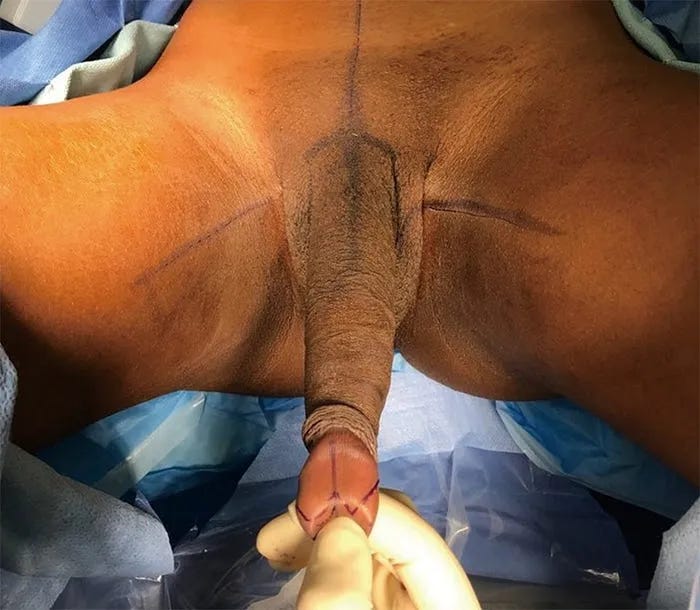

This is not a real vagina. It’s a painful surgical simulation. Postoperative care for the pseudo-vagina is a lifelong affair. Tissues have been removed, dissected, transplanted, inverted, and so on; and these tissues are not the same as real vaginas. Real vaginas are supple. They have a high stretch factor. Pseudo-vaginas don’t. The surgeons have sewn this inversion to the pelvic wall in order to force scarring, but repeated attempts to stretch the pseudo-vagina, which lacks the pliability of a real one, results in micro-scarring and calcification. So, inflammation and infection are perennial problems for recipients of this radical body modification. And, of course, there’s the aforementioned lubrication problem. Real vaginas work in this regard, especially well between menarche and menopause. Fake one’s don’t. Not an issue for those who’ve foregone penetrative sex for a lifetime, but for those who do (and their sexual partners), two things are required. The lubricants, of course (which have to be thoroughly douched out after sex to prevent infections, because the pseudo-vagina is not self-cleaning like real ones), and the frequent self-dilation of the canal using . . . rods. Every day, often more than once a day.
Phalloplasty is just as grotesque.
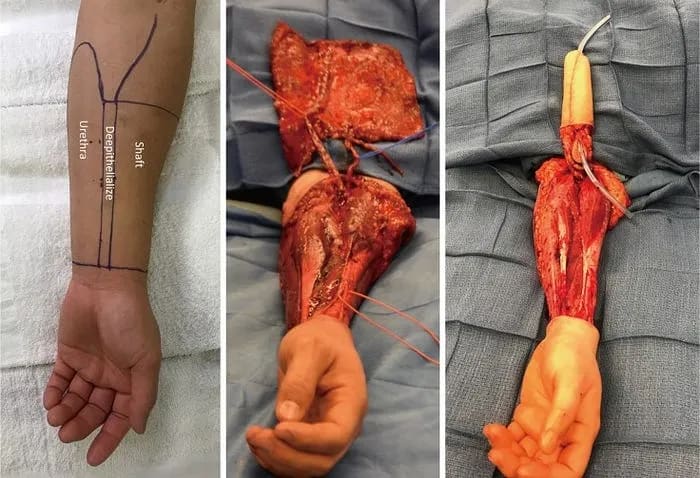

To make this surgical simulacrum, skin is surgically removed from the forearm or abdomen and used to construct the simulation. They’ve tried using leg skin, but it often resulted in excessive girth (like beer can girth), which requires follow-up liposuction surgery to “de-girth.” Constant in all these transition surgeries is that they take a long time to heal, have high rates of post-op complications, and high rates of subsequent surgeries to correct all the things that go wrong when “physicians” try to re-engineer perfectly normal human bodies.
With phalloplasty/socrotoplasty, the transplanted skin often scars, shrinks, and changes shape, becoming susceptible to pressure lesions, strictures, chronic inflammation, urethral blockage, and other marvels of iatrogenic medicine. The phalloplasty/scrotoplasty is generally performed after a metoidioplasty (detaching the clitoris), vaginectomy (removing the vagina), and hysterectomy (removal of womb and ovaries). With metoidioplasty and phalloplasty, an extension is grafted onto the urethra which is then subject to infection and often requires the use of catheters for this unfortunate person to urinate . . . which in its turn introduces bladder infections and bladder stones. Sometimes these tissue grafts result in fistulas — little unwanted ducts or channels — between the neo-urethra and the colon, creating a superhighway for gut bacteria to pay visits to the urinary tract. In one case I read about, doctors had to install a colostomy bag on a patient to reroute the feces before it could reach the fistula. (Line up now to be the first on your block.)
Phalloplasty complications range from 60–100 percent for women, depending on which complication you pick. There are no criteria yet agreed upon for phalloplasty patient risk profiles, though it’s generally agreed that obesity is a contraindication for surgery. A body mass index of 30 or less is often required. Surgeons also recommend smoking cessation, because blood flow and oxygenation are big issues when grafting tissues.
Before the procedure, the patient has to undergo electrolysis to remove all hair from the skin that is about to be excised and transplanted. No one wants hair growing out of her simulated penis.
The procedure itself proceeds in phases (think “vaginectomy, urethral lengthening, perineoplasty and scrotoplasty as perineal masculinization”), and each phase requires a lengthy recovery period. You won’t sleep much, because your excisions and new appendage require hourly checks throughout your hospital stay to ensure it that tissue death (necrosis) and-or infections don’t kill you. Think twelve weeks, before you can go home and try to pee standing up. Which is another complication. Dribbling, blockage, and having to “milk” the urine are common.
When the clitoris has been detached and pulled into the pseudophallus, the idea is to allow for future satisfying sexual encounters (in fact, sensation is dramatically reduced). But now there’s the whole business of pseudo-erections with which to deal. This requires — here’s that technological dependence again — “devices.” One can opt for a pump device that you activate by squeezing a pseudo-testicle (one pump nut, one silicone nut) or for a pop-out rod device, which one author compared to a little futon.
Some people, seeking that authentic look, will have penile veins tattooed onto the addendum.
Complications include full phallic loss (necrosis, it dies), partial phallic loss, infection, hematoma, wound dehiscence (splitting open), urinary fistula, strictures, loss of all sensation, and retained vaginal mucosa (oops, “revision surgeries” required).
Let’s also consider that grafting tissue takes the grafted tissue from somewhere: leg, abdomen, arm, or mouth (when mucosal tissues are required). There are frequent complications from these excisions themselves as well as the places onto which the tissues are grafted.
Based on “language constructs reality,” we have been led down the path where a young child can receive (with parental consent!) life-altering and medically unnecessary hormone treatment as young as eight years old.
When a young person has been convinced that he or she has been born into the wrong body, or that (as Judith Butler insisted once in stark contradiction to the “wrong body” thesis) gender is a pure choice, and that young person opts for medical transition, what exactly are the effects of puberty blockers, cross-sex hormones, and “transition” surgeries?
Frankly, they’re horrifying and should be banned from medical practice, full stop. Any medical paradigm that pathologizes normal puberty has strayed far afield of anything that rightly deserves the name medicine.
None of the pharmaceuticals, practices, and procedures that follow are necessary. Moreover, a body’s tissues and organs are going to defy these “modifications” by behaving the way natural tissues and organs behave in unnatural circumstances . . . with a kind of house-of-horrors menu of “complications” (read: predictable responses to doing unhinged things to a normal, healthy body).
The unnerving fact is that once a child is put on the gender medicine track, there is a very high probability that—in a kind of psychological sunken cost fallacy—they’ll fully “transition” (into a lifetime dependence on painful and costly “gender medicine”) in the future. Nearly 100 percent of kids put on puberty blockers will advance down the Transition Autobahn to cross-sex hormones and surgery. Puberty blockers are not a “pause,” as ideologues claim. They are putting kids on a conveyor belt to irreversible physical changes, sterility, and lifelong dependence on expensive and invasive pharmaceuticals.
What is a woman?
Transgender-identifying male inmate Nathan Goninan (aka, "Nonnie Lotusflower") was convicted of manslaughter for strangling a 17 y/o girl to death and is currently housed at WCCW, a "women's prison" in WA, reportedly in a mental health unit. While incarcerated at WCCW, he has received at least one infraction for sexually assaulting a female inmate. Last week, he filed a federal lawsuit asking to be released into the general population of female inmates. How did Lotusflower get into a facility meant for women in the first place? The ACLU helped him.
The demand for validation (public profession) of this fiction has found an ever more purchase on both the minds of children, the sometimes childlike minds of parents, and in the law. The subsidiary problem, particularly with regard to law, is that there were very good reasons that former feminists demanded legal protection of women’s spaces, from dressing rooms to sports to prisons; but the basis for those protections were the recognition of actual women as political subjects.
Trans-ideology is rapidly effacing women as political subjects, and engaging in aggressively anti-feminist politics (if feminism is still concerned with the interests of women as women).
I watched a politician ask a Federal judicial nominee on television, “What is a woman?” The nominee—trapped by this ideology and its censorious advocates (a subject to which we’ll also turn)—couldn’t answer. She evaded and equivocated, and this right-wing politician—again, handed this issue like a gift—made her look like a fool. Thirty years ago, any child could have given a coherent answer.
It’s an unfortunate reality that perfectly absurd ideas can gain traction in influential academic circles. This is almost certainly a function of an arrogant, out-of-touch groupthink which can take over among those who, in their leafy, well-kept campuses filled with un-anchored abstractions, compete with one another in a jungle war for publication novelty — fought with wine and bad faith instead of machetes.
The academic ideological transmission belt was once more effectively buffered, culturally and technologically. There was friction between the Academy and the rest of society that slowed and filtered fashionable academic ideas before they reached the rest of us, allowing for reflection and criticism. But with ever more corporate modeling in the academy, with technocratic rule, lightning speed communications, clique-sorting platforms, and the progressive integration of academic life with the attention economy, ideological transmission from academy to society is now nearly friction-free.
Hospital staff are required to refer to women who are having babies as “birthing persons,” because someone might be offended by calling a woman a woman. Breast-feeding is now called “chest-feeding,” lest some natal man who demands to be called “a woman” be offended, because nursable mammaries are an (obvious) aspect of the human female form.
The most hardcore feminist-hater of the 1960s couldn’t have devised a more effective method of erasing women as political subjects. Just as much of the early “transsexual” discourse was inherently homophobic (we now hear about “trans the gay away,” which is covert conversion therapy), much of trans-ideology discourse is inherently misogynistic.
And yet we arrive now at a point in history most would never have imagined, where defense of hard won feminist legal gains. i.e., “The prior Administration argued that the Supreme Court’s decision in Bostock v. Clayton County (2020), which addressed Title VII of the Civil Rights Act of 1964, requires gender identity-based access to single-sex spaces under, for example, Title IX of the Educational Amendments Act. This position is legally untenable and has harmed women,” is articulated by Donald fucking Trump’s legal stenographers in the face of “progressive” outrage.
Republicans defending Title IX against Democrats!
Public schools, in a system of compulsory schooling, paid for with taxes, are teaching children this ideology against parents’ wishes, and even bringing drag queens into classrooms. You can minimize it as a “culture war” issue, but where people’s children are involved, these “cultural” issues matter. The 2024 elections are a case in point.
Ideology, forced on your children — with or without your knowledge — at a school near you.
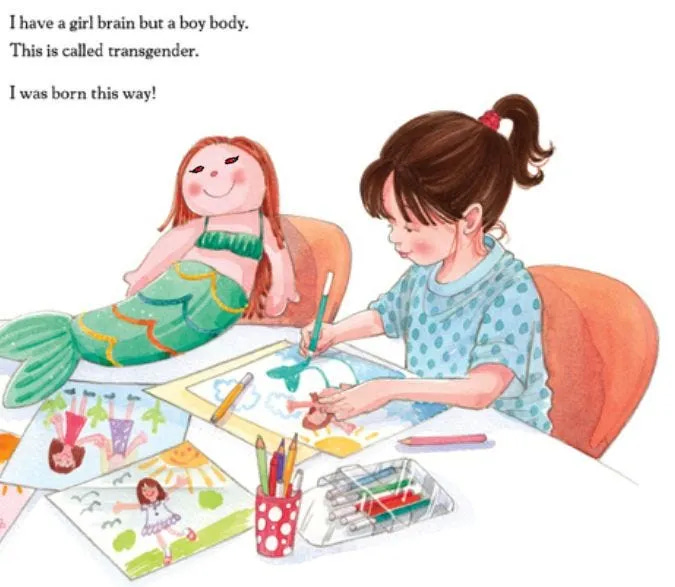
The last graphic is not only used to indoctrinate children, it is saying something very important about the contradictory beliefs of trans-ideologists and trans-activists.
Assigned, Inherited, Chosen
Trans-ideology proponents — who’ve successfully won over an avaricious medical establishment — simultaneously claim that “being transgendered” (a subjective self-report) is also some kind of inborn trait (a putatively “objective” essentialist claim), while also a matter of self-invention and “choice” (a libertarian, anti-essentialist claim).
Even the medical establishment, which has for rapacious reasons come to go along with this ideology and enshrine it in “medical literature,” refuses to recognize and deal with these logically contradictory premises.
Okay, what’s essentialism?
It comes from the word, essence—"the inherent, unchanging nature of a thing or class of things.” When earlier feminists said that girls were not inherently docile, but were trained to be that way, they were making an anti-essentialist claim. Female does not equal docile. Passivity is not an inherent and unchanging characteristic of all girls.
When a trans-activist or a “gender medicine” clinician convinces a twelve-year-old girl that she’s really, deep-down, a boy, because she likes “boy” things, they are saying much the same things that a 1968 anti-feminist might say. They are both being gender essentialists.
But these same activists and clinicians will also say that the “trans” kid (one who may not even have reached puberty!) is “trans” because the kid “feels” like the other sex. This is also an essentialist claim, because feelings aren’t intrinsically gendered.
Moreover, these kids are coached by peers online, by propaganda, by activists, and even by clinicians to interpret their “feelings” to mean they are actually “in the wrong body.” (see graphic above—“I was born this way” . . . No, you weren’t.)
On the other hand, these same ideologues will call “transition” a choice, a question of “bodily autonomy,” basing their argument on libertarian principles that directly contradict essentialist claims.
What overcomes this contradiction?
Ideology.
What do I mean by “ideology”?
If you think of it, the inability to distinguish philosophy (real thought) from ideology (logical articulation of preconceptions) stems from having lost the ability to get in contact with reality, i.e. to have experience.
--Carlo Lancellotti
There are entirely too many epithets being hurled about these days, especially online.
When you have no valid argument or are too lazy to make one, just throw some red meat to your base and get the applause. Terms like “woke,” and “fascist,” and “TERF” generally fall into that category. They are ideological shortcuts.
Sometimes, the word “ideology” itslef can be misapplied, too. So, let’s give it a definition and a set of criteria, provided in this case by Hannah Arendt, twentieth century historian, philosopher, and political theorist.
She wrote:
An ideology is quite literally what its name indicates: it is the logic of an idea … As soon as logic as a movement of thought — and not as a necessary control of thinking — is applied to an idea, the idea is transformed into a premise [and] a whole line of thought can be initiated, and forced upon the mind, by drawing conclusions in the manner of mere argumentation. This argumentative process could be interrupted neither by a new idea (which would have been another premise with a different set of consequences) nor by a new experience. Ideologies always assume that one idea is sufficient to explain everything in the development from the premise, and that no experience can teach anything because everything is comprehended in this consistent process of logical deduction. The danger in exchanging the necessary insecurity of philosophical thought for the explanation of an ideology and its Weltanschaaung [world view] is not even so much the risk of falling for some usually vulgar, always uncritical assumption, as of exchanging the freedom inherent in man’s capacity to think for the straight jacket of logic with which man can force himself almost as violently as he is forced by some outside power.
Not logic per se, but the logic of an idea (or, as Lancellotti says above, a preconception). If the idea (preconception) has problems, then the logic of the idea will drift further and further from any reflection of reality.
Hitler’s ideology (which was still on Arendt’s mind) began with a preconception called “race science.” There is a certain internal coherence to this “science,” which holds together as long as it freezes out information and arguments that contradict it.
The idea became a premise—as accepted proposition, prior to any logical conclusion.
In ideology, that idea confused as a premise, takes on the aspect of a given, a fact, a natural law almost.
Ideologies always assume that one idea is sufficient to explain everything in the development from the premise, and that no experience can teach anything because everything is comprehended in this consistent process of logical deduction. (Arendt)
The logic only remains logical by sealing itself off from the outside, a kind of intellectual withdrawal into an underground shelter, hiding from “the necessary insecurity of philosophical thought.”
Using what criteria can we identify an ideology?
The three features of ideology that constitute ideologies as self-enclosed systems are partiality, abstraction, and some co-constituent antagonism.
Ideology first reduces the subject (person, society, etc.) to some part of its whole (race, class, nationality, sexuality, gender, etc.).
Then it filters out, by means of abstraction, any and all characteristics that might challenge the totalization of that partiality, creating a “pure logic.”
That “pure logic” is itself always grounded in, and constitutionally dependent upon, some central conflict (co-constituent antagonism) between the ideologues themselves and who opposes them, an enemy without which the ideology would lose its raison d’etre. In this case, the “hegemonic cis-heteronormative gender binarists” or some other such monstrous linguistic contortion.
Given that no inconvenient information can be validated within his or her closed system, the ideologue has neither in capacity nor the inclination to deal with anyone who rejects the ideologues partiality, abstraction, and co-constituent antagonism. And so, the ideologue defends him- or herself ad hominem, attacking the person instead of the argument.
“You say that because you are a bourgeois.”
“You say that because you are a Jew.”
“You say that because you are a ‘woke’.”
“You say that because you are a TERF.”
POP QUIZ
What are Arendt’s three criteria for an ideology?
Born in the Wrong Body
There is something simple, something quite simple, to appreciate about being born: you cannot choose to do it. In being born something bigger and greater than you is acting.
--S. G. Belknap
Any time you hear the word “autonomy,” a red light should start blinking furiously in your mind. You don’t come into being autonomously, and you can’t survive infancy, childhood, or even adulthood autonomously. There is not now, nor has there ever been a single autonomous human being. It’s an ideological construct based on the notion of a “proprietary body,” or, the body as property—not like a slave is the property of another, but like property in “one’s own (««possessive apostrophe) body.”
The problem, right out of the gate, is figuring out—once “the body” is subtracted—who the “owner” is. You don’t own a body, you are one, which is not to say you are only a body, but to say that this “ownership” is based on a subject-object split that doesn’t actually exist.
Major conceit in trans-ideology: male and female “brains” that fail to match male and female bodies.
First! A brain is not a mind. That’s like calling a train a trip. (Another side trail we’ll pass for now.)
Are there statistical anatomical and physiological differences between men and women? Absolutely. Certain basic male and female characteristics certainly are inherent — anatomically, endocrinologically, and statistically (men on average are bigger and stronger than women, e.g., and even men who are smaller than women are still, generally-speaking, stronger).
These are only statistical averages. In the Netherlands, the average young adult male is six feet tall, the average young adult female 5’7”. In Laos, the average young adult male is 5’4”, the average female, five feet.
In the individual person, one seldom hits the average on the head, and instead will fall within a “normal range.” My lab-assessed hemoglobin count will be between 13.5 - 17.5. 13.5 is good to go. 17.5 is good to go. More to the point, within each person all these different anatomical and physiological characteristics work together in relation to one another, and not in relation to any statistic.
Thee brain-body distinction is unclear in many respects, none more unclear than in what we call the endrocrine system.
The endocrine system—as it was first explained to me during my anatomy and physiology training as a Special Forces medic, back when dinosaurs grazed in Utah—is an integrated network of chemical feedback mechanisms.
The chemicals are hormones, and they basically tell all our cells what to do, with regard to day-to-day maintenance/stability as well as longer-range developmental actions.
Hormones are synthesized inside organs (hypothalamus, pituitary gland, thyroid, parathyroid, adrenals, pancreas, etc.) and by tissues that receive “commands” from other hormones. The main point here is that the integration of the various organs, substances, and actions is so intricate that when you mess around with even one small part of the overall system, the effects ramify throughout the entire endocrine system, and through endocrine processes throughout the entire body. You cannot “cheat” this system without consequences.
The human being is a body — not merely a collection of parts, but an irreducible whole. We don’t have a body—that’s just a figure of speech. Without the body, there’s no entity surviving to claim possession.
We might exist as a body with problems—diabetes, or a club foot, or a congenital heart defect—but that doesn’t mean we have the wrong body, because being embodied is not a choice, but an ontological fact. You are the body you are, for better or worse, or you aren’t anything at all.
I said above that calling a brain a mind is calling a train a trip. In the same way, consciousness, or more theologically, a soul, is more than a brain, but it needs the brain (the train) to make the trip (consciousness/mind). In the same way, without a body (as a non-autonomous formal being), without the train (the mechanical substrate), there won’t be any trip (a life).
And no, sex isn’t only from the neck down. We cans say this without falling down the slippery slope of biological determinism and crude essentialism. (It is crude ahistorical essentialism to say that if you want “girly” things, then you are a girl.)
But a “brain” (or do we mean mind?) is not some separable component of the person, as it is portrayed in fantasy scenarios where people’s brains are exchanged. It is a neurological and endocrinological Grand Central Station; and situated in a particular place (living body) without which it would be just so much matter — an isolated ruin. Your “Grand Central Station” is not independent. It is characterized not merely by its existence, but by what flows into and out of it, by what exchanges take place there, from where and to where, and its very essence (forgive me) is synonymously dependent upon its connections to everything else going on in the body as a whole.
Each brain is also irreducibly unique, as is every embodied person of which a brain is an integral component. Even our “thinking” and “experience” are not confined to the brain, as a child might imagine. Everyone has experienced muscle memory, as one example.
By the same token, one cannot be “born into the wrong body,” and simply feeling that this is so is insufficient to support such a claim. “Feelings” are shaped from the outside, by the sum of experience, and by various influences (thinking now about a kid being pulled into an online cult—it can and does happen—or any of us being influenced [at the feeling level] by ideas and representations from books, films, and television).
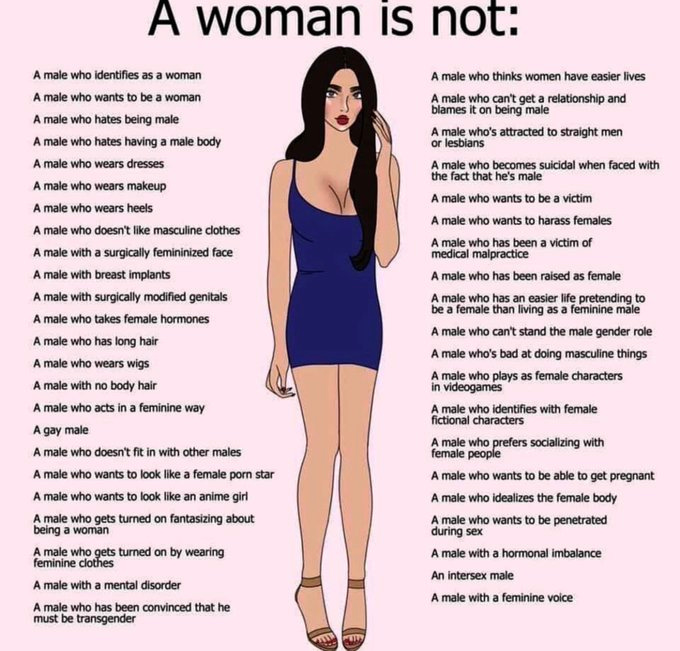
But What About the Intersexed?
Even at the genetic level, it is well-known that there are no direct effective causes between individual “genes” and either phenotypes or behaviors. It’s not one tuba; it’s a concert.
Let’s clear up one thing now. Exceptions to a rule or a norm do not disprove the rule or invalidate the norm. This is a sophomoric fallacy that fails at the outset to understand that rules and norms exist because there are exceptions. Otherwise, there would be no reason for them.
When we say that a “normal” oral temperature is between 97- and 99-degrees Fahrenheit, we anticipate the exceptions, because these are how we identify the abnormalities of hypothermia or fever. The claim that the existence of “intersexed” people proves there are more than two normative sexes either requires one to ignore the fact that exceptions do not disallow norms or to pretend there are no norms (or patterns that constitute types—like sexually-dimorphic species).
It’s well-established that one cause of sexual anomalies (deviations from norms) is pre-natal or perinatal exposure to unusually high levels of hormones. When in utero females are exposed to high levels of testosterone, this can result in an anomaly called congenital adrenal hyperplasia. It doesn’t result in phenotypical abnormalities (these girls have all girl parts), but it has been strongly associated with these girls having very male-typical preferences, interests, and behaviors. And yet — with this “male brain,” to put it in childish terms — they very seldom experience gender dysphoria. If any kid was going to be gender dysphoric based purely on the imaginary brain-body mismatch, you’d think it would be her.
But the fact is, brain-body separation — to put it in highly technical terms — is bullshit. The endocrine system is emblematic of all the ways neither can exist independent of the other. A human being is irreducible to this dichotomy until he or she is autopsied, at which point he or she has discontinued being a viable human being. Physiological integration has crashed.
Even at the genetic level, it is well-known that there are no direct effective causes between individual “genes” and either phenotypes or behaviors. It’s not one tuba; it’s a concert.
No, sex isn’t only from the neck down (anyone who’s seen a loved one suffer from amenorrhea knows), but “sex” itself is not independent except as a category. Human beings — with our highly adaptive plasticity — are, in many respects, biologically determined to not be biologically determined. But this, in turn, does not mean that biology doesn’t set boundaries that can be discernd as forms. Yes, there are general differences between male and female that prefigure and transcend what we learn, but they’re inseparable from what we do learn. Brains and bodies can’t be separated, and the “nature/nurture” debate is a false trail, a red herring.
For what it’s worth, I actually prefer to think about it in a more Catholic way.
Men and women (boys and girls) are alike and different in ways which can be mapped along three axes, general, specific, and particular.
General: our common humanity.
Specific: our sex-specific differences.
Particular: our personal particularity, or personality.
Three is contained within one and two, but allows for tremendous variety within them. Like girls who fish and boys who sew.
As to intersex (or intersexuality), there is basically no one such thing. It’s a little like many fellow Southerners I know who refer to ten different species of panfish (spotted sunfish, pumpkinseed, dollar sunfish, bluegill, longear sunfish, orange spotted sunfish, shellcracker, green sunfish, redbreast, and warmouth) as “bream” (pronounced brim).
A lot of nonsense has been written about this deceptive term, intersex, beginning with Havelock Ellis’ first use of it in the early twentieth century to refer to homosexuality—a term that was also invented in the twentieth century (longer story). One of the main forms of this nonsense is this notion that sex itself is not binary, but “a spectrum.”
No, it’s not. Sexually dimorphic means di (two) morphic (forms). Procreatively, that means an egg and a sperm, with the respective anatomies and physiologies. The equipment for each is different, but within each category, there are normal “patterns that constitute the form.”
One author, Anne Fausto-Sterling, oft cited in gender studies departments, claimed that 1.7 percent of human beings were “intersex.” The suggestions here are (1) that there is some range of sex between male and female, and (2) that the existence of these intersexed people disproves sexual dimorphism (the sophomore’s fallacy).
In fact, this “category” used by Fausto-Sterling included no fewer than thirty different diagnoses under the rubric of “disorders of sex development.”
The five most frequent she cites involve not one scintilla of procreative ambiguity; and when these five categories are eliminated, the number of people who really are sexually ambiguous (a congenital defect) is less than 2 in 1,000 (1.3 in every thousand have Down Syndrome, as one comparison).
These exceptions do not disprove the rule, they are identified and measured against the rule! Nonetheless, Fausto-Sterling insists there are no fewer than five sexes, even though the term sex has, until the psilocybin sunrise of gender ideology, referred to the procreative potential inhering in all sexually dimorphic species.
The point within the point? Intersexed, when it’s real, is not transgendered. It’s another ideological red herring.
Which brings me to the alphabet soup of LGBTQIA+.
The Identity Alphabet
How did all this come about? Well, I’ll tell you. The LGBs won.
I’ve often railed against the term “people of color” (non-white) and the abbreviation BIPOC (also non-white), because, in a strange reversal, beginning with the problem of the centrality of “white” people in older forms of racism. Using the BIPOC category, thousands of ethnic identities are subsumed and homogenized out of existence, and the only thing that remains untouched is the unmentioned constant—"white.” It once again, paradoxically, remains the measure of all “identities.”
The first use of the abbreviation LGB was around 1990. Lesbian-gay-bisexual.
These three categories weren’t all-encompassing “identities,” but a kind of quasi-political coalition based on the social obstacles encountered by people with same-sex attraction. Note, these three categories referred to sexual attractions (acting upon which people had been criminalized)!
I’ve spent a lot of time with lesbians—a peculiar feature of my own life, my family, and other associations. Even back then, the lesbians I knew (some I still know) would tell you that, while the LGB consolidation was an effective political coalition, many lesbians not only associated with very few gay men, but they were often very critical of them behind the scenes, on several counts—misogyny among some, for example, or the much higher levels of promiscuity (where lesbians were more likely to settle into monogamous relations). This is not to either generalize or to share in some judgement, but simply pointing out that even within the LGB grouping, there were political alliances to be made, but ther wasn’t any such thing as a “community” writ large.
(Interestingly, the LGB Alliance in the UK is comprised of lesbians, gay men, and bisexuals who reject trans-ideology.)
By adding T to the abbreviation, two categories were represented as one. LGB referred to sexual orientation. A lesbian is attracted to other women. A gay man is attracted to other men. A bisexual is either a man or a woman who experiences sexual attraction to men and women. It’s still a question of erotic attraction. T for transgendered is a category not about erotic attraction (it is, for some, but in a different guise we’ll discuss below), but about a declarative “identity,” independent of erotic orientations.
As people began expressing their “autonomy” be declaring ever more distinctions and demanding that others “recognize” and validate these declarative identities—under the threat of being denounced as an intolerant bigot if you refused—new letters were added to the alphabet soup. Intersexed, asexual, “queer.” No one has ever sufficiently explained to “queer” me. I looked it up.
In the context of LGBTQ+ identity, the word gay is typically used in reference to a person who is sexually and/or romantically attracted to people of their own sex or gender. The word queer is often used more generally to refer to a person who has a sexual identity that isn’t heterosexual or a gender identity that isn’t cisgender. Queer is used as a reclaimed term of pride by some, but not all, members of the LGBTQ+ community. Some people may identify as both gay and queer, though others may use only one of these terms or a different term altogether.
Well, that clears it up. It’s a negative reiteration of what’s already been listed? Did I get that right? Filty bigots, they failed to be “inclusive” of the I’s an A’ before they put in the plus sign (for any new “identities” that may evolve, one must suppose).
Anyone see what’s normative by virtue of being left out—the center of the new solar system? It has a new name now: cis. To conform the obvious difference between “trans” people and the actual sexes to an ideological construct, they required the cis-prefix to modify natal sex, linguistically neutralizing the root words, man and woman. Trans women are women, there’s no difference, but we still need to distinguish them using PMC-approved prefixes.
How did all this come about? Well, I’ll tell you. The LGBs won.
Not only was the stigma lifted on same-sex attraction, the law protected same-sex attracted people from discrimination in employment and housing, and same-sex couple were allowed to enter into state-sanctioned civil unions (marriage) with all the partner benefits thereof, including parental rights. Same-sex attracted people were represented in media and entertainment in ways that normalized them. But winning is not a win for everyone.
A entire institutional complex had been developed to advocate for the LGBs, one which also created well-paid salaries for the professional advocates. When they won, they realized they might have worked themselves out of a job. The solution? Add onto the alphabet soup, identify the new letters as somehow marginalized or oppressed, and begin fundraising anew. All we need now is an ideological framework. “Hey, do you remember that book by Judith Butler . . . ?”
Advocacy corporations have proliferated like mushrooms after a spring rain. The National LGBTQ Task Force, The Trans People of Color Coalition, TransAthlete, Trans Lifeline, Campus Pride Index, Point Foundation, The LGBTQ+ Victory Fund, Hey I’m Trans, The Bisexual Resource Center, The National Center for Lesbian Rights, Lambda Legal, SAGE, Human Rights Campaign, the ACLU, and on and on . . . many formerly LGB outfits, with lateral transfers from earlier gay rights formations into the new funding frontier of transgender advocacy. It’s a 501(c)(3) NGO network of funders and salaried staffs of grant writers, admin, HR, media liaisons, “organizers,” and polemicists. An ideological industry appended by academic grantmaking.
To become a part of it, you need a graduate degree and the ablity to say LGBTQIA+ as if it’s one syllable.
Around it is an ideological Chinese Wall.
Don’t Deviate (or There are Fascists Under Your Mattress)
“If you really cannot distinguish between someone being told they are not who they say they are and them being murdered, you need to get your head examined.”
—Stuart Parker
There are very real risks entailed for some people if they speak out against this dogma. Expulsion from one’s social circle, loss of jobs, cancellation of contracts, attacks on social media, as well as physical attacks, and the stigma of guilt by association fallacies.
There’s an extremely censorious assertion of this ideology, a kind of holy war belief that debate and discussion of these issues is harmful in itself, and that we apostates must be shut down at all costs, silenced, doxed, dis-employed, barred, and exiled. It is absolutely essential that this trend be confronted and reversed. The following is a phony picture of J. K. Rowling in a meeting with Hitler. It was generated by those who call her a bigot because she makes the simple claim that a man cannot be transformed into a woman or vice versa. She has never engaged in hate speech, or incited others to harm anyone with whom she disagrees. Her politics is center-left. She writes popular kids’ books and adult detective novels.

It’s apparently okay to malign, misrepresent, slander, smear, and attack those who reject the ideology.
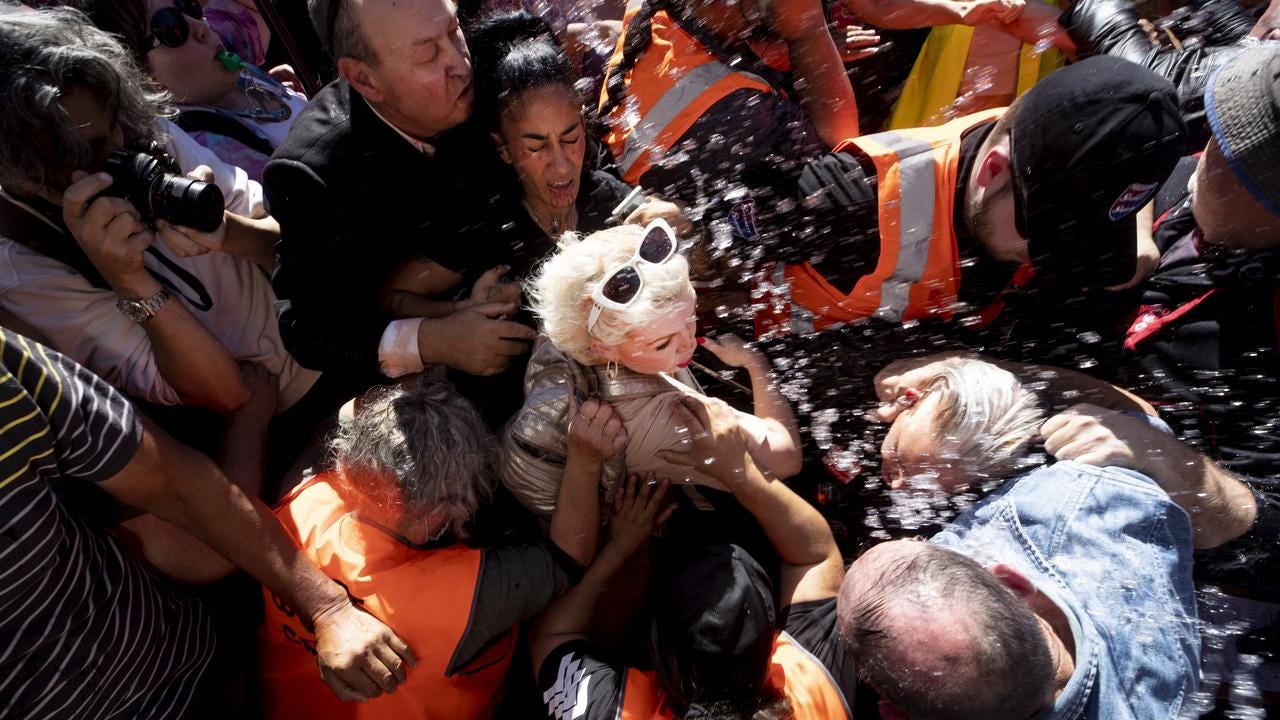
This ideology has become so hegemonic (ergo, the fightback) that a medical journal like The Lancet now feels compelled to refer to a woman, a human female, as “a body with a vagina.”
Everything I’ve read, like the (very cautious and benign) “Cass Report” for the English National Health Service, Littman’s work, the Diaz-Bailey study, or anything else that calls a single fragment of trans-ideology into question, is immediately and widely met by a collection of internally self-referential “debunkings,” none of which, to date, has actually debunked anything (see above, re the RaRe/Stonewall results).
It can take hours of research to get to the bottom of these reactive ideological floods to establish the original source material, funders, and so forth. It reminds one of that trope in legal dramas, where the good guys ask for material in discovery, and the bad guys ship over a truckload of boxes with millions of pages.
The best anaolgy I can find in history for this manfuactured tidal wave protection of propaganda is the tobacco industry. Fund counter-research in mutiple locations (like crating shell companies), then cross-reference between them to create an impenetrable appearance of legitimacy. It’s more effective than the tobacco industry, because it answers the desperate need of ideologues to be validated and protected from outside threats.
Ideologies always serve some function. They are aimed at something. They seek to control the cultural temperament. Gender ideology is no different from other ideologies that spawn their own paradoxes. The paradox, apart from the contradictions above, of gender ideology its adoption of “freedom” talk to justify a new Puritanism.
I don’t mean that as a perfunctory metaphor. The parallels are more than skin deep. Puritanism was a movement to “purify” Protestants of any vestige of Catholic tradition. The New Puritanism is all about razing traditions. Puritans were Calvinists, who saw the world divided between the “elect” and the rest of us who are impossible reprobates — the elect being confirmatively (Deuteronomically) visible by way of their adherence to a set of cultural codes. The New Puritans identify one another (and those of us who are the non-elect), likewise, by the adoption and acceptance of special fashions and insider language. Natal sex is not “assigned,” but identified; nonetheless, even physicians now use this Trojan horse terminology, this question-begging, deceitful, insider language.
Those of us who ignore or refuse said fashions and insider language are obviously apostates; and there is no hesitation — in fact, hesitation might suggest one is not among the elect — to suppress and punish the non-elect.
The Puritans were zealous witch hunters, and they wanted women out of public life, beginning with the destruction of Marian theology. The New Puritans, who’ve stolen the mantle of feminism, are both on the hunt for witches and profoundly misogynistic — to the point of denying women’s natural existence, and (with regrettable political success) now aiming at actual women’s erasure in politics and law.
When the Puritans achieved political power, they were enthusiastic enforcers and censors. Today’s New Puritans are now imposing themselves through law and blacklists in politics, medicine, “journalism,” entertainment, “human resources” departments, and education, and they have a Jacobean mob presence on social media. (I admit to having great trepidation in seeking representation for my novel, because the literary agent bios are around ninety percent appended with terms like BIPOC, LGBTQIA+, and neurodiverse.)
This dogma — and here is what’s so remarkable about it — gets away with saying things, and having those things widely accepted, that are obviously not true. Neither is a man a woman, nor is a woman a man. But this cultural schizophrenia has, with the aid of a savagely effective propaganda machine, advanced so successfully that people who recognize the absurdity of these claims are increasingly afraid to state these obvious truths in public. I suspect there are many academics, for example, who have revervations about this racioactive ideology, who are terrified to speak out.
Children in public schools are being indoctrinated into this dogma; and opposing them will summarily result one being shunned as a “fascist,” of all things. Public figures being physically attacked. People being forced out of their jobs. Speakers being shouted down by disruptive mobs. I hesitate to mention “human resources,” only because that term itself is part of the larger problem, but HR departments now routinely warn employees in briefings not to use terms like “pregnant woman.” You cannot make this shit up. Stephen Adubato calls it “liberal pietism du jour.”

Holly Lawford-Smith is an Associate Professor in Political Philosophy at the University of Melbourne, Australia. She gave a speech earlier this year at a Let Women Speak rally, when she was off the clock, and within days the campus of her employer was papered with posters calling her a fascist.

Even the Dean of her own school, under pressure from ideologues, resorted to associating her with neo-Nazis.
The longer game here is to drive anyone who questions this ideology out of every public space except where the ideologues haven’t yet gained power, which are often “conservative,” then to brand the offenders as right-wing for speaking to the only people who will give them an audience. I’ll be accused of this most likely, and I’ve been a public socialist (not the “national” kind) of one sort or another for over thirty years.
As such, I’d gladly make an alliance with someone on “the libertarian right,” for example, to stop a war. This is exactly why many otherwise leftish feminists are showing up on conservative venues. They have this one issue in common with conservatives, and the way to advance one’s position on an issue is to make tactical alliances. You don’t catch a disease called “fascism” from mere contact. Moreover, they’ve been frozen out (cancelled) in every other venue by the New Puritans and moral cowards. It’s either have the conversation on conservative venues, ar accept being silenced.
Speaking of which, the so-called political right sees trans-ideology as a gift, but it’s a transient gift, and you can separate those who are right-ideologues and opportunists from those who are honest and principled “conservatives” with one simple test. Do they deploy “science” against trans-ideology and still embrace climate change denial? This is my own red-line of determination about whether I should take seriously anyone who says he or she is of the “right” or anyone who has been assigned that label by others. I’ll overlook ignorance about climate science and the more general biospheric catastrophe that’s unfolding around us. Most people don’t have the time or interpretive tools to deep-dive these issues, and so they’re vulnerable to distortion, disinformation, and demagogues. Confirmation bias is a enduring temptation. But when someone with influence and an education is feeding that confirmation bias out of desire to advance a more general political program (especially for big business), I’m going to point the finger and say, “J’accuse!” You’re not honest. You’re just another cheap polemicist, an obedient foot soldier for your party.
I’ll say the same thing about those who want to weld trans-ideology to a more general “woke panic” program, conflating this issue with race, for example. The restoration of white supremacy has been a key organizing principle for portions of the US Republican Party ever since Nixon’s Southern Strategy, so when I hear these conflations, I know I am hearing from someone who is either ignorant of the history or every bit as much an ideologue as the most rabid gender cop.
I won’t divert down the path here of racial opportunism on the left or the racial identitarianism that corresponds to gender liberalism — real things, too, which empower the right by giving them the stick to beat the rest of us. I’m just saying, when a topic under discussion becomes programmatically conflated in a partisan menu, as opposed to sticking to the debate topic, we are dealing with a power-seeking agenda and not a principled interlocutor. Here is neither good will nor good faith.
The gravitational fields of partisan politics are always a danger to principled debate, because it inevitably becomes tactical and instrumental . . . manipulative, in other words. It no longer about seeking the truth together. Manipulation is so much the water we swim in that we seldom recognize how this Machiavellian consequentialism has become an ethical default.
All that said, in recognition of this default as a social reality, and in pursuit of some kind of general account of our political terrain in the here and now, we have to acknowledge what an excellent wedge issue we are dealing with.
In the US, this woke-panic (there is no such thing as “wokeism,” y’all) — with gender ideology as its battle banner — is one of the main things assisting the continued survival of the Republican Party, which has devolved in all other respects — against the backdrop of a Democratic Party that is corrupt all the way down and now the vanguard of technocratic managerial despotism — into a squabbling cacophony of old guard capitalists, social conservatives, economic interests (like small businesses and big oil), evangelical millennarians, libertarians, gun nuts, conspiracy theorists, patriotic fantasists, and hard-boiled racists.
This is an effective wedge issue, because gender ideology is as described above — and it’s really, actually becoming politically powerful. When the perceived threat of any ideology on the march is to our children, it has crossed the Rubicon, and the fightback is inevitable. That is precisely why this “issue” has taken on the aspect of civil war. In war, as the saying goes, we see strange allies.
I am a Magnificat socialist. As a long standing member of the economic left — and by that I mean for me Barack Obama is a right wing Democrat and a Reagan Republican — who will continue to side with the precarious and the poor against the rich who prey upon them (us), I am chagrined at the disappearance of any genuine left, which has now been swallowed whole by trans-ideology and all the metaphysical assumptions that are smuggled in with it. As someone gratefully tutored by leftist feminists (not the fun kind) — who recognized out of the gate how thoroughly misogynistic were the fuzzy “feminists” of what Abigail Favale calls “trickle down Butlerism,” with their ardent defenses of the woman-hating porn industry, the woman-hating prostitution industry, and the woman-erasing trans-activism movement — I am equally chagrined by liberals’ power-grabbing attempts to establish a dangerous and offensive medicalized biopolitical regime which wants to speak a transhumanist incumbency into existence and police our language to advance their agenda with all the censorious enthusiasm of a Saudi despot.
My flirtation with the Democratic Socialists of America during the Sanders campaign was soured early by my experience of three meetings, where the first thing one encountered was the threat of being browbeaten if one failed to proclaim one’s pronouns on one’s name tags. I was sixty-four-year old man (73 now) with a beard, wearing the same grunge-clothing I’ve favored all my life. Everyone knew goddamn well I was a “he-him,” but failure to put these pronouns on a piece of sticky paper and wear it on my chest led people to keep their distance and give me the side-eye, even though I’d had more political experience than pretty much anyone else in the room.
This, of course, exposes a perennial fracture in the left (who’da thunk it?) between the Prometheans, whose metaphysical convictions align closely with transhumanism and technomanagerial rule, and the ecologic-economic left that spans from ecocommunists to agrarian social democrats to subsistence socialists to degrowthers to distributists. They’ve all been sidelined by the fantasy-left who still dream of some techno-utopia, including one that surgically re-engineers healthy bodies.
Canadian activist and eco-socialist Stuart Parker, who roundly and very convincingly confronted this nonsense, was driven out of public spaces with malignant glee by the gender Stasi. In a recent Facebook post, he said:
In my thirty-six years as a climate activist, no conservative who has disagreed with me on climate has ever tried to destroy my career, my home, my relationship, my friendships, my social media accounts, my radio shows, my podcasts or my recreational activities.
People working in the fossil fuel industry who feel my efforts are destroying their employment prospects, people who think climate change is a hoax, a fraud I am helping to perpetrate, people who falsely believe I receive money from shadowy European interests: none of these people have felt entitled to go after my ability to earn a living or have a romantic partner.
In my three years of opposing genderwang, dozens, likely hundreds of progressives (many of whom I considered comrades and/or friends) have felt it totally appropriate to engage in unapologetic concerted public efforts to destroy these things, to even come after my fortnightly tabletop Runequest games and try to stop those.
In a social partition of contemporary North America, I would rather be in a conservative society, even if it were significantly more on fire, because I wouldn’t feel unsafe disagreeing with my neighbours.
EDIT: Ultimately, I am not choosing to be a conservative. I am realizing that it is easier to be a Marxist eco-socialist among conservatives than among progressives.
You want to know why some of us are talking with conservatives. That’s why. That, and because trans-activists target children, and we’re not having it. Kids ar not going to be sacrificed on the altar of ideology, full stop.
I’ve joined this fight, because the state, with its immense power, is now an active ally in the indoctrination of children with an ideology that will lead them to disfigure and disable themselves for the rest of their lives, throughout which they will have been made drug dependents — ATMs for so-called professionals and corporations. Parents are having their children taken away by courts for refusing to “affirm” these “identities.” State schools are putting these ideas into their heads. No, I don’t want a drag queen — in drag — teaching my children. Twenty years ago, a fraction of one percent of American high schol kids identified as “trans.” Now, in places, it’s almost one in ten.
This is an emergency. It’s a medical emergency. It’s a cultural emergency. It’s a political emergency. It’s a spiritual emergency.
I’ll recommend to readers, especially parents, an articled called “A State of Parental Dysphoria,” which says, among other things . . .
Parental dysphoria involves the extended state of having to stay silent about something that you know will lead to tragedy, because you don’t want to lose your child, your friends, your extended family, and your marriage — everything you’ve worked to build. You do this to preserve some small chance of having an impact, to keep your child close enough to eventually help them find their way out of this delusion. It’s living with fear — fear of loss, fear of estrangement, fear of losing your own mind, fear of losing your integrity by denying your own instincts. Those who suffer from this condition, myself included, know this to be the most awful feeling you’ve ever experienced in your life.
If you suffer from parental dysphoria, you wish to say, “You were not ‘born in the wrong body’ — that’s impossible.” But you also know your child wants so badly to believe this that you aren’t sure whether to lie or tell the truth about how you see things. So, instead, you say very little and pray every day that your child will find peace in their own body before it is too late, before your child denies and destroys their own sexual function and fertility, and poisons their body with synthetic hormones.
It’s the tears you choke back as you do your best to support your child despite their best efforts to push you away. It’s holding your breath, not even knowing how you can carry on. It’s a feeling of hopelessness you have never felt before.
It’s the horror of being told by your other child, the one who serves as the pronoun police in your home, that you are the one who isn’t loving and supportive. It’s the shame of realizing that you’ve lost your ability to be the adult in the room. It’s feeling that the liberal, progressive values you instilled in your children are being used against you in a way you could never have seen coming. It’s disheartening, destabilizing, and destructive.
Parental dysphoria is what follows when you’re advised by a professional to call your child by a new name, one that represents to you a symbol of their deep pain, a name that is more likely to have its origins in Pokémon than in the family heritage you tried to pass on to them.
It’s the dissonance of having to validate a decision to transition at school made by a child going through a confusing and difficult time in their life. It’s the out-of-body experience of hearing your child say, “I am not the person you raised — I am someone else entirely.” It’s the loneliness of being the only person who thinks all of this is damaging to your child, rather than it being “brave” and “liberating.”
It’s insane, actually, this parental dysphoria. It’s insane to live with and to live through. It makes you gradually lose your own tether to reality, bit by bit, day by day.
We should all want to know why so many kids are declaring a trans identity. We should not simply accept this as normal, and we should certainly not teach it, nor enshrine it into law, until someone can demonstrate through unassailable longitudinal studies that any of it is valid in the first place. Many of these young people are being led astray by the very people who are supposed to protect them. Doctors and psychologists are no longer experts to be trusted.
Here is a documentary, called “Affirmation Generation.”
Now, about that other trans word.
Trans-ideology and transhumanism
Transhumanists argue that machine intelligence can become conscious, eventually making fleshy humans obsolete.
Donald Trump is a malignant narcissist with the mind of a spoild child. It doesn’t make him unique in American Presidential history. We’ve had several who were just as venal, and even more who didn’t have the sense, as we Southerners say, to pour piss out of a boot. George W. Bush comes to mind, and Biden “governed” with advancing dementia. Ronald Reagan’s last years in office were managed around his Alzheimers.
The big story, as I’m about to publish this, is how the Chinese, with DeepSeek, have just end-run Microsoft, Facebook, Apple, Google, and Amazon’s AI ambtions, and with it Trumps whole tech-bro coterie, just as Trump was crowing about a half-trillion dollar AI investment in Texas that’s now . . . moot. (I’ve said it before. Russians play chess. Chinese play Go. Trump plays checkers.)
The point I’m creeping up on is that Republicans and Democrats share a radical technological optimism, and they’ve let these tech bros amass enormous wealth and power.
Anybody following it casually has seen how it went down. U.S. tech companies, with the support of the federal government (and the Pentagon), built up a dominant global position through genuine innovation. Microsoft, Facebook, Apple, Google, and Amazon reshaped the world. Microsoft, one of the first major companies to rise, tried to put a halt to that innovation by buying up and/or crushing its competitors, but the U.S. sued it in 1998 for violating antitrust laws. The Bush administration settled the case, backing off the effort to break them up. What followed was a bipartisan embrace of Big Tech; the Bush and Obama eras saw unbridled growth and mergers. As tech companies saw smaller firms innovating, they would buy the company, kill it, and absorb some of its staff. (link)
The tech bros themselves are, to a man (they’re all dudes), committed to transhumanism. Ergo (using a simple syllogism), both parties have enabled transhumanism.

So, what is this thing? From the Open Encyclopedia of Anthropology:
The social and intellectual movement known as transhumanism questions the figure of the ‘human’ at the centre of humanism and modern political formations. As part of a broader ‘posthuman turn’ it is frequently associated with technological enhancements that redefine human bodies and their limits. However, the core argument of transhumanism has to do with the human mind or consciousness. Transhumanists suggest that the human mind is reducible not only to its biochemical substrate but also to something more fundamental called information that characterises all existence in the universe. Since silicon-based computation is the basis of informatic processes today, transhumanists argue that machine intelligence can become conscious, eventually making fleshy humans obsolete. This process of technological advancement towards a super-intelligent computational civilisation is regarded as part of a larger unfolding of intelligence in the universe, a universal telos of existence of which humans are only one instance. Thus, human intelligence is set to yield to a nonhuman destiny. This entry traces the formation of transhumanism, reviews some of the anthropological studies, and concludes by questioning transhumanism’s narrow social and metaphysical visions of post-humanity in which both intelligence and biology end up being delimited around particular (civilisational, racialised) forms of life and thought. (emphases added)
“[I]nformation … characterises all existence in the universe.”
“Language constructs reality.”

The 2018 Libertarian Candidate for California Governor, Zoltan Istvan, wrote a piece for Huffpost in 2015, called “The Future of the LGBT Movement May Involve Transhumanism.” The cut-line read, “In the future, transhumanist technology and science will compliment the LGBT movement and help push it forward in the face of continued social oppression and closed-mindedness.”
Transgenderism is a subset of transhumanism, and the latter shares the former’s airy imaginary of some wonderous cyborg future. Istvan writes:
Frankly, I could see many humans in the future stopping physical sex altogether as cranial implant technology finds precisely the right means to stimulate erogenous zones in the brain -- something researchers are already working on. Real sex will probably not be able to match direct and scientifically targeted stimulation of our minds. Such actions may lead to a society where male and female traits disappear as pleasure becomes "on-demand," and gene therapy is able to combine the most functional parts of both genders into one entity. Not surprisingly, some institutions like marriage may end up going the way of the dinosaurs.
But it doesn’t look like this:

It looks like this:

Y’all, this is batshit!
Remember the Jestons, a 1962 techno-utopian cartoon, with flying cars and robot maids?
People actually imagined then that by now (2025) we’d have colonized other planets. In 1968, the film 2001: A Space Odyssey was released, abox office blockbuster. By 2001, it was imagined, there would be teams of astronauts exploring Jupiter’s moons.
This kind of technological optimism has been a feature of techno-boosterism since the beginning of the twentieth century. I devoted a twenty-page chapter to the history of techno-boosterism in Borderline.
Zoltan Istvan and Elon Musk, et al, are not visionaries. They’re crackpots. And America has always had a love affair with crackpots. Transhumanism is the current in-thing crackpottery.
Jetsons (anticipated tech outcomes)
2025 (Actual tech outcomes)

The Spiritual Crisis
We live in bubbles of simulacra and lies, cut off from the very nature of which we’re a part.
Gender dysphoria, spiritual fads, ADHD, autism, obsessive-compulsive disorders, depression, unfocused anxiety . . . the fact that we’re all incorporating plastic into our tissues now, that we eat low-quality food, that we rush-rush-rush to get things done — read the Sapolsky-Share primate studies on the physiological effects of “stress” — that our intimate bonds are being replaced by disembodied ones, that we’re the slaves of institutions and metrics and money, that we’re subjected to a constant barrage of noise and distraction that whips our attention to and fro like the end of an escaped fire hose, that our lives are mediated for hours each day by electronic screens, that our daily experience is often devoid of the complex web of life which has been destroyed to make the built environment . . . that 66 percent of Americans are using prescription drugs, and that doesn’t even count how many of us are self-medicating with alcohol, marijuana, and the rest. It’s a wonder, a testament to human resilience really, that we’re not all crazy as a bag of squirrels, that we still manage to occasionally be attentive, reflective, rational, loving, honest, ethical, and creative in the face of all this distortion, perversion, and damage.
Trans-ideology is but one manifestation of our material, metaphysical, and spiritual crisis.
Does it surprise anyone that being human in such a state, now normalized and naturalized, might be attracted to the childish escapism of transhumanism? We are living, walking, talking symptoms of the world in a most precarious state of disorder disguised as super-order. Hell yes, people want to escape. We live in bubbles of simulacra and lies, cut off from the very nature of which we’re a part.
Trans-ideology is but one instantiation of the way in which modernity has made us mad as hatters. That very saying comes from a period in which hat makers were exposed day in and day out to chemicals that at away at their brains — the environmental hazard of their time. Our environmental hazards are materials like chemicals, to be sure, but also a sense of dislocation manifested as a terrible spiritual deficiency, a scurvy of the soul which includes a hatred of the body and the disordered will to rip it apart and rebuild it.
And with that, I’ll leave my conclusion hanging, leaving readers to walk it out for themselves.
Thanks for listening.
Peace.
I think you've done a magnificent job of tackling a difficult issue. Only quibbels, I had to look up PMC (professional managerial class?) and Magnificat Socialist, which it turns out, also describes me.(I used to say, "Dorothy Day Socialist.")
Wish I could unsee some of the photos but that's getting to my suggestion. You've put in so much work, added so many layers, footnote links and related perspectives, that reading through your whole long opus felt a bit like being inside a giant single cell that's just about to divide. You might want to think about rewriting/editing (copying and pasting) into two separate essays. One with a much narrower, simplified focus on the sex/gender issue and another with a much more open and wide ranging look at the many ways we're all being perpetually set up to be beefing and quarreling amongst ourselves. That could be a separate piece, on its own. Without the photos of the medical gruesomeness. This old episode of Star Trek is what came to mind, while I was reading:
https://en.m.wikipedia.org/wiki/The_Immunity_Syndrome_(Star_Trek:_The_Original_Series)
Stan, this is just about book-length itself, but the link you include that says "a book-length monograph" actually (as of this comment's time stamp) just directs to the wikip article on Tina Beatty.
Also thank you for the warnings re. the surgical photos.
more later, possibly, after i have digested the whole arc of the piece.