
Migration
prehistory, people, and panalectics

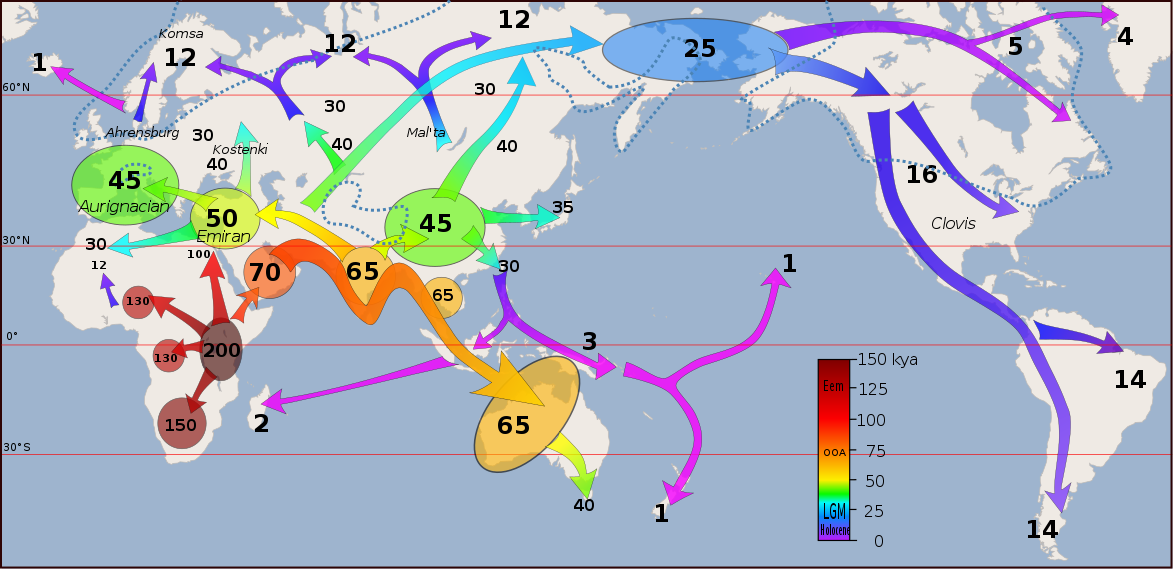
For most of my life, I’ve been fascinated by prehistory, by the flora and fauna, the topographies, the shifts in the earth, the weather, and especially by our ancestors for whom I feel a wistful affection. Ever since, after the epistemic jolt of Vietnam, my old lit teacher, Frank Reuter, taught me about projected anachronism in the study of literature, I’ve been able to detach, with a bit of concentration, from my personal history and experience, and inhabit—in a way that is simultaneously exciting and a little scary—worlds of the past not my own, and so this out-of-body, retrojective commiseration.
In response to a conversation on Substack, I recently dredged up and redistributed a piece I did back in 2021 on de Certeau’s anthropology and creolization, which got me thinking about migration and the many subtexts thereof. Migration is a political issue right now, because the world has fallen under the spell of management; but even if there’s a politics waiting in ambush here, that’s not what I’m trying to describe. People are going to cast themselves and their obsessions into pretty much everything. That’s “beyond my power to heal.”
Where to begin.
In the past few years, the people who study these things have used the synthesis of archeology, anthropology, and DNA research to put together some remarkable new insights on the history of prehistory.
The oldest hominid known is Lucy, an Australopithecus afarensis, her skeletal artifact dated at around 3.5 million years ago. Her species is believed to have lived from around 3.9 -2.9 million years ago, though, as we’ll see, this periodization of speciation is a pretty blunt instrument.
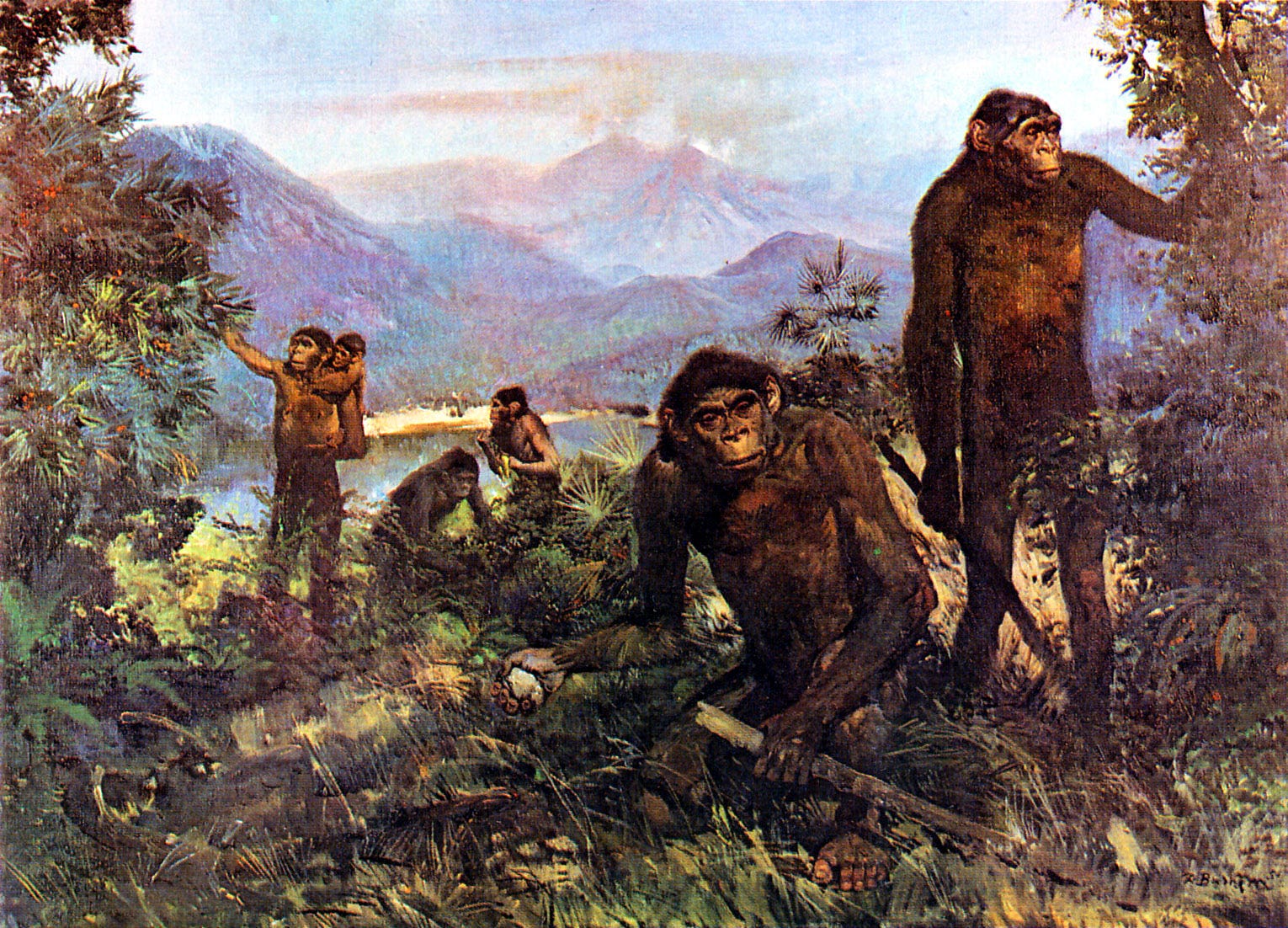
Lucy and her band in and around what is now Ethiopia. The African Continent looked very different than it does now, with many now extinct species, but suffice it to say that Australopithecus was in the minority of the minority among them, and so Lucy and her kin were not apex predators, but one of many potential prey species for giant crocodiles and megantereon—a 250-pound saber-toothed cat—as well as other predators. I mention crocs and cats, because Lucy’s kin’s skeletal remains show fatal wounds from both. They walked upright, which combined with their veggie diet of grasses, succulents, and root vegetables, strongly suggests they preferred open landscapes, which is where great herds of vegetarian mammals also lived . . . which also attracted big predators.
Our Australopithic forebears were, by our standards, extremely strong for their size, and may well have retained some tree-scaling ability like their arboreal cousins—a handy skill for escaping predators. Based on what I’ve been able to glean from my cursory studies, I strongly suspect that Lucy and her kin had a rudimentary language and it’s been proven that they were already making stone tools and having an occasional bit of meat, which is to say, the bones of animals from that period have been found with marks from primitive stone cutting tools. They were only around three to three-and-a-half feet tall, so it’s doubtful they were taking down rhinos and wildebeests; but they were almost certainly adept at throwing stones and using clubs, so it stands to reason they chased other, smaller predators off of kills. I’ve seen video of wiry, barefooted, little African tribesmen running cheetahs off a kill with flexible branches wielded like bull whips.
Australopithecus roamed, based on seasonal and ecological changes, and what is obvious from their range is that, based on a host of factors, they migrated.
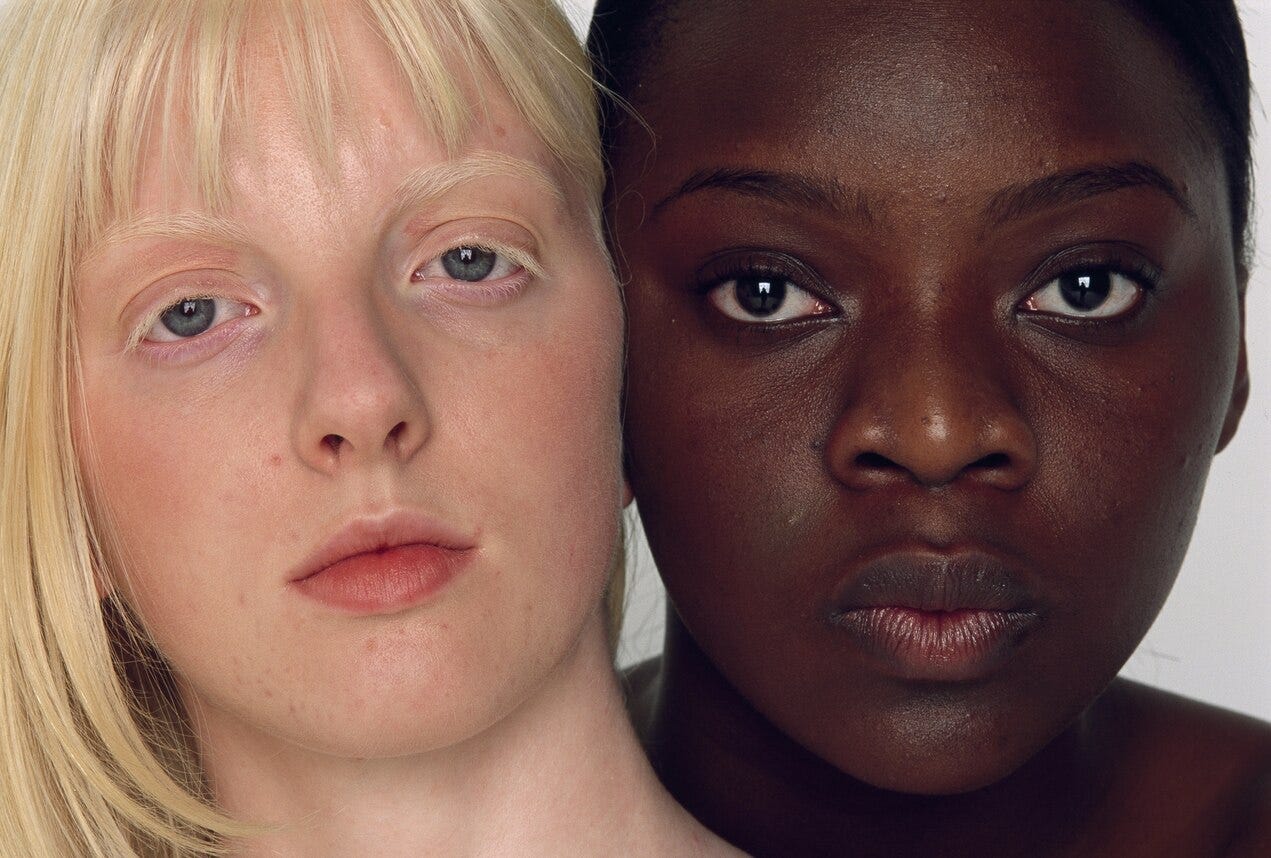
Something I’ll bring up early here is that for most of prehistory, these many peoples lived in groups of limited size and often very isolated from one another. This meant a limited pool from which to select mates, and over time, various groups took on certain in-group resemblances. We all see resemblance in our own families, and we see this in various human phenotypes that emerged among human groups in regions around the world. We’ve also seen, as we’ve become more cosmopolitan, how quickly phenotypes “blend,” which is to say (1) phenotype is not species and (2) that a phenotype can dissolve rather quickly within just a couple of generations.

These three grandkids are a combo of Central and West European (which we’ll see later also means a mad mix from the Mediterranean to Mongolia to the Arctic), Mexican mestizo (Spanish and indigenous), and West African (also a migratory amalgamation).
Applying this retrospectively, Lucy’s “species,” like all those after, “evolved” for short periods largely independent of one another, interrupted by close contact (and interbreeding) with other groups, whereupon former group phenotypes dissolved into new ones. This applies later to pre-human and human migration, where we see, for example, “Neanderthals” were genetically dissolved (not “gone extinct”) by interbreeding with Homo sapiens from the South, whose phenotypes were likewise altered. Nothing to do with pop-Darwinian “fitness,” as we’ll see further along. In fact, some groups, throughout prehistory, were probably isolated and lost (more to crappy luck than lack of “fitness”).
When the fossil finds are separated in time by millennia, the finds are categorized, whereupon the categories themselves are reified into “species,” even though common sense tells us that actual people pass through time at the same rate we all experience (stop and “feel” a quiet minute), gradually and inter-generationally. Moreover, since these finds are of individuals or very small groups, we can’t justifiably infer that certain particularities were indicative of actual prehistoric norms. Being fossilized is itself pretty . . . outlier. How many readers have lost their kin to peat bogs or landslides?


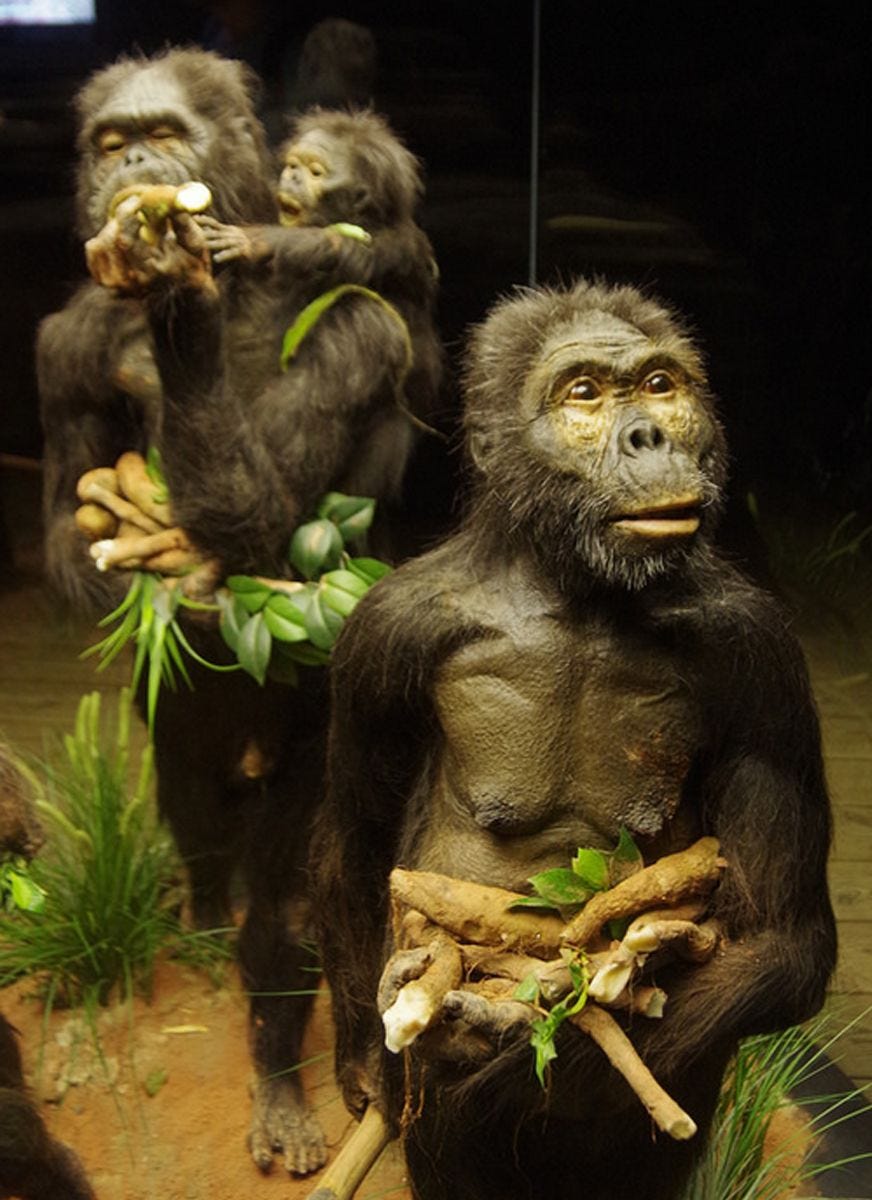
Anyway, returning to Lucy, she and her kin sought out food, they raised children (whose infant dependency was already longer than her primate cousins), they played, they poked around and tried things out, they had probably begun thinking symbolically, they smiled and laughed, they cried, and experienced many of the same emotions we do—including love. She was already, in many respects, one of us.
By around 2.4 million years ago, hominids showed up along what is now the Huang He (Yellow) River in China, where they were no longer just breaking rocks to expose a sharp cutting edge, but popping flakes off them to give them particular shapes. So, the distance from today’s Addis Ababa to Yanggu is over 5,000 miles in a straight line, with seas, oceans, deserts, wide rivers, and mountain tangs in between. That’s some serious migration there. What impels migration?
Lot of things, actually. Nowadays, its economics, war, ecological catastrophe, and on a smaller scale things like vocation and marriage. Back then? Lots of things.
The next leap I’ll take in evolutionary time is from the 2.9 million years ago when we see the last of the Australopiths to around 1.5 million years ago when Homo erectus comes on the scene. That’s a period of 1.4 million years. People were gradually growing bigger brains and bodies—(somewhere in there, archeologists found and named Homos habilis and rudolfensis)—improving their linguistic capacities, thinking more symbolically, and making the transition from scavengers of meat to hunters. The oldest civilization currently in existence might be the Chinese, at 5,000 years, less than one-percent of that time; and you can look around at how turbulent things are for us now.
Homo erectus shows up generally between modern Kenya and Georgia—the nation, not the Peach State. So, Mr. and Ms. Erectus were migrating mofos.
Migration can be chosen or forced or a combination of the two. Many peoples had annual cycles of migration to seek seasonal advantages. Niche exhaustion is a big one. An environmental shift or catastrophe can provoke us to move. Conflict moves people around all the time. Sociological changes, created internally or externally, can move us along. We often hear about imperial expansion as the cause of the Native American social catastrophe; but the first and most devastating phenomenon for indigenous Americans after European contact was epidemiological. One group had diseases for which they’d independently evolved immunity, and a separate group has no such exposure to develop the immunological response.
Touching base now with Homo erectus, this category covers a lot of territory, spatial and temporal. More than 1.8 million years, from Ivory Coast to the Korean Peninsula. They even built boats, because their remains show up on islands (that were already islands back then).
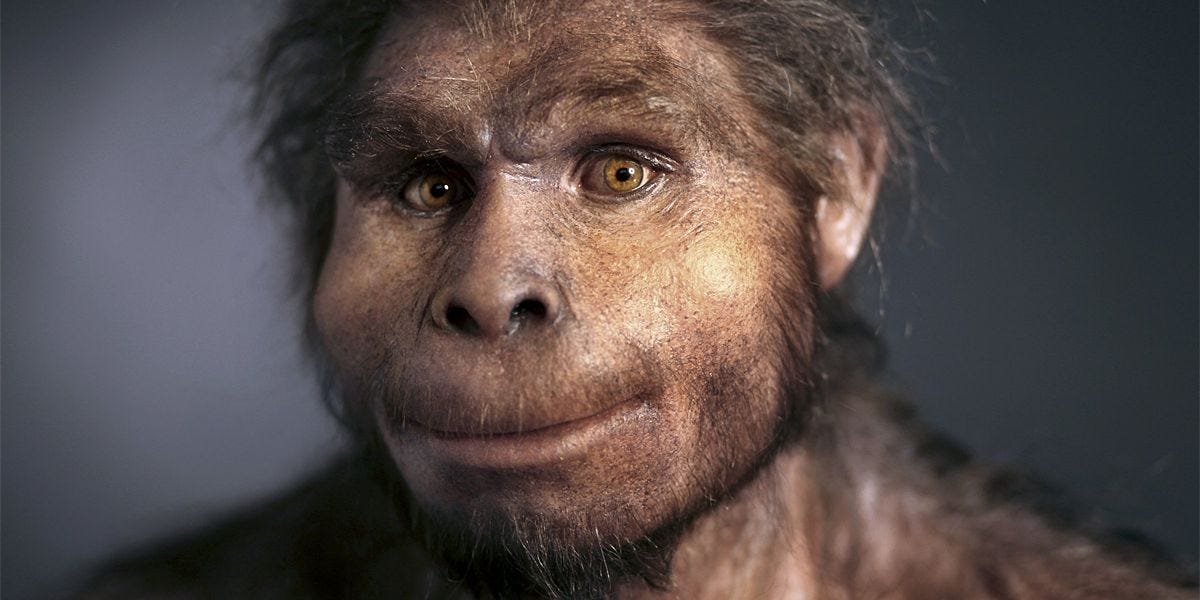
As previously noted, paleoanthropolgy needs its categories to communicate, but people can develop unhealthy attachments to their conceptual categories. Because this “species” was so successfully widespread over such a long period of time, many fossil discoveries led to lots of different names for each discovery, and with many of these rather presumptuous claims of distinct speciation. Confusion, projection, ego, presuppositions . . . it’s all part of the mix, even among sciency people. You should see how many different artistic representations there are for Homo erectus.
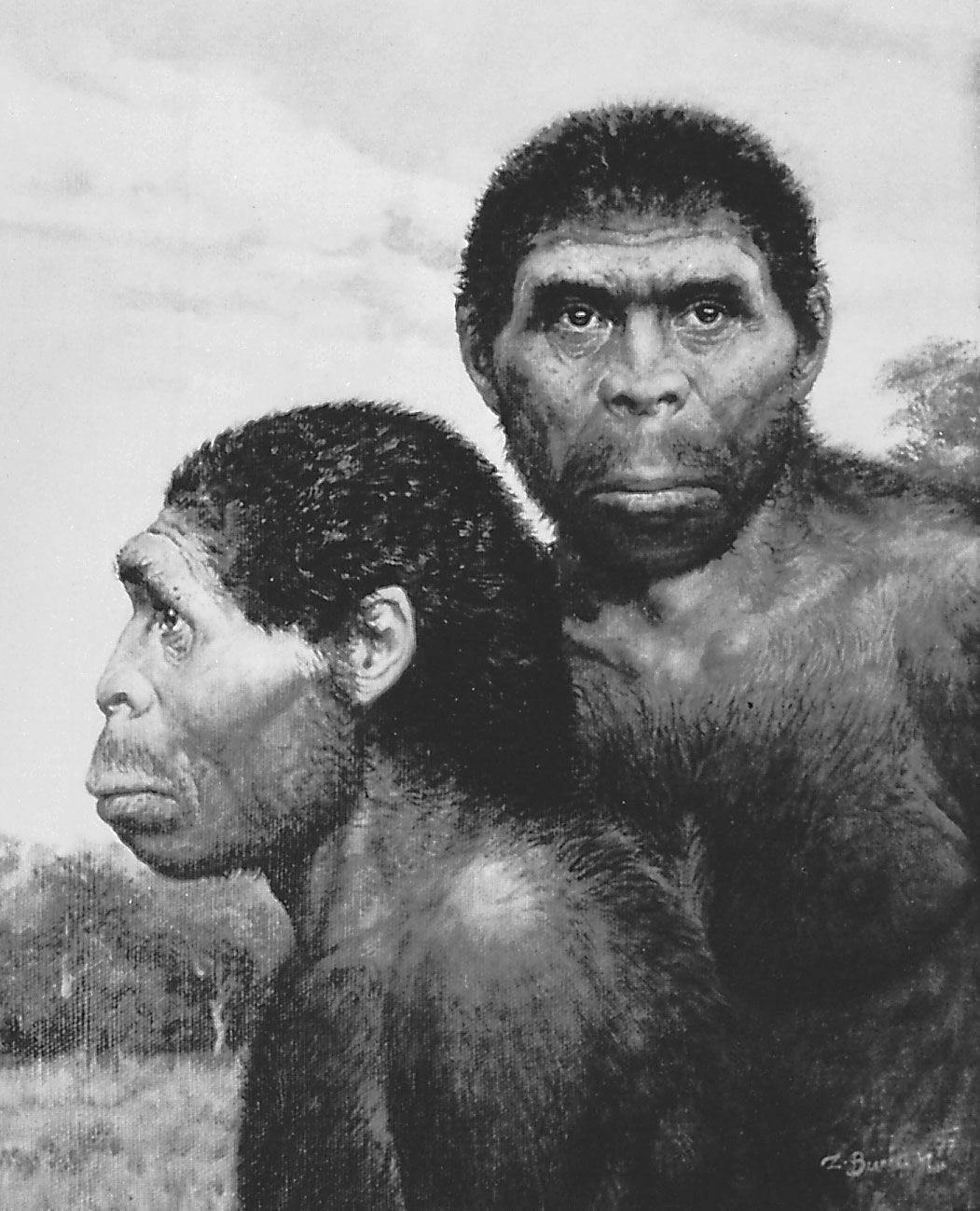

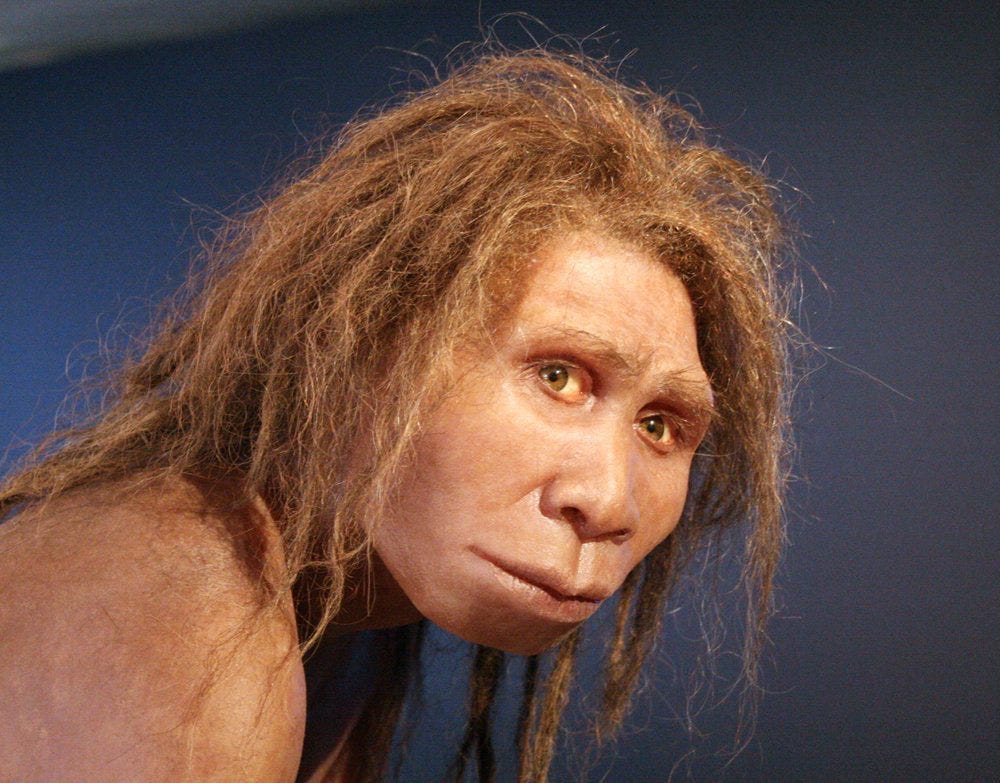
Anyhow . . . the main thing uniting these finds—to the point where it’s likely that most if not all of them were procreatively compatible—is that they’d acquired comparatively enormous brains (which corresponded to changes in the female body to let this big-head infant out, and longer infant dependency to allow the big-head out earlier in his or her development). This conceptual powerhouse had developed over a period of around a million years through a self-rewarding feedback loop (and they say “evolution” is not teleological!) Another self-reinforcing development was the narrowing of their hips and increase in respiratory capacity that allowed these grandparents to become the Eliud Kipchoges of their day—people who could run their asses off for hours. Corresponding to this ability was the loss of overheating body hair, greater sweating capacity, and darker skin to tolerate greater sun exposure due to hair loss. Genetics, morphology, and behavior were performing their trialectical dance, in what I’ll call the larger and far more granular “panalectic”—everything co-inflecting everything else at once (the truly true story is here, fully visible only to God).
I can’t help but assume that language was being refined over this period; in fact, to me it seems inevitable, apart from any other evidence. That would include symbolic thinking (which can be a double-edged sword), and probably some similar psychological traits (and tics) to ours. This would have contributed to efficacy in cooperation, especially during hunts—these folks weren’t just hunting bunnies and birds, they were now going after horses and hippos. Symbolic language would also have been a big assist in camp and household cooperation and mentoring the young. And, as we all know, language is fun. We like what Wittgenstein called “language games,” the give and take, the exchange of chatter, gossip, jokes, and especially . . . we like stories.
Homo erectus, in short, was smart. (We see regressions in our species, of course, for example, I’m quite sure that your average Homo erectus was more cognitively advanced than our current head of state.)
These changes required a diet higher in protein, and, again in the trialectical dynamic, one key “behavior” was hunting, improved with tools, improving alongside greater cognitive capacity, etc. etc. etc. I’m speculating here, but, because of greater periods of infant dependency, and because nursing probably continued longer than we do now with a kind of forced weening, women carrying and guarding kids likely focused on gathering as opposed to hunting, while men looked for meat. This put certain weapons in the hands of men . . . and eventually this would take a sinister turn toward war. That said, there is good evidence that in some cases, early human females, once the males had spotted the game, set the younguns down and participated in the hunt.
Look at the biggest, baddest, iron-pumping, beefarillla bastard you see in your local gym, and know that the average Homo erectus female could have easily taken his best punches, then body slammed him and ripped off his arms. I’m quite sure that any animal that threatened her kids would’ve been met with a blitz-beating delivered at the end of a sturdy club wielded by a mom who could’ve benched 350 while she had a cigarette.
Homo erectus surely still scavenged for meat—who turns down free food—but the evidence says they were pretty skilled at taking their own game, including, as we said, really big game. Animal bone fossils show stone axe cuts along the long bones, with animal teeth marks on the ends. That is to say, our grandparents killed and butchered, and the hyenas got the leftovers.
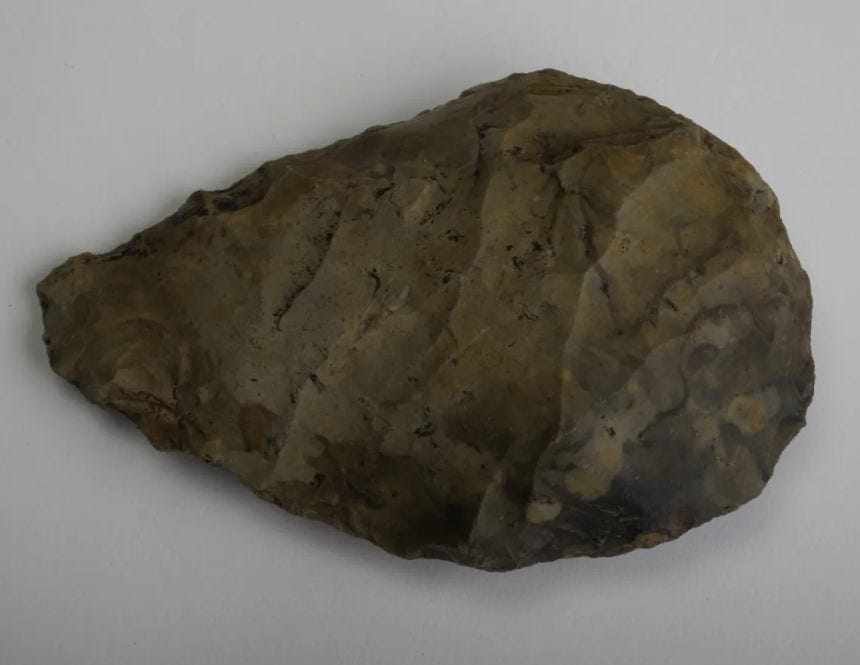
Aechulean hand axe. Homo erectus was already knapping both sides of stones to shape them into two-sided blades (bifacial).
What do wild herd animals do? They migrate. Welp, so do those who live on them.
Now, a diet high in meat can take a long time passing through the digestive tract—the more meat, the slower the passage—even though it’s very high quality protein. But there’s a way for a smart biped to pre-digest meat while making it more palatable.
Fire.
No one knows if the hominids before erectus were manipulating fire; but we’re absolutely sure that fire was an essential part of Homo erectus life. How much mastery over fire is not easy to discern, but my bet is . . . a lot. Scientists who study other primates will tell you that they spend hours each day . . . chewing. Cooking as pre-digestion creates a lot of free time for other things, like throwing rocks in the water, studying their environment, horsing around, telling stories, or tidying up the camp.
Modern humans evolved with fire; we are fire-creatures.
This marks a turning point not only in human evolution, but in technological evolution. Humans had now become exo-somatic energy producers. Animals who eat produce energy the energy they need to live from the food inside their bodies (endo-somatically). The sun transfers energy to plants, who store it chemically, whereupon an animal (or even smaller life forms) consume the stored energy, and convert it into work. I won’t indulge a long excursus here, but ever since we learned to manipulate fire, we also learned how to make heat do work for us. Today’s biospheric emergency is the result of our ever-increasing use of exo-somatic energy stores, particularly fossil hydrocarbons. Okay, I’ll digress on that no further. Yet.
Fire was useful for a lot of things, like cooking, protection, and hunting. Another thing fire is good for is warmth, which means fire-manipulators can travel to colder climes. I’ve built a snow cave in -30 degree temps, where we could light one candle inside and bring the inside temp up to around 30 above.
As to genetics, the evidence is sparse, and paleoanthropologists argue vigorously among themselves about fossil finds mean; but it’s pretty safe to assume—at least from this layman’s perspective—that our Homo erectus progenitors themselves calved off into a variety of phenotypical groups, several of whom were procreationally compatible, and that somewhere in all this breeding and migrating, various isolated groups retained this compatibility, such that we find, hundreds of thousand of years later, differing “species,” such as African Homo sapiens, Asian Denisovans, and European Neanderthals, who obviously made a lot of babies together, even though, through a series of accidents of some kind, of conflicts, or whatever, the dominant phenotype that survived was the thus-modified Homo sapiens. Every European to this day is likely carrying around traces of Neanderthals, as most Asians are with Denisovans. A lot of us are carrying both. At Denisova Cave, in what is now South-Central Russia near Kazakhstan, Neanderthal remains were found, who were likely mixing with both Denisovans and Homo sapiens around 50,000 years ago. The “Narmada skull” found in India has characteristics of all three, though it’s believed to predate them, as well as strong similarities with Homo erectus. In fact, even though its cranial capacity matches modern humans, many call it one form of Homo erectus. The fossil find of Jebel Irhoud, Morrocco, dated at around 315,000 years ago, revealed skulls that appeared as much like Homo sapiens and Neanderthal, and as much like Neanderthal as Homo sapiens—suggesting possibly a common ancestor of both. Fossilized wooden tools found in Sichuan, China—likely used by Denisovans—not only suggested a very advanced intelligence, but did so at around 300,000 years ago, which one might connect with the Jebel Irhoud find, which had already pushed back estimated Homo sapiens origins by 100,000 years (and NOT in east Africa, but northwest Africa). The Petralona skull in Greece—another one centered morphologically on an erectus/Neanderthal/sapiens Venn—is thought to be 375,000 years ago. You see how slippery this all is, when you get too attached to imposed categories . . . and you also see, these folks got around.
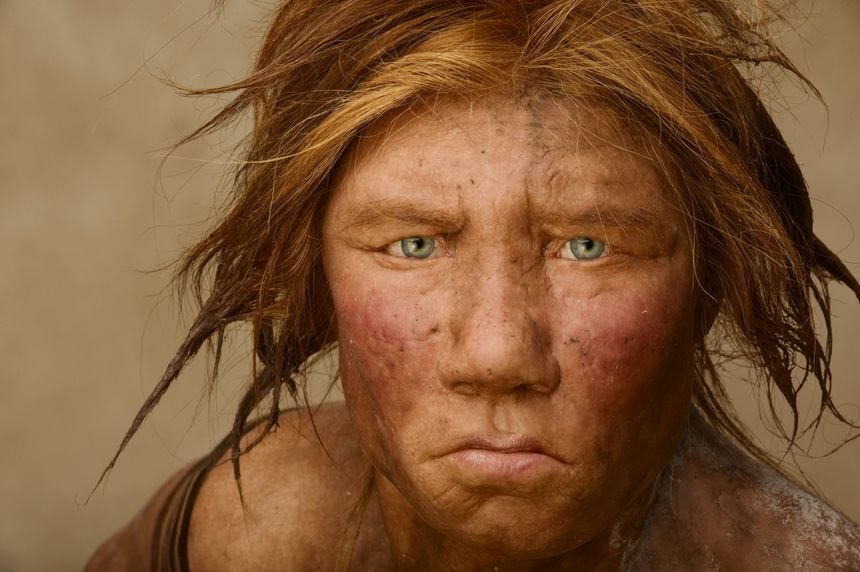
Speculative Neanderthal female
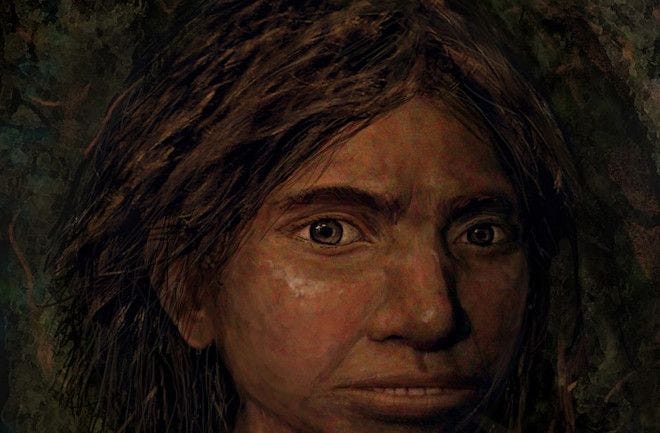
Speculative Denisovan female

Non-speculative Homo sapiens male (with a great dentist)
The tension created by species categorization (and its reification) is between genetics, behavior, and morphology/phenotypes. Take coy-wolves, for example, a cross between coyotes and wolves. Coyotes and wolves are different species in most respects, but at the genetic level, in one respect, they are not. Yes, they keep to themselves, and rarely interbreed. Each group has its own distinct patterns of behavior, and they look different, in spite of canine similarities.
The confusion, I’ll assert, is not in nature, but in that reification of categories. Nature doesn’t get confused.
This, I have to emphasize, simply does not apply to present-day “racial” debates (so don’t even try)—Homo sapiens cannot in any meaningful way be separated as species, and the various groups have been interbreeding fairly promiscuously for hundreds of thousands of years.
It does however apply, to an extent, if we don’t get wrapped around the axle of reified categories, and if we don’t indulge racial claptrap, to the evolution of Homo sapiens, who appear to have incorporated—a la coyotes and wolves—other groups that, apart from DNA testing, have disappeared from the scene, though in an entirely un-managed way. Not being an expert in these matters, I’m not sure if you or I could successfully interbreed with a time-traveling Denisovan or Neanderthal, but some Homo sapiens obviously did, and not that long ago. Nature doesn’t play by our cognitive categories, as useful as they are sometimes for figuring out what nature is trying to tell us. (One of those cognitive categories is humility, now sadly in abeyance.)
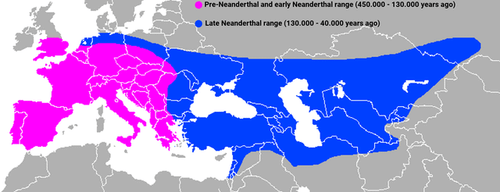
There’s been one skull discovered in Guangdong, China, an area thought of as Denisova, if you will, that appears to have been, at least in its morphology, Neanderthal, who’d been getting it on with Homo sapiens throughout Europe, whereas Denisovans were known to have spread across Eurasia. Prior to this, the furthest east anyone thought the Neanderthals had gone was Siberia, so it seems likely—given this skull, if it is indeed Neanderthal, and given how quickly interbreeding dissolves phenotypic morphologies—that a few intrepid Neanderthals may have trekked from Siberia through present-day Russia, Mongolia, and China to take up residence by the South China Sea. That’s one helluva trek.

We can’t just assume that our ancestors only traveled out of Africa and headed east. It’s pretty certain, that migration went in every direction, and even doubled geographically back on itself, including returns back to Africa. This was over hundreds, then tens, of thousands of years, so the genetic deck was constantly being shuffled.
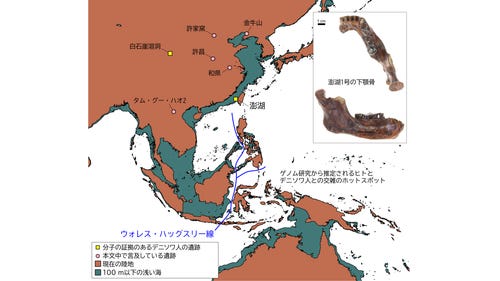
Denisovan fossil finds
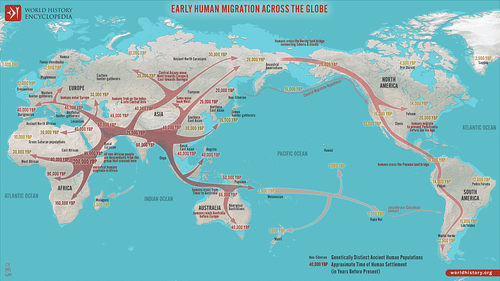
Wooden tool artifacts found in China and Germany from around the same Homo sapiens/Denisovan/Neanderthal period show a high degree of innovative intelligence; but other finds show something more, and more “human”: symbolic thought in art and ritualistic disposal of their dead. They had become transcendent. (Barbara Duden, on of my favorite historians, once remarked that formal disposal of our dead is a decisive break between humans and other animals.) We can infer, and reasonably so, that these people not only believed, they had belief systems that reached in beyond the merely sensory. We were already taking our first steps—in my own interpretation—toward understanding the world (rightly, in my view) as enchanted, even divine. I’ll leave that there, lest I steer myself and the patient reader off onto a more Platonic path that posits spirit and consciousness as ontologically prior to the material. (Roughly paraphrasing Private Witt from The Thin Red Line: “What if there’s one big soul? Everyone lookin’ for salvation by himself. Each like a coal thrown from the fire.”)
I mentioned earlier about our symbiosis with fire, and it just occurs to me, as anyone whose ever been hypnotized by a camp fire knows, that the miraculous and volatile magic of fire unlocks our imagination, and with it the capacity to grasp the transcendent.
Along that line, I want to talk about love, a manifestation of that transcendence that binds together more species than even our own. In particular, I want to detour—if that’s what I’m really doing—into the relationship that grew up between ourselves, and the animals that we know now as dogs. Any dog-lovers out there, know that dogs, like us . . . know love (a relation as miraculous and as volatile, in many ways, as fire).
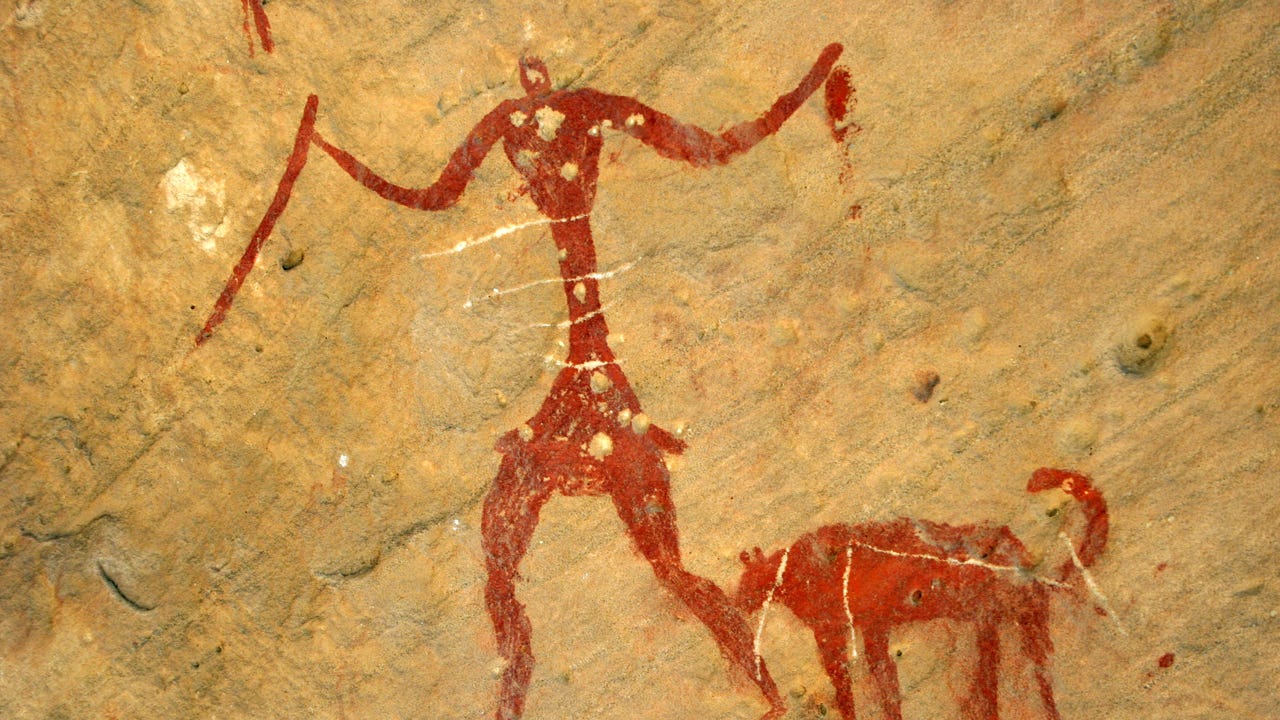

Some researchers have called the human-dog relationship a “dual mediator” of empathy, but dog-lovers and their dogs know this is nothing so bloodlessly clinical. It’s miraculous! Dogs, as intelligent and affectionate animals, call to something in us that knows love prior to the intervention of judgement (something Christ preached, but which is much harder between humans who stand before each other pre-armed with that judgement), a liminal bridge of consciousness and recognition across the species divide.
It seems likely that the first instances of perhaps ostracized wolves or abandoned wolf pups being human cohabitants may have happened as far back as 130,000 years ago. People keep wolves now as pets, so surely this kind of relation, especially in a symbiotic quest for food, was earlier than most fossil records—as thin as they are—attest. I would speculate, given the late arrival of pastoral, cultivator, and war societies, that hunter-gatherers with wolf-dogs were the first instantiation of animal husbandry among humans, leading (through “cognitive flowering”) to the domestication of horses, cattle, sheep, camels, cats, chickens, and the like. By at least 36,000 years ago, dogs were already distinct from their lupine forebears, according to the discovery of a canine skeleton in Belgium.
It needs saying, again, nothing linear here, as 40,000 years back, wolves themselves were far more genetically and morphologically diverse than they are now, and domestication, likewise, surely happened in several places independently of one another. Let’s bear in mind that the flora and fauna within and upon which they lived were also very different. Genetic evidence traces all modern dogs back to at least two distinct “domestication events,” and yet all modern dogs are procreatively compatible with one another.
(Does anyone doubt that early humans sometimes watched wolf pack taking down prey . . . and then adopted their tactics?)
Yes, the early canine-human relation was in many ways far more practical than sentimental (but canines are practical as well as sensual people). More than that, upon this practical relation—as between humans themselves—form the bonds of companionship. Dogs and humans are both intensely social creatures.
Fun fact: As cultivation came to play a larger role in human communities, both humans and dogs evolved an increased capacity for the digestion of vegetable starches. In selective breeding for different tasks (pulling sleds, herding sheep, tracking, hunting rats, etc.), these breeds also display variable tolerances for starch-heavy omnivorous diets.
Personal speculation: By learning cross-species ‘empathy,” or selfless affection and a willingness to understand one another, our ability to care for one another was accelerated.
Now, speaking of domestication, let’s begin with the late Upper Paleolithic, and see how our migrating ancestors were drawn or compelled to move house and eventually settle.
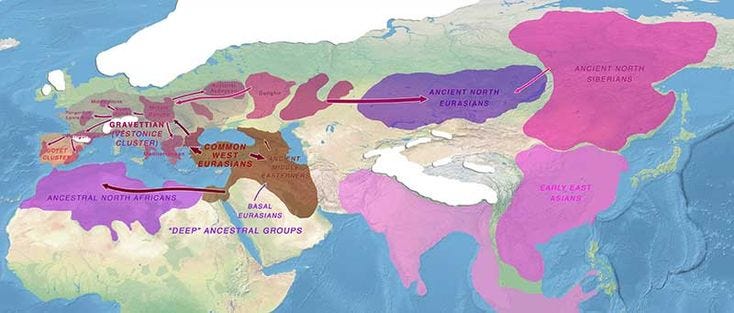
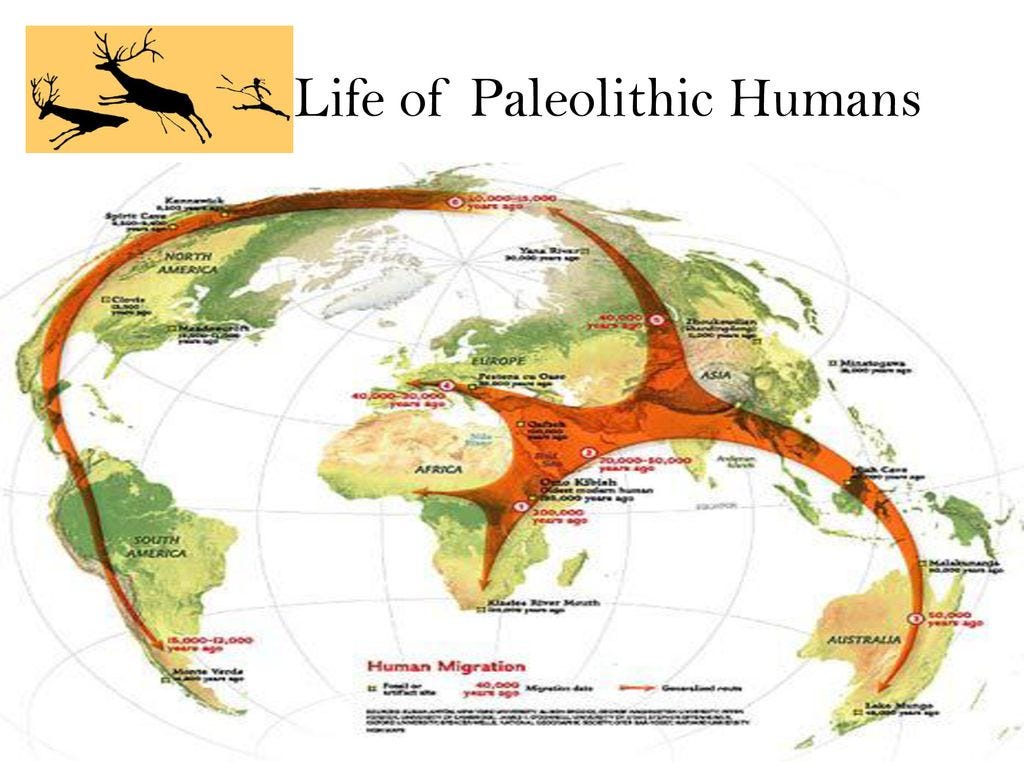
I’ve said as much as I need to on our speciation, itself irrevocably entangled with migrations, so let’s look at the periods after multiply-modified Homo sapiens emerged as the sole human species. We can start with tools and cognition—that crucial dialectic within the panalectic.
Simon Baron-Cohen, a clinical psychologist with a theory on autism (which we’ll forego) constructed a theory of “the cognitive revolution” that relies primarily on a brain-structure notion of some zero-sum balance between empathy and systemization (this is what happens when you apply a reductive-materialist bias to an obsession with autism . . . “when all you have is a hammer” and all that). Nonetheless, his graph, based on the increased complexity found in dated tools at archeological sites is only a bit off the current consensus that the cognitive revolution begins around 70,000 years back. (Not to be confused with a turn in psychology called the “cognitive revolution,” which is a systematic rejection of behaviorism.)
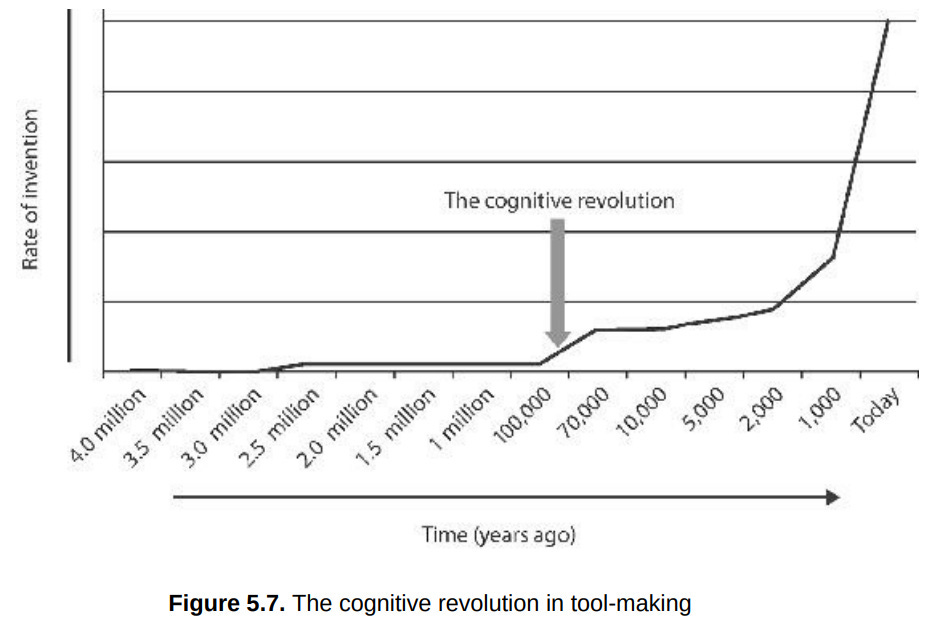
What Baron-Cohen ascribes to evolving “brain structures,” of course, leaves out all manner of environmental factors, including step-changes like control of fire, and the exponential, as opposed to additive, effect of certain discoveries first by “fooling around,” followed by an “aha!” response. Cordage started as someone farting around with dried out leaves around the camp, just as bread was invented by someone leaving leftover porridge near a fire. Who among us has not experienced that cognitive cascade when one idea suddenly causes many doors to fall open. I remember (inexactly, I’m sure) the first time, as a kid, when I grasped the notion of space-time as a unity, and the way I’ve walked away from certain books going “dayam!” These weren’t brain-structure events. They were cognitive flowering events. Anyway . . .
The last identifiably distinct Denisovans passed on around 25,000 years ago, and the last identifiably distinct Neanderthals go by the wayside around 40,000 years ago. Homo sapiens have been around for roughly 300,000 years. So, any brain-size/development equals cognitive revolution stuff is, if not nonsense, at least desperately inadequate. Obviously, natural adaptations in conjunction with various environmental evolutions was working on “brains” (which don’t “evolve” independently of many other factors); but this linear, univocally genetic obsession with “brains” is itself a cognitive error.
New tools increase the food supply, increasing the population and changing the relation to a given environment and to one’s neighbors. This isn’t a dialectic, or a trialectic, but—again—a panalectic. It’s surely not some discrete, monocausal bullshit like “brain structure.” This is a scientistic, not a scientific, supposition. (Sorry, I’m old and grumpy.)
(The richest man in the world, financier to the current US head of state’s last election, with access to unlimited education and more advisors than a hundred potentates, just claimed that Caesarian sections make babies have bigger brains. Not sure what to make of that crypto-Lamarkian idiocy.)
The same thing applies to theories about the non-extinction extinction of Denisovans and Neanderthals, the phenotypic disappearance of which was likely both gradual and multi-causal, including occasionally killing each other. (Both groups were making art, fashioning sophisticated tools, decorating themselves with paints and jewellery, caring for their dead, telling stories, and making-do in some pretty challenging conditions, so they were anything but “inferior,” which is an arrogant [and ignorant] valuation in any case.)
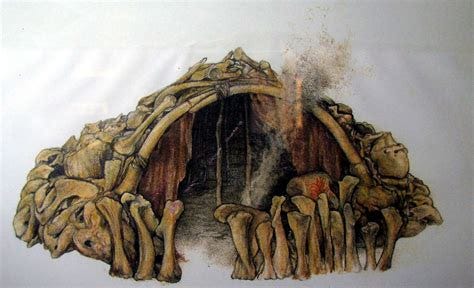
One tool that is almost exclusively seen on Homo sapiens sites is the bone needle. Nonetheless, the oldest bone needle yet discovered—around 50,000 years old—was the singular exception, made by Denisovans (in Siberia’s Denisova Cave). This means people could make clothes that were more than wraps and ponchos, as well as fitted tents—both great advantages for people who had to migrate to and endure cold climates. (Everyone likes to talk about weapons, what with our perhaps masculine biases, but sewing is a tremendous technological leap.)
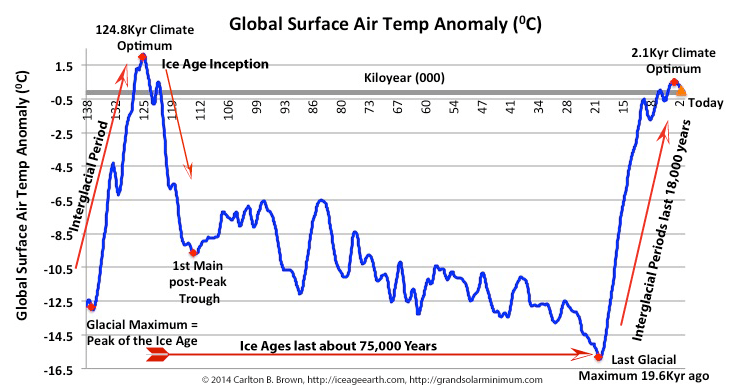
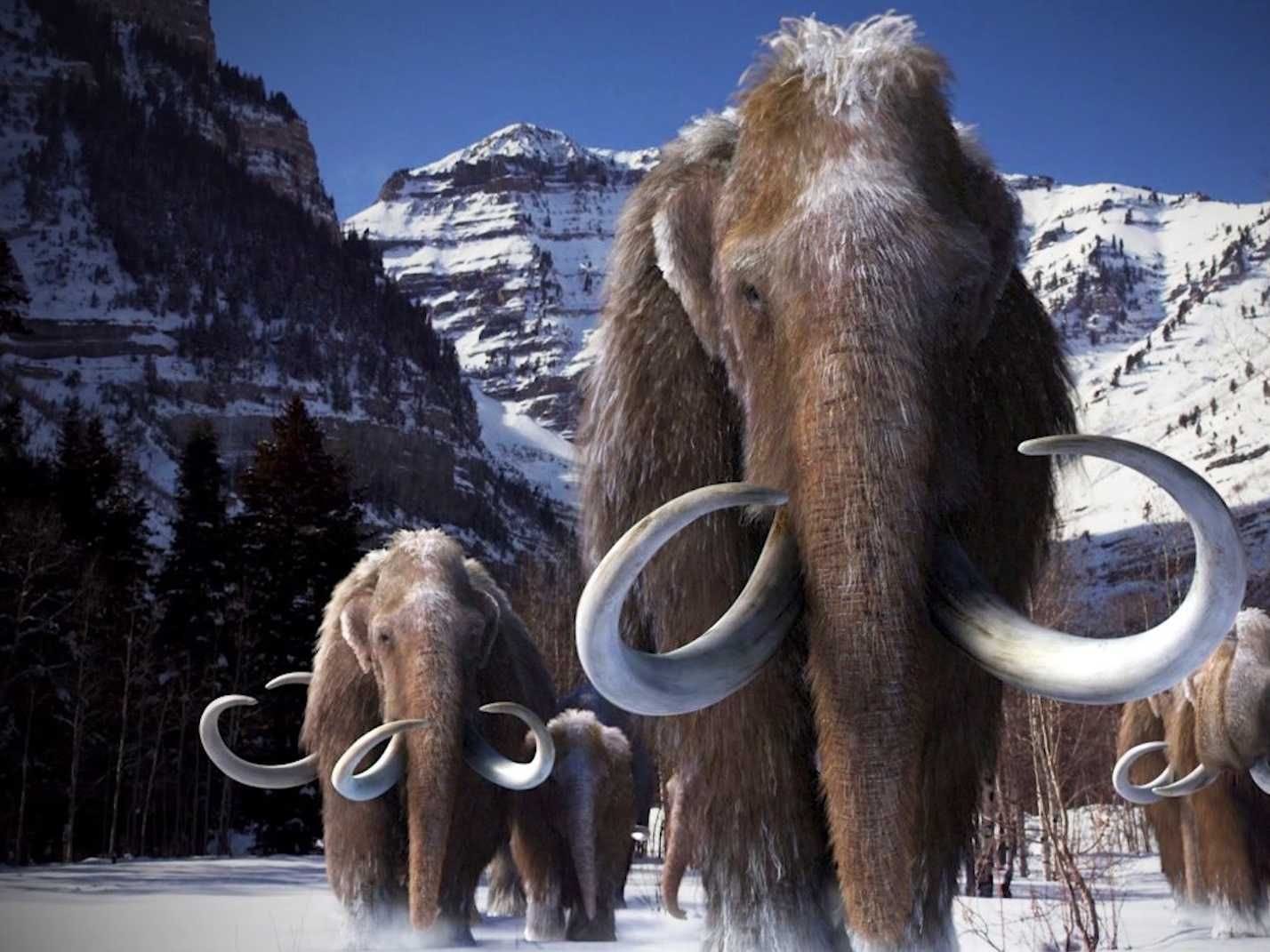
If you look at the climate graph above, you’ll see that between roughly 125,000 years ago and 20,000 years ago, things were a lot colder. I can’t help but imagine that certain tools were created in response to harsh climates, the need for greater caloric intake, and the abundance of megafauna—whose numbers diminished dramatically everywhere to which Homo sapiens migrated.
41,000 years ago, the earth lost 95 percent of its anti-UV protective magnetic layer in the Laschamp event, which was just as bad as it sounds. We’d drop like flies today from malignant melanomas. What innovations came about in response to this? When the bubonic plague bumped off almost half of Europe, it empowered the laboring classes afterward by putting them in a seller’s market. How might diseases and epidemics have affected the emergence of Homo sapiens as the only humans? We just can’t say. But one thing they knew how to do, in every case where necessary, was migrate, because they had learned to adapt to almost every environment on earth.
There’s always been a lot of things going on at once, and a hundred millennia, or even fifty millennia, or even ten millennia . . . are long trails of once’s on what for us is a vast planet. Then there are these step-changes, phase-shifts, punctuations, pivots . . . whatever you want to call them . . . disruptions that flip more gradual developments like a mean kid shaking a terrarium and setting things on a new course. (Inside all this turbulence, I reckon, there’s also some stabilizing force—call it a strange attractor or a spirit, your call—that resets things through a process of self-organization, a fractal teleology that operates at every scale in every order of Being, defying our puny pursuit of effective causation chains along Being’s visible shell.)
In all of it, what we’ve been is migrators, from the Haitians living in Montreal to the Euro-Americans living in Tokyo, to our “black-white-Mexican” grandchildren living in Stuttgart.
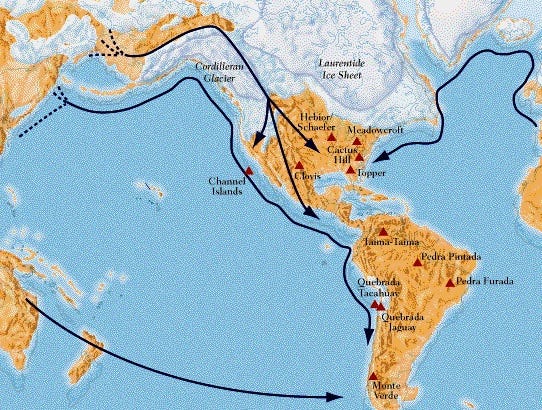
I’ll hypothesize, then, that migration itself—as much as any other factor—distilled the modern Homo sapiens, an Upper Paleolithic creole roaming across Africa and Eurasia, then leaping into Australia and the Americas.
The Paleolithic Era (stone age) is reckoned between 3.3 million-11,700 years ago. So, it’s not a genetic age, but a tool-age, everything that happened before we think people started using metallurgy. It’s followed by the Copper Age (beginning roughly around 7,500 years ago), then the Bronze Age (beginning around 4,000 BC), which is around the time a lot of people mark the end of prehistory and the beginning of history; but this is really geographically determined, because “history” corresponds with record-keeping (writing), and what we know of writing begins with different groups at different times and places. The earliest Judaic scriptures are Bronze Age writings, parts of the Pentateuch composed around 3,600 years ago.
Apart from migratory “interbreeding,” if it can be called that at all, given procreational compatibility, migration certainly entailed the exchange of language, ideas, and technology, and even accelerated it. One of the reasons the Mediterranean area, during Classical antiquity was so culturally and technologically fertile was the ease with which many groups could meet one another along five thousand miles of easily navigable coastline joining Europe, the Near and Middle East, and North Africa.
The comparatively gradual pace of migration across even the Upper Paleolithic, once Homo sapiens had blended out the Neanderthals and Denisovans probably had quite a lot to do with mundane matters like population sparsity and the fact that all these groups were still living in hunting and gathering economies.
There are a plethora of YouTube videos with nonsense titles like “This is how one ‘tribe’ conquered the world,” trying to explain the how of a process that never had a how, and where there was no “tribe,” and certainly no “conquest” involved for the same reason—because it didn’t involve any inter-generational collective intent. For that matter, trying to infer what happened over these vast spans of time from the number of actual fossil records is akin doing a US opinion poll by sampling from one to ten people in five places you select using a dartboard. The sample is too small, and the speculative void too great. (I was born in 1951, and when I became a dinosaur-obsessed kid looking at 3-D brontosaurs through my Viewmaster, everyone was convinced they were massive lizards.)
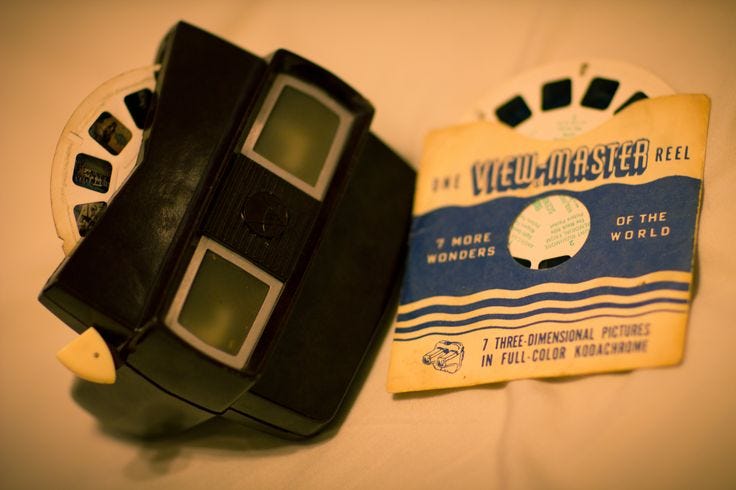
Sorry, there I go again! If you want to be educated and entertained by the complexity of it all by a YouTuber who actually knows what he’s talking about, check out Stefan Milo’s (Milosavljevich) vids. He has a funny accent (Worcester, England) and drives on the wrong side of the road, but he comes across as a very personable and humorous fellow.
Populations, population (they’re two entirely different things, btw) . . . we need to say something about that, before we ease out of the Paleolithic, but population explosions, as we see most dramatically in the capitalist epoch, are engendered by explosions in the availability of food. Food is either procured or produced, and both require tools.
What brought our species into the cognitive revolution (or leap) was almost certainly associated with the procurement and production of food and the tools thereof. You are reading this on a “tool,” and this tool has in some way “made” you over, and the tool-cognition dialectic is a transhistorical constant for human beings.
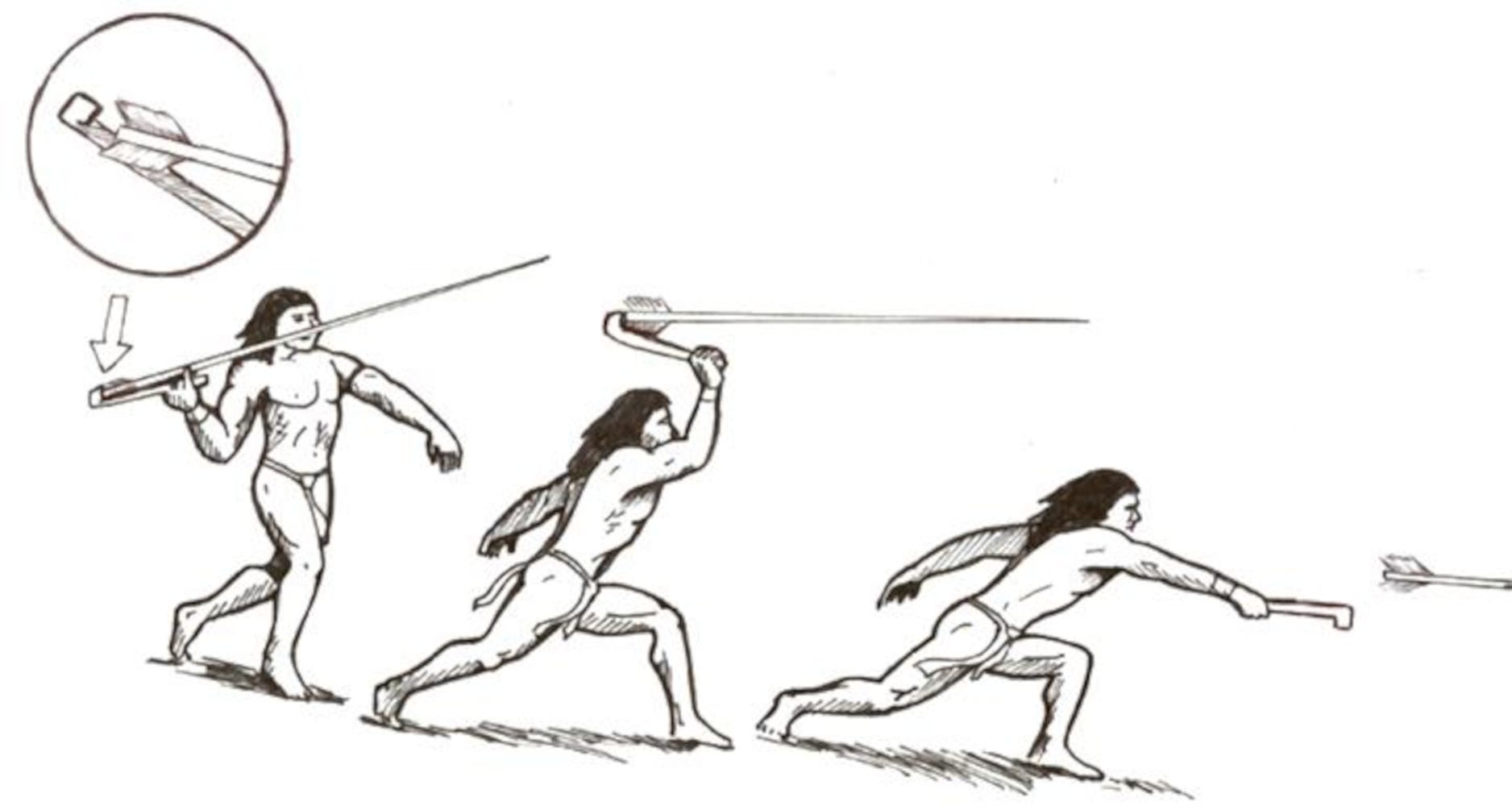
Tool-making is early physics (think of the atlatl ^^^), and these discoveries in physics are transformed by the metaphorical imagination into increasingly complex, symbolic, and abstract concepts. The cumulative process hits explosive inflection points. Miniature conceptual big bangs.
This “progress” in thinking goes exponential during the aforementioned “cognitive flowering events.” Sewing needles were a cognitive flowering event. The wheel was a cognitive flowering event. The horse collar was a cognitive flowering event. Copernican astronomy was a cognitive flowering event. Gunpowder was a cognitive flowering event (hey, they aren’t all benign). The microchip was a cognitive flowering event with an autoimmune disorder.
In the same way, migration stimulates the imagination in ways that enhance the capacity for future migrations. Other people like me, who have traveled extensively abroad and even lived abroad, among people with different languages and cultures, already know how doors fall open in one’s mind as one crosses into new environments and cultures (and I don’t mean bubble-wrapped tourists or bodyguarded colonial overseers with catering budgets).
The xenophobe and migra-phobe in all of us is supplanted by travel, and the world becomes more discernible, invitingly mysterious, and occasionally hazardous. In sum, we become smarter. Just as our prehistoric ancestors did. I can say all this—as a non-scientist—without limiting myself to bifacial flint-knapping or whatever. (Good scientists, as scientists, are always, as they should be, inductively circumspect; so, I’m not throwing shade on them . . . I admire the good ones.)
What archeologists found, which led them to name the cognitive revolution, starting with cave art, was a “sudden” specialization in tools across very large areas that required much higher degrees of complexity and craftsmanship. Now, did “brain structure” stimulate innovation, or vice-versa? Given that this level of abstraction and temporal condensation borders on the ludicrous, I’ll just say again, the granular reality at life’s actual pace always defies conceptual frameworks, and maybe we should look beyond just brain structures (which are as much effects as causes). Besides moving around a lot, humans are also excellent mimics. A useful new tool is going to spread pretty fast (because we move around a lot).
I’m not writing a book here, so I’ll just jump forward fairly quickly through a few thousand years where human population was still fairly sparse, a couple million or so, to when some of us shifted into cultivation. (Whew! That Ice Age was an ass-kicker.)
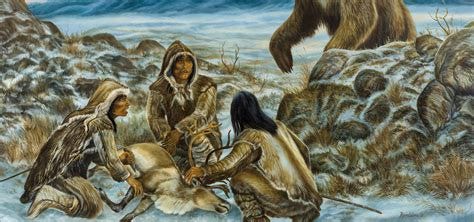
Speculation is—and it seems reasonable—that with the withdrawal of the ice, (1) cultivation became a more winning proposition, and (2) with cultivation came settlements, and (3) with settlements came raids, and (4) with raids emerged the first glimmerings of organized warfare (as opposed to merely skirmishing), and (5) with organized warfare arrived new and stricter forms of hierarchy, and (6) a division of labor eventually materialized between fighters and cultivators, then rulers and various servant classes . . . you see where it goes . . . we’re just filling in the spaces between prehistory and history, where warfare had become a way of life, and with it consolidations of political power that allowed and-or enforced mass cultivation (and population explosions), necessitating administration, necessitating written records . . . Presto! History!
Interjecting here, one of my own pet theories about the subordination of women in social hierarchies—and I don’t mean by that mere divisions of labor (which can be “natural”), though that plays a role, but the loss of social esteem and a place at the decision-making table—became far more pronounced with the development of organized warfare (something about which I wrote a whole book).
The sum of all this at some point was “civilization,” which doesn’t mean being nice to one another. In fact, civilization was a horrifyingly savage process everywhere it popped up, from Sumeria, to the Olmec, to China. It was predicated, in many cases, by warfare. To civilize means to urbanize. Civitas means city.
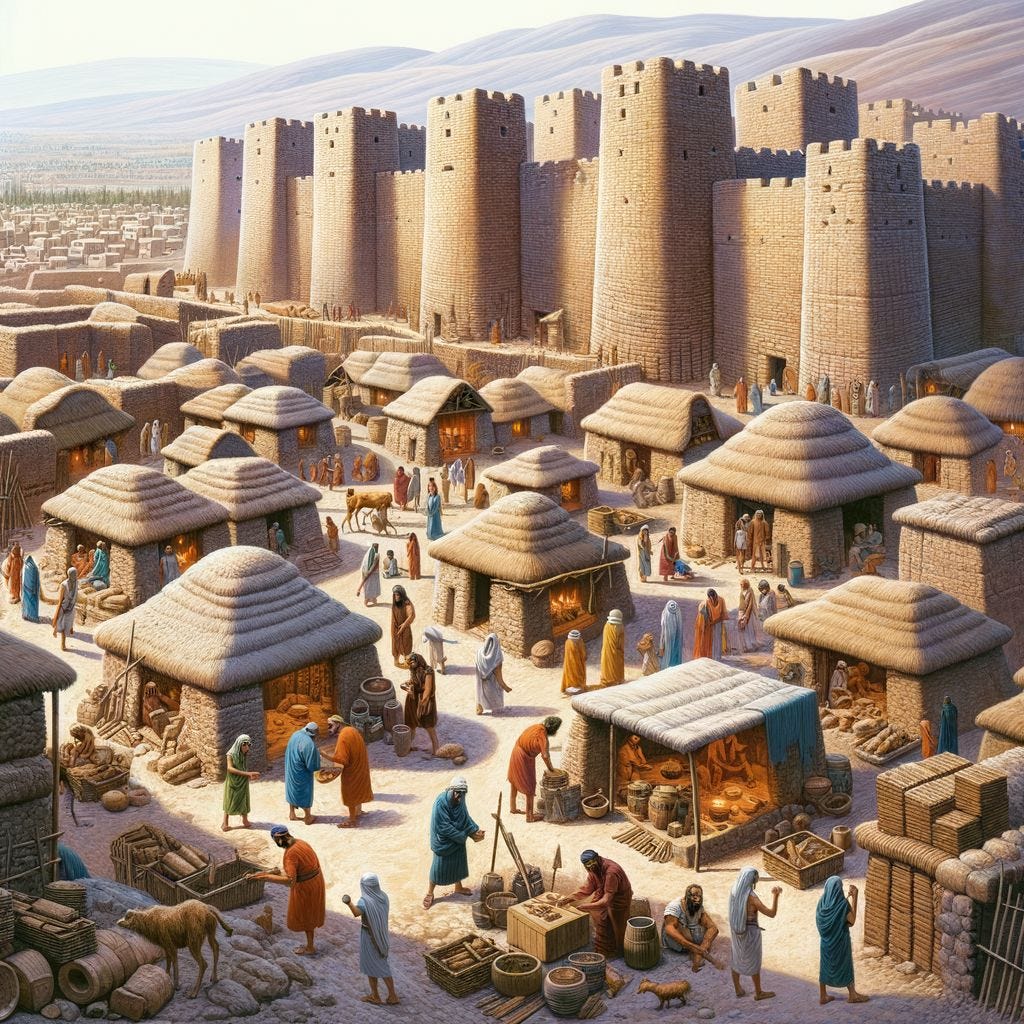
Artist’s rendition of ancient Jericho
The top dogs in these new urban schemes were confronted by a new temptation—one that went beyond the mere desire for esteem in one’s little group: power. Warfare generates an arms race in arms, but it also generates an arms race in architecture, trade, divisions of labor, and logistical technology (the internet is a military technology).
All in all, this stuff changed the incentives and patterns of human migration. We should point point out that everywhere didn’t civilize at once, but that war civilizations are by their nature expansionist, so what they don’t conquer—because conquest is a self-limiting enterprise—they alter.
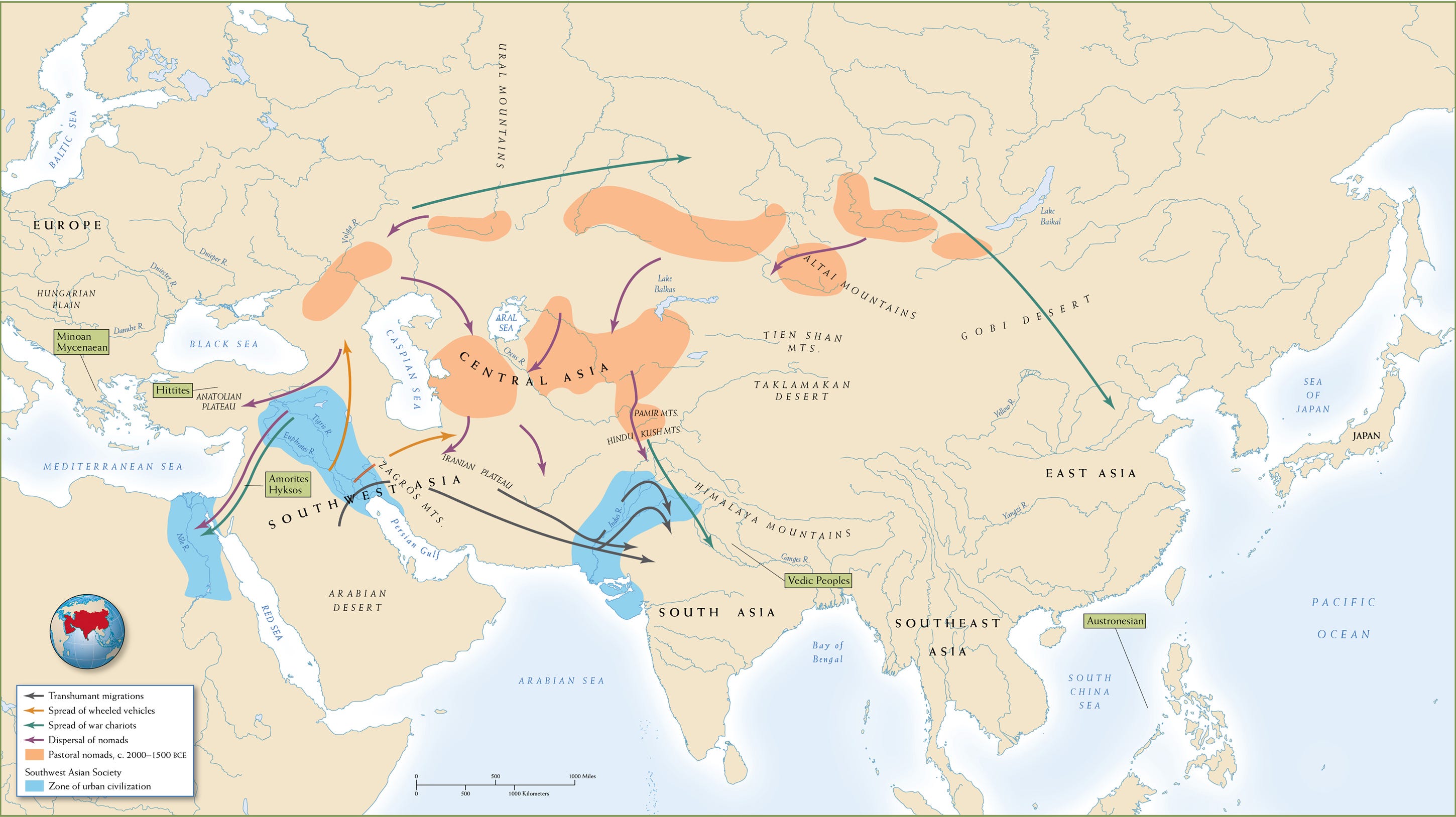
By around 2000 BC. the world was a stew pot of hunter-gatherers, cities, farms, villages, environmental shifts, nomads, traders, micro-societies, seasonal migration cultures, and new territorial states. (Any of today’s racial-paranoia types would have swooned in shock at the extent of “race-mixing.”)

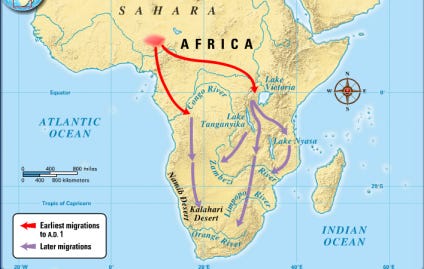
There were Indo-European-Mediterranean migrations—many provoked by environmental catastrophes—African migrations, East Asian migrations, Austronesian migrations, American migrations, where do you want to start?
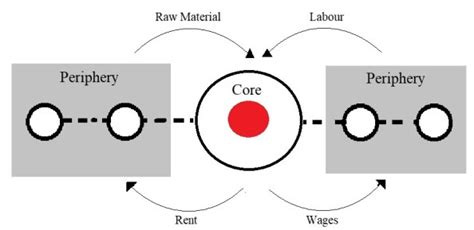
Shifting gears now (technological metaphor), ever since Wallerstein, we’ve had a name for a universal civilizational phenomenon: the core-periphery dynamic. Urban/political/imperial cores require constant inputs, or feedstocks, from rural or politically subjugated or colonial peripheries. It’s driven by the desire for power, of course, but that’s an internal phenomenon, so to speak. The dual driver for this dynamic is competition (especially in war preparation) and ecological exhaustions. Again, there is a panalectic. More resources require more people on more land necessitating more food production. More people, more food production, more resource extraction, and technological development stress the environment, necessitating expansion, which entails both defensive and offensive warfare, which lead to “arms races” for better weapons, greater speed of transport, more roads, etc. etc. etc., exhausting more ecologies, and on it goes.
Eventually, this led to the development of empires: Akkadian (c.2334 BC – c.2154 BC), Assyrian (c.2025 BC – c.605 BC), Babylonian (c.1894 BC – c.1595 BC), Hittite (c.1600 BC – 1178 BC), Egyptian, Elamite, Zhou, Roman, Han . . . you get the picture, there were more than 150 of them across every continent except Antarctica, all the way to the current US empire which displaced the European empires in the twentieth century. What you’ll also notice is that every one except the current one had an expiration date (this one will, too). The panalectic gives, and the panalectic takes away. The Roman empire lasted almost 1,500 years. The First Mexican empire lasted two.

Since the beginning of these entropic monstrosities, the fact of empires (or the core-periphery dynamic) remains, even though the imperial mantle changes hands.
The Mediterranean Bronze Age collapsed between c. 1250 - c. 1150 BC, and the panalectic involved the development of iron metallurgy (putting more weapons in the hands of more people than bronze could, and arming insurrections), several devastating earthquakes, a climate catastrophe, and a series of invasions by a naval pirate confederacy called the Sea Peoples. This was called a “dark age,” because written records disappears en masse, as rulers and their retainer classes were put to the sword by insurrectionists in a kind of early reign of terror. This de-urbanization was abrupt and brutal, and probably put a lot of urban specialists, artisans, and craftsmen on the road to ply their trades nomadically. But it was only a matter or time before the newly anointed warlords and chieftains were winnowed down to a few of the luckiest and most effective, who would finally re-consolidate as the “iron empires.” So it goes.
Migration—once provoked by curiosity, seasons, local catastrophe, and food scarcity—was more and more prompted by agricultural crises and war.
This was worldwide, but we can just look at Europe as one example, where, by the fourth century, migration and the fusion (creolization) of cultures as the last of the Roman empire faded, was on fast-forward.
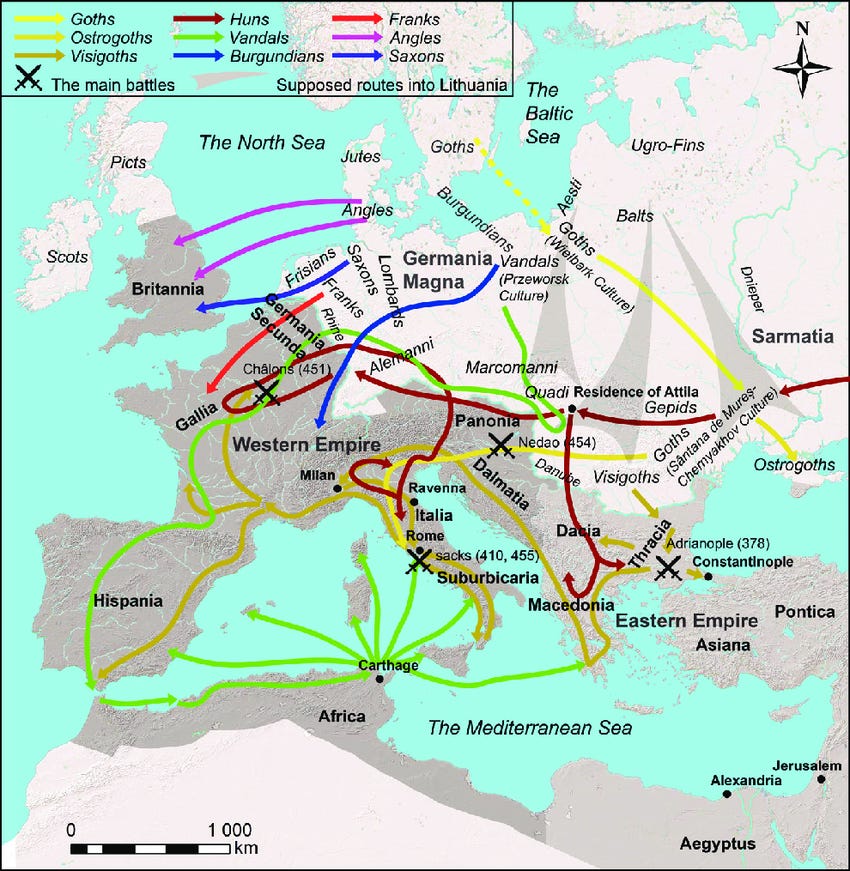
Not to leave other cultures behind, just look at how many languages are spoken today in China.
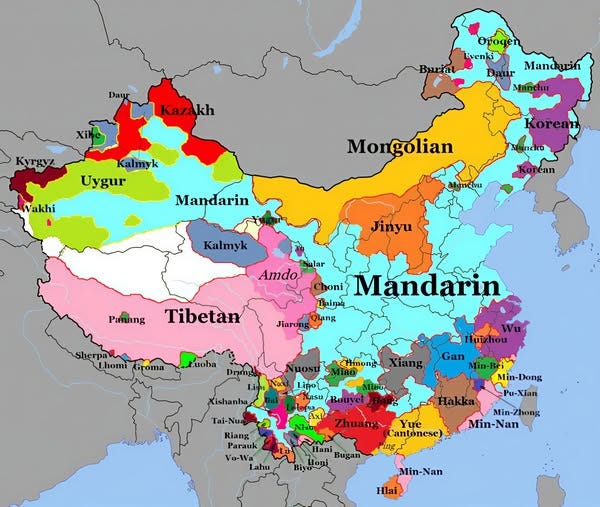
The very idea of “racial” or ethnic purity is, in fact, contrary to our nature, history, and prehistory.
Let me start to wind this up.
This essay is a Matisse, not a Courbet, not that I’m in a league with either, so I’m just placing conceptual markers out there. The next marker is the fossil-energy machine.
Seventeenth-century Britain suffered what one of my mentors called an “iron famine,” which was accompanied by massive deforestation. The production of cannon and ships exhausted Britain’s forests, which were used as fuel for the smelters, forgers, iron mongers, and blacksmiths. Jason C. Moore wrote:
[T]he shortage of shipbuilding timber was first noticed during the wars against the French in the 1620s and the shortage became acute in the 1650s, particularly for specialized requirements such as masts. a first-rate, 120-gun ship needed a main mast forty meters long and over a meter in diameter. Until the mid-seventeenth century the navy could rely on the oak forests of England, especially those of Sussex. In the late seventeenth century, the admiralty belatedly introduced officially sponsored replanting schemes even though it would take a century before the trees could be used. In the meantime timber would be imported.
Imported meant taking them from weaker people to the east, as far as Poland. The fuel crisis (including fuel for critical iron smelting) forced a new reliance on coal, but the mine pits were often filled with water. So, studying some old Greek ideas for machines that never found a use, the Brits designed a steam pump that would drain the pits. It wasn’t long after—here’s another cognitive flowering—that these heat-powered machines were combined with the now-available and abundant stocks of coal to make . . . well, every damn thing. Actual human and animal slaves could be replaced now by energy-slaves: machines. The industrial revolution was on. By 1804, Blake was decrying England’s “dark Satanic mills.”
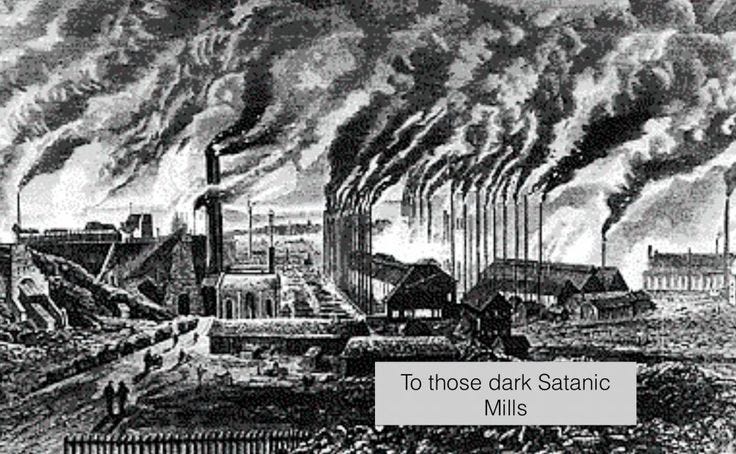
What might we say now about the microchip?
The panalectic combines new ideas and practices with new dependencies. All the while, the need to move remains. Settlement is always temporary, at least it has been so far. Sometimes a generation, sometimes a century or two, a few even longer . . . but everything that can’t last won’t.
We now live in a world run by fossil hydrocarbons, hyper-informed and hyper-surveilled (and hyper-atomized) by the microchip. We’re also still at war. We’ve come to depend on both the energy slaves and the information Autobahn, but these, too, have expiration dates. What fossil hydrocarbons have done to the biosphere has introduced a new danger, as great as that of nuclear war (that most horrifying of phase-shifts), but one that creeps up on us like a cosmic super-predator in our dependency, our denial, and our political paralysis.
The wars are moving people, as the information Autobahn gives us access to a tremendous quantity of information, about which we are powerless, aiming us at despair. But the real migratory impetus, now and in the future, is going to be the sub-panalectic with the anodyne name: climate change.
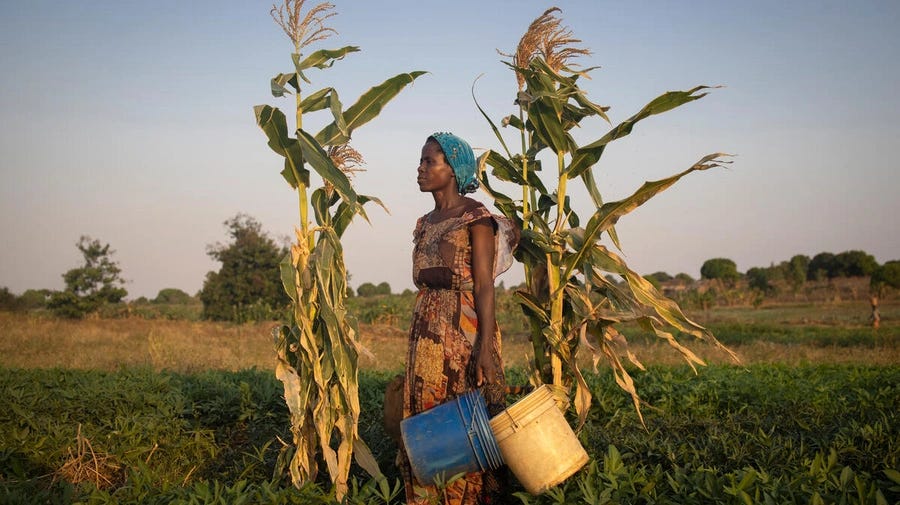
Conservative estimates are that within twenty years, a billion of us will become climate refugees. This is a problem for which the modern nation-state, at least in its current configurations, is inherently unequipped. The smoke outside my Michigan house right now comes from Canadian wildfires. Climate change respects no borders. And even if we stopped using fossil fuels today—an impossibility at this point—the knock-on effects would exacerbate our general condition for the next fifty to a hundred years . . . if not permanently (we still don’t know the methane tipping point).
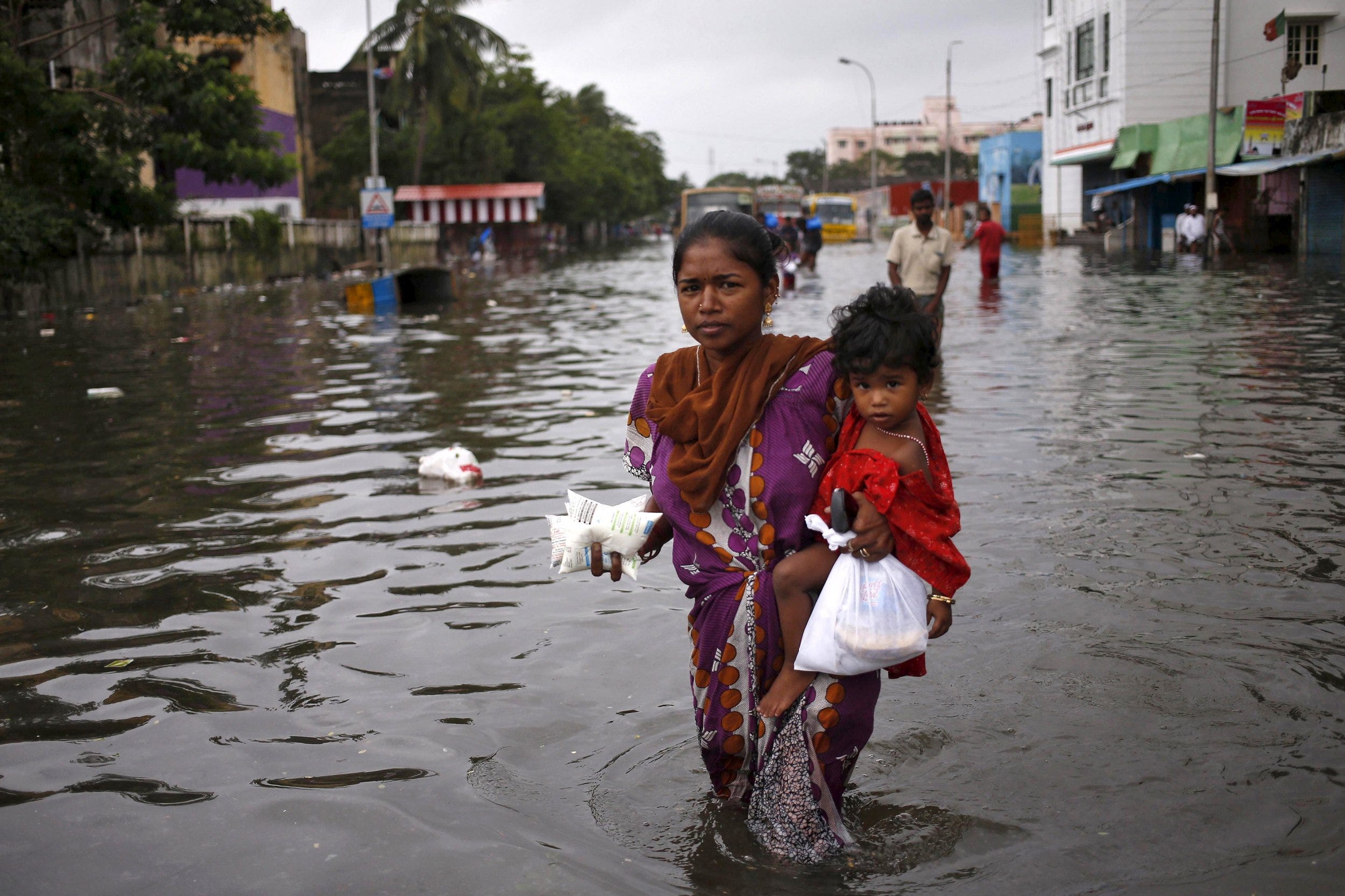
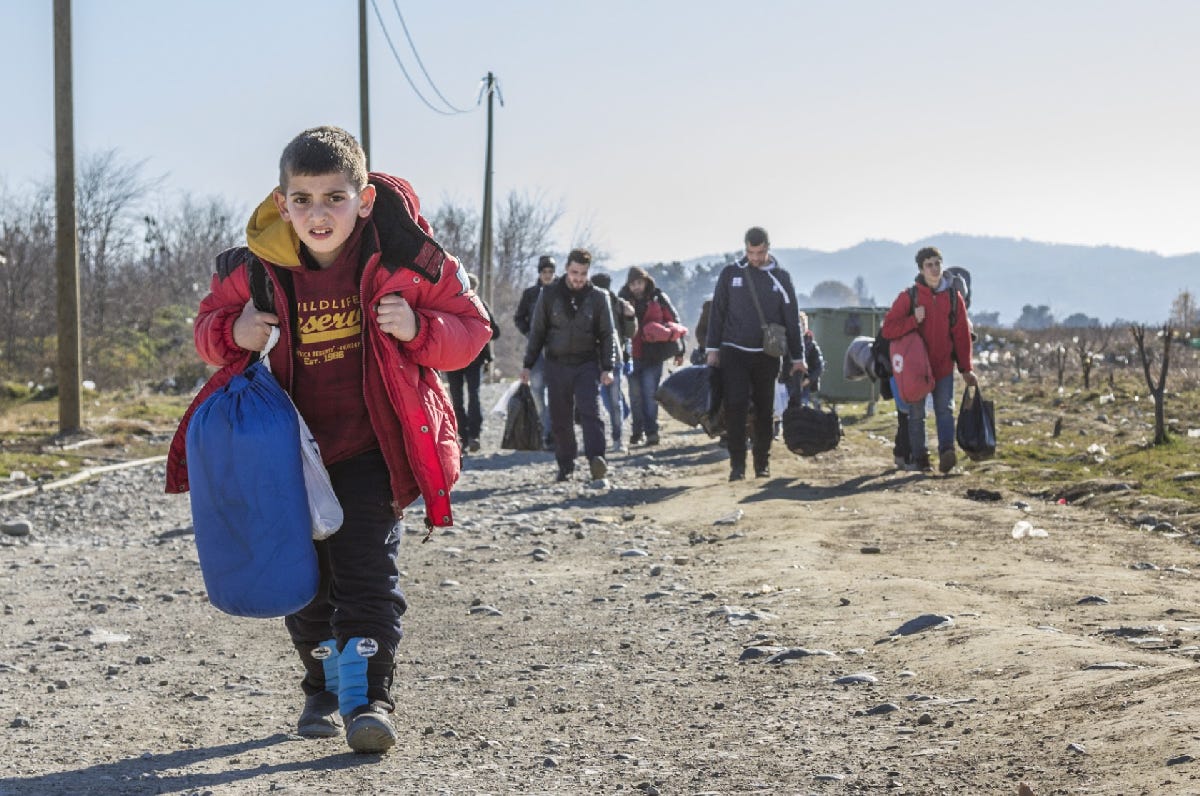

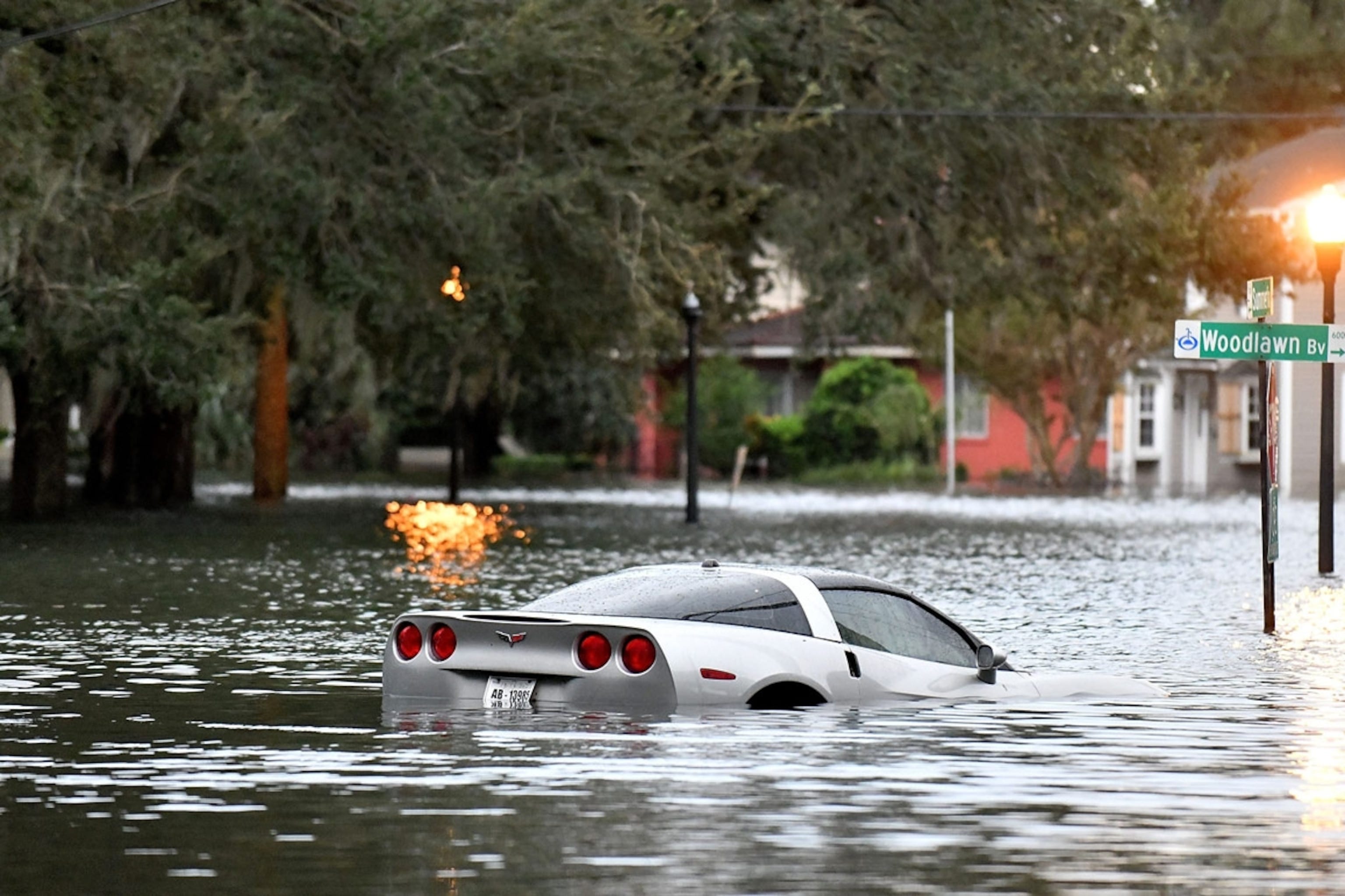
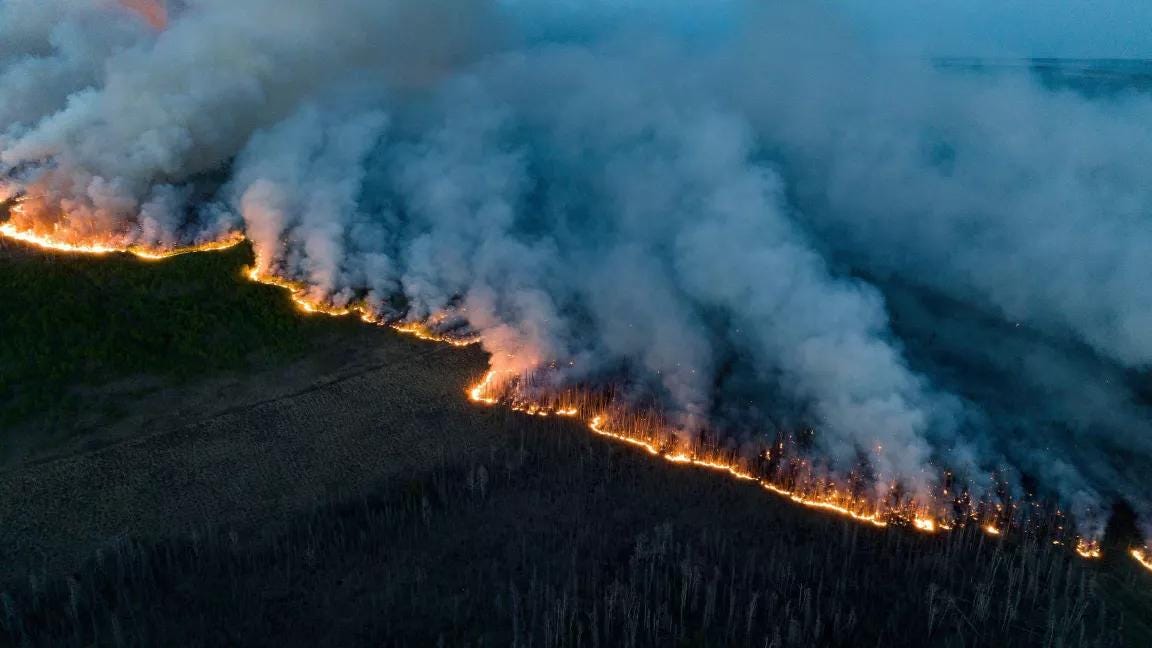
Many of the refugees from south of the US who are knocking at our door are climate refugees. Up to 30 million will be displaced from the south in just two and a half decades. Already, there are 3.2 million Americans who’ve been displaced by climate catastrophes of the threat thereof. This year, 50 nations will experience temperatures over 125 degrees F. By mid-century, 13 US states will be part of an “extreme heat belt,” where 125 will be a regular occurrence. That’s over 100 million people (and a good deal of our crops).
The current Federal administration is right now trying to suppress and eliminate alternative energy programs and ramp up fossil fuel use. This is the administration who has declared war on immigrants.
I said I wouldn’t go political . . . but I just . . .
. . . time to stop.
Peace.
Excellent! Great read brother.
Lucy was found in Ethiopia which is thousands of miles from South Africa