
Subsistence & death
according to Ivan Illich


I’m in the habit of saying, when asked how I’d categorize my political orientation, of saying I’m a “subsistence socialist.” The term is partly to avoid ad hoc political discussions, and it works well. Once I’ve said that, many people respond as if I’d said “Scientology”and change the subject. They imagine that I imagine . . . oh, something vaguely Medieval, The Shire for full-sized humans, which strikes them as fanciful (because it is pretty fanciful). Then they project their own imaginations into what they imagine I’ve imagined, and see something quite scary: filthy, hardscrabble people eking out their livings in the mud under perpetually gray skies. A lot of the things we believe are imaginings of imaginations coupled with projected imaginings, which accounts for around 80 percent of Substack content—kind of the chaff that comes with the grain in the other 20 percent. Nature of the wheat . . . so to speak. Still makes the bread though.
I’m actually using the term subsistence in a different sense than one might reflexively imagine. I’m using it in the sense that Ivan Illich used it. He was a Croation, raised in Austria during the war, who became a priest in Rome, then migrated to New York, where he settled in with the Puerto Ricans, then moved to Puerto Rico, and finally ended up living just outside Cuernavaca, in the State of Morelos, Mexico. All to say, he was a kind of creolized cosmopolitan personality, who spoke Italian, Spanish, French, German, Croatian, Ancient Greek, Latin, Portuguese, Hindi, and English, and so the way he used certain words is easy for the rest of us to confuse, because we project our own first impressions of those words onto them from an entirely different perspective.
Illich’s work can be divided between what I call his “political” period and his “reflective” period, with the dividing point at the 1982 publication of Gender, the point at which the progressives and anarchists who’d once claimed him, now joined by a chorus of Promethean feminists, publicly denounced him—in today’s terms, cancelled him—and sent him into public exile. Those denunciations—and I’ve read most of them—were more viral than political; because they were based on imaginings of imaginings . . . that is to say, they missed the point almost entirely. This problem wasn’t helped along by the fact that Illich himself made irascible throwaway comments in the text that were easily picked up and misconstrued. The previous publication—Shadow Work—was a kind of preface to Gender, and it was a jeremiad against “sexism,” seen again from that atypical Illichian standpoint.
Illich was declared unclean, and all the work he had done to date was similarly declared unclean. He was forgotten. Being unclean in Left World (cancel-culture contagion narratives have been around for a good long while), it was dangerous even to say his name, much less promote or discuss all his prior publications. And so much of his very best work was buried with his reputation until it made a gradual comeback beginning when Giorgio Agamben in 2013 said—five years after our financial Titans had plunged the world into an economic crisis—“[P]erhaps only today the work of Ivan Illich is getting to know what Walter Benjamin called ‘the hour of legibility.’”
It was from that exile between 1982 and Illich’s death in 2002, now freed from a public career which had nearly exhausted him, that he wrote some of his most historically, philosophically, and theologically penetrating works. In those works, if there is one thread that runs through them all, it’s alienation.
Conversant in Marx, while never a Marxist, Illich acknowledged the Marxian account of alienation, but described a far deeper form of alienation that transcended class struggle, one that was enclosing the whole world—capitalist and socialist, bourgeois and proletarian, right and left, theist and atheist, West and East and South—one where everything once thought to have the capacity to redeem us had undergone a dark alchemy to become body-snatching monstrosities.
To hell with the future. It’s a man-eating idol.
—Illich
He described the geopolitical process than surrounded the emergence of this “Moloch”—an ancient demon who demanded human sacrifices—as a “war on subsistence,” what modern experts called “development.”
I’m going to lean on Shadow Work in this piece, because it’s where Illich begins to organize these thoughts most systematically, prior to his “reflective” phase; and Shadow Work anticipates Gender, which is why Shadow Work fell into obscurity with Illich’s “cancellation.” Shadow Work, when I first read it around 2005-6, after a decade-long immersion in feminist scholarship, echoed much of what I’d been reading from “Marxist,” “materialist,” and “eco” feminists. These categories are a wee bit arbitrary, but they manifested in a tight Venn overlap between, say, Nancy C.M. Hartsock, Vandana Shiva, Maria Mies, Silvia Federici, Carole Pateman, and Carolyn Merchant. Illich speaks, like Hartsock, of the Marxian distinction between productive and reproductive labor; like Shiva on the destruction of vernacular culture; like Mies on “housewifization”; like Federici on enclosure of the commons; like Pateman on the division of life between public and private spheres; and like Merchant on objectification and the “death of nature.” He cites feminist historians lavishly—many who are Continental and haven’t yet been translated for an English reading audience. He consulted heavily with Barbara Duden, a German feminist scholar (whose home he died at in 2002), on the composition of Shadow Work.
Illich uses one other Marxian idea in Shadow Work: the distinction between use-value (Illich calls it “utilization value,” which is annoying) and exchange-value, one that Marx drew himself from Aristotle. He was likewise influenced by Karl Polanyi—whose signature work The Great Transformation was overshadowed by its publication in 1944 just as the war was coming to an end.
The other Illichian definition one needs in preparation for Shadow Work, and its thesis about “the 500 year war on subsistence” called “modernity,” is the vernacular.
From Karl Polanyi I take the idea that modern history can be understood as the ‘disembedding’ of a market economy. However, I do not analyze this uniquely modern, disembedded economy from the perspective in which the concepts of formal economics can be meaningfully applied to it. Rather, I am interested in its shadowy underside. I want to describe those of its features which escape both the categories of formal economics, and those which anthropology finds applicable in the study of subsistence cultures. Looking at early nineteenth century history, I find that with the progress of monetization a non-monetized and complementary hemisphere comes into existence. And both these hemispheres are equally, however differently, foreign to what prevails in pre-industrial societies. Both degrade the utilization value of the environment; both destroy subsistence.
With the rise of this shadow economy I observe the appearance of a kind of toil which is not rewarded by wages, and yet contributes nothing to the household’s independence from the market. In fact, this new kind of activity, for which the shadow work of the housewife in her new non-subsistent domestic sphere, one prime example is a necessary condition for the family wage earner to exist. Thus shadow work, which is as recent a phenomenon as modern wage labor, might be even more fundamental than the latter for the continued existence of a commodity-intensive society. Its distinction from the vernacular activities typical for subsistence-oriented popular cultures is the most difficult and the most rewarding part of my research.
My study is not motivated by mere curiosity. I am moved by concern over a trend which manifested itself during the seventies. During this time professional, economic and political interests converged on an intense expansion of the shadow economy. As ten years ago Ford, Fiat and Volkswagen financed the Club of Rome to prophecy limits to growth, so they now urge the need for self-help. I consider the indiscriminate propagation of self-help to be morally unacceptable.
What is here propagated as self-help is the opposite of autonomous or vernacular life. The self-help the new economists preach divides the subject of social policy (be it a person or entity) into two halves: one that stands in a professionally defined need, and the other who is professionally licenced to provide it. Under the policies that are thus labelled as self-help, the apartheid of production and consumption, characteristic of industrial economics, is projected into the subject itself. Each one is turned into a production unit for internal consumption, and the utility derived from this masturbation is then added to a newfangled GNP. Unless we clarify the distinction between this self-help and what I shall call vernacular life, the shadow economy will become the main growth sector during the current stagflation, the ‘informal’ sector will become the main colony which sustains a last flurry of growth. And, unless the apostles of new life styles, of decentralization and alternative technology and conscientization and liberation make this distinction explicit and practical, they will only add some color, sweetener and the taste of stagnant ideals to an irresistibly spreading shadow economy. (Shadow Work, Introduction)
Note the almost equal-sign he puts between vernacular and autonomous. We might call this local if we qualify that the local in a fully enclosed society—like ours—is already conformed to a monopolistic market-version of locality. Local, prior to enclosure. Local production, local dialects, local customs, local foods, local geography, local metaphysical priors. You may not see any ti lwa around your place—Yoruba and Fon spirits who crossed the Atlantic with the slaves, and who have a lot of interpersonal drama between them—but the Massifs (mountain ranges) of Haiti are crawling with them. You can attend feasts where they’ll drink and dance with you. The price of admission is some liquor, rum if you can afford it, for which these spirits have developed a real taste.
In economic terms, subsistence is autonomous precisely to the degree that it hasn’t been enclosed by commodities and the “needs” they create for themselves. Not to harp on Haiti—it’s just somewhere I spent a lot of time—I knew an houngan (vodou priest) in Fort-Liberté (in Kreyol, Fòlibète), Haiti—Michel—and we were shooting the shit out behind his little house on the salt marsh. We were discussing poverty, and we came to agree there were two kinds. In the cities, people were poor without food. That’s why there was so much crime, as well as tremendous competition for whatever shitty jobs were available. Factory work, becoming the gran mange’s servants, and so forth. In the countryside—including ti vils like Fòlibète—a lot more people were poor with food. Michel stated that he himself was poor with food.
Every nearby peasant grew enough banan, casava, yam, legum, fwi, and pwa to get by and have some to trade. Their houses were made of light wood and mud with thatched roofs—all materials nearby and available. Most kept a few chickens, maybe some goats, and a couple of pigs—who are garbage disposals, bank accounts, and, on one fateful day, food (perhaps at a gede, one of those ceremonial feasts where you can dance with spirits). They needed a little money, which they could get here and there, doing little jobs or selling some produce. Money just to buy some rice, some chabon with lighter-knot for cooking fires, and cheap soap (which, in a pinch, they could make at home from wood-ash and pig fat). They washed dishes with lime juice—limes were everywhere. The price of “social reproduction” in Marxian terms, was low, because they didn’t depend on electricity, central sewage systems, gas, and so forth.
Then again, Haiti—which I’m not proposing as a model—is living between a little autonomy for the remaining few and enclosure for the rest. Most of its residents in the cities are living in squalid misery. Haiti is a disposable periphery, locked into a world system that’s already been enclosed; though it retains—along with its unique language and beliefs—strong elements of the vernacular, which even the leftists I knew there wanted to “overcome” with “development.” Vernacular Kreyol and vodou and musik paisan could be used as mere cultural artifacts employed in the service of some imaginary revolutionary nationalism. One of my old comrades’ model was China, for fuck sake.
Illich—I’ve said he used words in atypical ways—didn’t mean by subsistence that everyone would return to some pre-industrial state where we barely scrape by (this wasn’t always the case then either). More than once, he reminded people that this was not what he was saying, and that it’s an impossible idea in any case. Nonetheless, his most hostile critics have continued to straw man his arguments about this by ignoring his disclaimers about subsistence, and about the things he wrote that were critical of the institutions of medicine, education, and technology.
One of his interlocutors—Maria Mies—came close to Illich on the question of subsistence, in her brief essay, “The Subsistence Perspective.”
I have to say that we are not talking specifically about subsistence economy. When I say “we,” I am referring to my two friends Claudia von Werlhof and Veronika Bennholdt-Thomsen, with whom I developed this approach in the mid-1970s. We aren’t speaking of a subsistence economy, but of a subsistence perspective. That is to say, it’s not an economic model, but rather, a new orientation, a new way of looking at the economy. That means something entirely different. It doesn’t just apply to the economy, but also to society, culture, history, and all other possible areas. The second thing is that a lot of people ask: What do you mean by subsistence? I usually say: For us, subsistence is the opposite of commodity production. Commodity production is the goal of capitalist production, in other words, a general production of goods, everything that there is, has to be transformed into a commodity. It is possible to observe that today, especially in the course of globalization. Subsistence production has an entirely different goal, namely, the direct satisfaction of human needs. This isn’t accomplished through money and the production of goods. For us, quite essential is that it is a direct production and reproduction of life. That’s why we talk of “life production” rather than “commodity production”. (Mies)
Illich—who rejected the Marxian template of production-reproduction (see below)—tried to situate his thought on the matter using three axes, or “the three dimensions of public choice.”
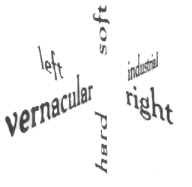
Ten years ago [written in 1981, so 1971], we tended to distinguish social options exercised within the political sphere from technical options assigned to the expert. The former were meant to focus on goals, the latter more on means. Roughly, options about the desirable society were ranged on a spectrum that ran from right to left: here, capitalist, over there, social ‘development’. The how was left to the experts. This one-dimensional model of politics is now passé. Today, in addition to ‘who gets what’, two new areas of choice have become lay issues: the very legitimacy of lay judgment on the apt means for production, and the trade-offs between growth and freedom. As a result, three independent classes of options appear as three mutually perpendicular axes of public choice. On the x-axis I place the issues related to social hierarchy, political authority, ownership of the means of production and allocation of resources that are usually designated by the terms ‘right’ and ‘left’. On the y-axis, I place the technical choices between ‘hard’ and ‘soft’, extending these terms far beyond a pro and con atomic power: not only goods, but also services are affected by the hard and soft alternatives.
A third choice falls on the z-axis. Neither privilege nor technique, but rather the nature of human satisfaction is at issue. To characterize the two extremes, I shall use terms defined by Erich Fromm. At the bottom, I place a social organization that fits the seeking of satisfaction in having; at the top, in doing. At the bottom, therefore, I place a commodity-intensive society where needs are increasingly defined in terms of packaged goods and services designed and prescribed by professionals, and produced under their control. This social ideal corresponds to the image of a humanity composed of individuals, each driven by considerations of marginal utility, the image that has developed from Mandeville via Smith and Marx to Keynes, and that Louis Dumont calls homo economicus. At the opposite end, at the top of the z-axis, I place—in a fan-shaped array—a great variety of societies where existence is organized around subsistence activities, each community choosing its unique life style tempered by skepticism about the claims of growth. On this z-axis of choice I do not oppose growth-oriented societies to others in which traditional subsistence is structured by immemorial cultural transmission of patterns. Such a choice does not exist. Aspirations of this kind would be sentimental and destructive. I oppose to the societies in the service of economic growth which I place at the bottom of the z-axis those which put high value on the replacement of both production and consumption by the subsistence-oriented utilization of common environments. I thus oppose societies organized in view of homo economicus societies which have recovered the traditional assumptions about homo artifix, subsistens. (Shadow Work: “The Three Dimensions of Public Choice”)
“Shadow work”—in case one might be wondering by now—is what Illich called the unpaid work, unaccounted for by economists, that was necessary to sustain a “developed” commodity-regime based on wage labor. This unpaid labor is in the shadow of the money-world seen by economists. When he wrote it, most of that shadow work was done by women (still is). In vernacular societies, women and men had different work, but both recognizably contributed to household production. In commodity-regimes, women were transformed into something entirely new: housewives—little economic peripheries at the level of family, adding un-remunerated value to wages and commodities (non-household production).
We have seen that wherever wage labor expands, its shadow, industrial serfdom, also grows. Wage labor, as the dominant form of production, and housework, as the ideal type of its unpaid complement, are both forms of activity without precedent in history or anthropology. They thrive only where the absolute and, later, the industrial state destroyed the social conditions for subsistence living. They spread as small-scale, diversified, vernacular communities have been made sociologically and legally impossible – into a world where individuals, throughout their lives, live only through dependence on education, health services, transportation and other packages provided through the multiple mechanical feeders of industrial institutions.
Conventional economic analysis has focused on only one of these complementary industrial age activities. Economic analysis has focused on the worker as wage earning producer. The equally commodity-oriented activities performed by the unemployed have remained in the shadow of the economic search-light. What women or children do, what occupies men after ‘working hours’, is belittled in a cavalier fashion. But this is changing rapidly. Both the weight and the nature of the contribution made by unpaid activities to the industrial system begin to be noticed. Feminist research into the history and anthropology of work has made it impossible to ignore the fact that work in an industrial society is sex-specific in a manner which cuts deeper than in any other known society. In the nineteenth century, women entered the wage labor force in the ‘advanced’ nations; they then won the franchise, non-restricted access to schooling, equal rights on the job. All these ‘victories’ have had precisely the opposite effect from that which conventional wisdom assigns them. Paradoxically, ‘emancipation’ has heightened the contrast between paid and unpaid work; it has severed all connections between unpaid work and subsistence. Thus, it has redefined the structure of unpaid work so that this latter becomes a new kind of serfdom inevitably borne by women.
Gender-specific tasks are not new; all known societies assign sex-specific work roles. For example, hay may be cut by men, raked by women, gathered by men, loaded by women, carted away by men, fed to cows by women and to horses by men. But no matter how much we search other cultures, we cannot find the contemporary division between two forms of work, one paid and the other unpaid, one credited as productive and the other concerned with reproduction and consumption, one considered heavy and the other light, one demanding special qualifications and the other not, one given high social prestige and the other relegated to ‘private’ matters. Both are equally fundamental in the industrial mode of production. They differ in that the surplus from paid work is taxed directly by the employer, while the added value of unpaid work reaches him only via wage work. Nowhere can we find this economic division of the sexes through which surplus is created and expropriated. (Ibid.)
Illich likewise spotted a modern counterfeit for autonomy: self-help. In this he was prescient perhaps beyond his own prescience.
A lot of people—projecting their own ideas onto Illich—thought Illich was some kind of self-help/DIY guru. (I’m working on a book chapter now about some of the ways in which Illich has been—intentionally and not—misappropriated by both the left and the right, but the right in particular.) We see Illich’s reference to self-help in the first extended quote above.
Neither Illich nor this author are against, for example do-it-yourself tasks and projects. DIY can potentially be liberatory; but the context matters. On the one hand, there are the satisfactions of mastery (I made the desk I work on from wood salvaged off of forklift pallets ← good hardwood, that).

On another hand, it’s an economic workaround, what De Certeau called bricolage, or making-do, “poaching,” which has its own piratically-gratifying, fuck-you sense of autonomy.
On the third hand, it’s a form of shadow work—“the apartheid of production and consumption, characteristic of industrial economics, is projected into the subject itself.” Anyone up to become an Uber driver?
WHERE the war against subsistence has led can best be seen in the mirror of so-called development. During the 1960’s, ‘development’ acquired a status that ranked with ‘freedom’ and ‘equality’. Other peoples’ development became the rich man’s duty and burden. Development was described as a building program – people of all colors spoke of ‘nation-building’ and did so without blushing. The immediate goal of this social engineering was the installation of a balanced set of equipment in a society not yet so instrumented: the building of more schools, more modern hospitals, more extensive highways, new factories, power grids, together with the creation of a population trained to staff and need them.
Today, the moral imperative of ten years ago appears naive; today, few critical thinkers would take such an instrumentalist view of the desirable society. Two reasons have changed many minds: first, undesired externalities exceed benefits – the tax burden of schools and hospitals is more than any economy can support; the ghost towns produced by highways impoverish the urban and rural landscape. Plastic buckets from Saõ Paulo are lighter and cheaper than those made of scrap by the local tinsmith in Western Brazil. But first cheap plastic puts the tinsmith out of existence, and then the fumes of plastic leave a special trace on the environment – a new kind of ghost. The destruction of age-old competence as well as these poisons are inevitable byproducts and will resist all exorcisms for a long time. Cemeteries for industrial waste simply cost too much, more than the buckets are worth. In economic jargon, the ‘external costs’ exceed not only the profit made from plastic bucket production, but also the very salaries paid in the manufacturing process.
These rising externalities, however, are only one side of the bill which development has exacted. Counterproductivity is its reverse side. Externalities represent costs that are ‘outside’ the price paid by the consumer for what he wants – costs that he, others or future generations will at some point be charged. Counterproductivity, however, is a new kind of disappointment which arises ‘within’ the very use of the good purchased. This internal counterproductivity, an inevitable component of modern institutions, has become the constant frustration of the poorer majority of each institution’s clients: intensely experienced but rarely defined. Each major sector of the economy produces its own unique and paradoxical contradictions. Each necessarily brings about the opposite of that for which it was structured. Economists, who are increasingly competent to put price-tags on externalities, are unable to deal with negative internalities, and cannot measure the inherent frustration of captive clients, which is something other than a cost. For most people, schooling twists genetic differences into certified degradation; the medicalization of health increases demand for services far beyond the possible and useful, and undermines that organic coping ability which common sense calls health; transportation, for the great majority bound to the rush hour, increases the time spent in the servitude to traffic, reducing both freely chosen mobility and mutual access. The development of educational, medical and other welfare agencies has actually removed most clients from the obvious purpose for which these projects were designed and financed. This institutionalized frustration, resulting from compulsory consumption, combined with the new externalities, totally discredit the description of the desirable society in terms of installed production capacity. As a result, slowly, the full impact of industralization on the environment becomes visible: while only some forms of growth threaten the biosphere, all economic growth threatens the ‘commons’. All economic growth inevitably degrades the utilization value of the environment. (Shadow Work, “Three Dimensions”)
Illich’s relation to the left was always tense. He was read more by subscribers to Mother Earth News than to The Nation or Monthly Review.
I was watching Briahna Joy Gray’s podcast, Bad Faith, a few years back. She was having a conversation with Slavoj Žižek. They were talking about automation. Gray — former press secretary for the Sanders campaign, Harvard trained lawyer, and contributing editor then at Current Affairs — restated one of the main themes I remember in those long past discussions of automation from my youth: Automation — we call it technology now, but that’s a very broad term — promises a future, Gray said, where machines do all the work, and we can just loaf around and write poetry or drink. I don’t fault her for this Disney-delusion, which is shared by many on the left, because three years before she was even born Illich had published Gender and been cast into the Left’s outer darkness. She’d never encountered groups of students at Harvard discussing Illich as they had in the seventies.
In the epigraph of Energy and Equity, Illich quotes José Antonio Viera-Gallo Quesney, once the Assistant Secretary of Justice for Salvador Allende, the socialist president of Chile who was overthrown in a US-orchestrated coup d’etat on September 11, 1973. The epigraph reads: “El socialismo puede llegar solo en bicicleta.” Socialism can arrive only on a bicycle.
Some on the left or liberal-left may have clutched thier pearls when they read that last excerpt from Shadow Work, because he sounded as if he were against hospitals and schools and electrification; but Illich’s work—in which his interlocutors selectively presumed denunciations of various aspects of modernity—was not strictly valuative. It was genealogical—Foucault with Jesus instead of Nietzsche.
His orientation was outside and above the dominant épistémè—political, civil, and academic—because he saw the period from the Reformation to the present as what he called a “war on subsistence.” This critique applied equally to progressives and reactionaries, to capitalists and Promethean socialists, and to religious and secular institutions. This was not a rejection of modernity, which he acknowledged as an historical fait accompli. Illich had surgery, flew on airplanes, stored his food in refrigerators, used a computer, and all the rest. His was another way of knowing, and, in spite of his flirtation with communitarian “political counter-solutions” in the heady seventies, his overarching “goal,” if he had such a thing—especially in his reflective phase—was to return Christian practice back to its “Incarnational” roots ← another essay.
The reason some reactionaries are among those who have picked up Illich in his fresh “hour of legibility”—especially since the pandemic—is that he proof-texts well on their behalf about “gender,” and conservative opposition to social welfare programs (public hospitals and schools). In fact, Illich acknowledged that in our current situation, some social services are necessary for the time, something the reactionaries leave out. His point—eclipsed by the politically polarized environment in which he tried to make it—was about those externalities and counter-productivities, which we ought not ignore, and how they had materially and socially deskilled and disembodied us. (Illich was deeper than Mies, here, because he was questioning the very foundations of economics—right or left—and following these questions down into phenomenology, into the ways in which our very felt-personhood is affected by them.)
Yes, a single payer medical system would be better than this extractive vampire monstrosity we have now, but it’s advocates (I am among them) refuse to talk about limits (I do not refuse—keep it real). The right went after single-payer with talk of “government death boards,” but the left had handed them the stick by disingenuously refusing to talk about limits.
The current medical paradigm is to fight for the preservation of something Agamben called “bare life” until the last possible moment, even as “patient” costs go exponentially up as the quality of that “life” becomes increasingly horrible. It’s a creepy thing that we routinely refer to hospital death as “pulling the plug.”
The cost of a heart transplant, after which 50 percent of recipients die within ten years—and here there’s no accounting for the post-operative health maintenance measures—is $1.66 million. I’m not saying there should be no heart transplants; I’m saying that (1) no budget can ignore it’s own limits and refuse to decide upon spending priorities (enter “government death boards”), (2) someone will have to decide (the specific person him- or herself? doctors? admninistrators?) whether the post-operative quality of life is “worth it” (and not just in financial terms), and (3) can the whole world afford this level of medical intervention, not only in terms of national economies, but in terms of the “externalities” (high-tech medical equipment and bulk disposables have a huge and totally “unsustainable” “ecological footprint”).
As to compulsory schools, I’ve still seen zero evidence that Illich was wrong about them. They do set up many kids for failure, simply because some kids lack certain very selective aptitudes; and they do stigmatize them. The less factory-like private schools are reserved—because of their costs—for the rich, who are grooming the next generation of the ruling class and its retainers.
On “energy,” yes we are radically dependent now upon it, but where are the limits? Well, there are none, because one can always posit the next priority on behalf of development or safety or national security or keeping up with the market.
Illich’s Energy and Equity begins . . .
It has recently become fashionable to insist on an impending energy crisis. This euphemistic term conceals a contradiction and consecrates an illusion. It masks the contradiction implicit in the joint pursuit of equity and industrial growth. It safeguards the illusion that machine power can indefinitely take the place of manpower. To resolve this contradiction and dispel this illusion, it is urgent to clarify the reality that the language of crisis obscures: high quanta of energy degrade social relations just as inevitably as they destroy the physical milieu.
The advocates of an energy crisis believe in and continue to propagate a peculiar vision of man. According to this notion, man is born into perpetual dependence on slaves which he must painfully learn to master. If he does not employ prisoners, then he needs machines to do most of his work. According to this doctrine, the well-being of a society can be measured by the number of years its members have gone to school and by the number of energy slaves they have thereby learned to command. This belief is common to the conflicting economic ideologies now in vogue. It is threatened by the obvious inequity, harriedness, and impotence that appear everywhere once the voracious hordes of energy slaves outnumber people by a certain proportion. The energy crisis focuses concern on the scarcity of fodder for these slaves. I prefer to ask whether free men need them.
The energy policies adopted during the current decade will determine the range and character of social relationships a society will be able to enjoy by the year 2000. A low-energy policy allows for a wide choice of life-styles and cultures. If, on the other hand, a society opts for high energy consumption, its social relations must be dictated by technocracy and will be equally degrading whether labeled capitalist or socialist.
At this moment, most societies — especially the poor ones — are still free to set their energy policies by any of three guidelines. Well-being can be identified with high amounts of per capita energy use, with high efficiency of energy transformation, or with the least possible use of mechanical energy by the most powerful members of society. The first approach would stress tight management of scarce and destructive fuels on behalf of industry, whereas the second would emphasize the retooling of industry in the interest of thermodynamic thrift. These first two attitudes necessarily imply huge public expenditures and increased social control; both rationalize the emergence of a computerized Leviathan, and both are at present widely discussed.
Pretty prescient, I’d say. The right, oddly enough, was never quick to pick up Energy and Equity.
Let’s return to wage labor and housewifization now.
All through the eighteenth and well into the nineteenth century, the project of Economic Alchemy produced no echo from below. The plebeians rioted. They rioted for just grain prices, they rioted against the export of grain from their regions, they rioted to protect prisoners of debt and felt protected whenever the law seemed not to coincide with their tradition of natural justice. The proto-industrial plebian crowd defended its ‘moral economy’ as Thompson has called it. And they rioted against the attacks on this economy’s social foundation: against the enclosure of sheep and now against the enclosure of beggars. And in these riots, the crowd was led, more often than not, by its women. How did this rioting proto-industrial crowd, defending its right to subsistence turn into a striking labor force, defending ‘rights’ to wages? What was the social device that did the job, where the new poor laws and workhouses had failed? It was the economic division of labor into a productive and a non-productive kind, pioneered and first enforced through the domestic enclosure of women. [as “housewives”]
An unprecedented economic division of the sexes, an unprecedented economic conception of the family, an unprecedented antagonism between the domestic and public spheres made wage work into a necessary adjunct of life. All this was accomplished by making working men into the wardens of their domestic women, one on one, and making this guardianship into a burdensome duty. The enclosure of women succeeded where the enclosure of sheep and beggars had failed.
Why the struggle for subsistence was so suddenly abandoned and why this demise went unnoticed, can be understood only by bringing to light the concurrent creation of shadow work and the theory that woman, by her ‘scientifically’ discovered nature, was destined to do it. While men were encouraged to revel in their new vocation to the working class, women were surreptitiously redefined as the ambulant, full-time matrix of society. Philosophers and physicians combined to enlighten society about the true nature of woman’s body and soul. This new conception of her ‘nature’ destined her for activities in a kind of home which discriminated against her wage labor as effectively as it precluded any real contribution to the household’s subsistence. In practice, the labor theory of value made man’s work into the catalyst of gold, and degraded the homebody into a housewife economically dependent and, as never before, unproductive. She was now man’s beautiful property and faithful support needing the shelter of home for her labor of love.
The bourgeois war on subsistence could enlist mass support only when the plebeian rabble turned into a clean-living working class made up of economically distinct men and women. As a member of this class, the man found himself in a conspiracy with his employer – both were equally concerned with economic expansion and the suppression of subsistence. [emphasis added] Yet this fundamental collusion between capital and labor in the war on subsistence was mystified by the ritual of class struggle. Simultaneously man, as head of a family increasingly dependent on his wages, was urged to perceive himself burdened with all society’s legitimate work, and under constant extortion from an unproductive woman. In and through the family the two complementary forms of industrial work were now fused: wage work and shadow work. Man and woman, both effectively estranged from subsistence activities, became the motive for the other’s exploitation for the profit of the employer and investments in capital goods. Increasingly, surplus was not invested only in the so-called means of production. Shadow work itself became more and more capital-intensive. Investments in the home, the garage and the kitchen reflect the disappearance of subsistence from the household, and the evidence of a growing monopoly of shadow work. Yet this shadow work has been consistently mystified. Four such mystifications are still current today.
The first comes masked as an appeal to biology. It describes the relegation of women to the role of mothering housewives as a universal and necessary condition to allow men to hunt for the prey of the job. Four modern disciplines seem to legitimate this assumption. Ethologists describe female apes like housewives guarding the nest, while the males hunt through the trees. From this projection of family roles onto the ape, they infer that nesting is the gender specific role of the female and real work, that is, the conquest of scarce resources, is the task of the male. The myth of the mighty hunter is then by them defined as a cross-cultural constant, a behavioral bedrock of humanoids, derived from some biological substratum of higher mammals. Anthropologists irresistibly rediscover among “savages” the traits of their own moms and dads, and find features of the apartments in which they were bred, in tents, huts and caves. From hundreds of cultures, they gather evidence that women were always handicapped by their sex, good for digging rather than hunting, guardians of the home. Sociologists, like Parsons, start from the functions they believe to discern in today’s family and then let the gender-roles within the family illuminate the other structures of society. Finally, sociobiologists of the right and the left give a contemporary veneer to the enlightenment myth that female behavior is male adaptive.
Common to all these is a basic confusion between the gender-specific assignment of tasks that is characteristic for each culture, and the uniquely modern economic bifurcation in nineteenth century work ideology that establishes a previously unknown apartheid between the sexes: he, primarily the producer; she, primarily private-domestic. This economic distinction of sex-roles was impossible under conditions of subsistence. It uses mystified tradition to legitimate the growing distinction of consumption and production by defining what women do as non-work.
The second mask for shadow work confuses it with ‘social reproduction’. This latter term is an unfortunate category that Marxists use to label sundry activities which do not fit their ideology of work, but which must be done by someone – for example, keeping house for the wage worker. It is carelessly applied to what most people did most of the time in most societies, that is, subsistence activities. Also, it named activities that in the late nineteenth century were still considered to be non-productive wage labor, the work of teachers or social workers. Social reproduction includes most of what all people do around the home today. The label thus thwarts every attempt to grasp the difference between woman’s basic and vital contribution to a subsistence economy, and her unpaid conscription into the reproduction of industrial labor – unproductive women are consoled with ‘re-production’.
The third device that masks shadow work is the assignment of shadow prices to sundry behavior outside the monetary market. All unpaid activities are amalgamated into a so-called informal sector. While the old economists built their theory on the foregone conclusion that every commodity consumption implied the satisfaction of a need, the new economists go further: for them, every human decision is the evidence of a satisfying preference. They build economic models for crime, leisure, learning, fertility, discrimination and voting behavior. Marriage is no exception. Gary S. Becker, for instance, starts from the assumption of a sex-market in equilibrium, and hence derives formulas that describe the ‘division of outputs between mates’. Others calculate the value added by the housewife to a TV dinner made by her unpaid activities in selecting, heating and serving it. Potentially, this line of thought would permit to argue that wage workers would be better off if they were to live as homebodies, that capital accumulation is what women have been doing unpaid at home. For Milton Friedman’s pupils, it is sex which offers a paradigm for the economics of what women do.
A fourth mask is placed on shadow work by the majority of feminists writing on housework. They know that it is hard work. They fume because it is unpaid. Unlike most economists, they consider the wages lost huge, rather than trifling. Further, some of them believe that women’s work is ‘non-productive’ and yet the main source of the “mystery of primitive accumulation”, a contradiction that had baffled omniscient Marx. They add feminist sunshades to Marxist spectacles. They wed the housewife to a wage-earning patriarch whose pay, rather than his penis, is the prime object of envy. They do not seem to have noticed that the redefinition of woman’s nature after the French Revolution went hand in hand with that of man’s. They are thus double blind both to the nineteenth century conspiracy of class enemies at the service of growth and to its reinforcement by the twentieth century war for the economic equality of the sexes they carry into each home. Abstract sex-roles in society at large rather than real pants in the home have become the issue of the domestic battle. The woman-oriented outlook of these feminists has helped them to publicize the degrading nature of unpaid work is now added to discrimination on the job, but their movement-specific commitment has compelled them to cloud the key issue: the fact that modern women are crippled by being compelled to labor that, in addition to being unsalaried in economic terms, is fruitless in terms of subsistence. (Shadow Work, “Shadow Work”)
He’s not quite done with Marxists yet . . .
The modern age can be understood as that of an unrelenting 500-year war waged to destroy the environmental conditions for subsistence and to replace them by commodities produced within the frame of the new nation state. In this war against popular cultures and their framework, the State was at first assisted by the clergies of the various churches, and later by the professionals and their institutional procedures. During this war, popular cultures and vernacular domains – areas of subsistence – were devastated on all levels. Modern history, from the point of view of the losers in this war, still remains to be written. The report on this war has so far reflected the belief that it helped ‘the poor’ toward progress. It was written from the point of view of the winners. Marxist historians are usually not less blinded to the values that were destroyed than their bourgeois, liberal or Christian colleagues. Economic historians tend to start their research with categories that reflect the foregone conclusion that scarcity, defined by mimetic desire, is the human condition par excellence. (footnote, Shadow Work)
The war on subsistence, above all, creates dependency and its consequent infantilization. That infantilization is concentrated and intensified by disenchantment and disembodiment as the fear and denial of death—manifest in a perpetual personal optimization and risk-management paradigm, in the fear of aging, the fear of vulnerability, and the denial that suffering is part and parcel of living as creatures. A kind of anxious and terrible utilitarian calculus that sits on our heads like a fucking incubus. That fear/denial of death is why some readers may again gasp at my remarks about “health care.”
Would you let people die? Ask me, instead, whether I’d prefer to die a year or two earlier in my home, with some good painkillers, and surrounded by family, or be poisoned and carved into spending one or two miserable additional years, only to pass while connected to noisy electronic gadgetry in some sterile, fluorescent hell?
Ever been to a “rest home”? Really . . . I mean, fuck that. I’d rather take a fistful of Vicodin and lay down in a warm bath.
Agamben’s “bare life” is the presence or absence of a pulse. Plus or minus, zero or one. That’s not life and death as we experience it. It’s the base-point of a fucking algorithm.
Death . . . give meaning to life, as birth gives meaning to conception and pregnancy.
—Illich
Illich said that we need not fear death, but regard it as a prayer; though he freely acknowledged “fright” at the prospect of death—that adrenaline thump when the real momentarily breaks through the symbolic and imaginary. Illich is a Christian, of course, and so may not make sense to some. He’s not what most people think of when they think of Christians, though.
“Illich’s theology of death,” writes David Cayley, “was entirely orthodox and deeply rooted in biblical and patristic sources, but he felt himself nonetheless to be something of a voice in the wilderness in pointing to the contradiction between this theology and the contemporary cult of life.”
Illich compared learning languages to prayer and death.
“Properly conducted language learning is one of the few occasions in which an adult can go through a deep experience of poverty, of weakness and of dependence on the good will of another.”
—Illich
Prayer and language learning both require close listening and complete humility. There’s one other thing both require—and this may seem arcane, but it’s part of that humility . . . also freedom: renunciation. In Rivers North of the Future, he says:
I think I would start a little bit too high if I began now to speak about Jesus’ absolute request that, if you came from solid, middle-of-the-road, practicable Judaism into his little sect, you renounced the freedom to separate from your wife. You renounced an opportunity the Jew had. You renounced the need to belong to a “we” in order to find your “I.” The place outside of Jerusalem, Golgotha, where the cross was put up, became a symbol of that renunciation. As in the Temptation, he renounced changing the world through power. Christians who imitate him soon discover that little practices of renunciation, of what I won’t do, even though it’s legitimate, are a necessary habit to form in order to practise freedom.
. . . renunciation is especially necessary in the world in which we live. Tyranny of old was exercised over people who still knew how to subsist. They could lose their means of subsistence, and be enslaved, but they could not be made needy. With the beginning of capitalist production in the spinning and weaving shops of the Florence of the Medicis, a news type of human being was being engendered: needy man, who has to organize a society, the principle function of which is to satisfy human needs. And needs are much more cruel than tyrants. (101-3)
I’d refer my reader back to the quote above, where Illich says, “Economic historians tend to start their research with categories that reflect the foregone conclusion that scarcity, defined by mimetic desire, is the human condition par excellence.”
He also said that late modernity had turned us into “prisoners of addiction and envy.” I remember a heroin addict at an NA meeting once. She “needed” heroin, and she stated, with tears in her eyes at the memories of her own degradation, that her “recovery” (renunciation of use) had “led me out of bondage.”
Now to death.
“Death,” said Illich, “is a birthday.” So . . . death is a prayer, a renunciation, and a birthday. Otherwise, there’s nothing left but that death is “a violence imposed on man by God.” In every case, given Illich’s comparisons here, death is a last choice, and by that I don’t mean some liberal justification of assisted suicide or whatever. The choice is in how to face death, not attempt to bring it under some form of control. Choosing, as a student of some foreign tongue, or a woman on her knees in a darkened bedroom, “a deep experience of poverty, of weakness and of dependence on the good will of another.”
Illich describes those who have “outlived their death,” as the “living dead,” those who exist in a limbo state of “posthumous longevity.” He described a poor drunk in Cuernavaca, whose liver was shot, and how the institutional “social servants” scooped up the old alcoholic—who would have died somewhere quietly in his own village and in his familiar cups—and had him placed “under care,” where he was subjected to many months of dialysis, which required a smorgasbord of medications to alleviate the side affects, only to die in a white room mechanically attended to by total strangers.
We are moving into what I would call an a-mortal society. To illustrate, I would open a computer and show you what a crash means, the crash of a state. Or I would lead you into an intensive care unit where the brainwave monitor is on above the patient and is being watched for the moment when it goes flat. Or I would show you the billboard which impressed me and several of my friends along the road between Claremont and Los Angeles which shows brainwaves and then a flatline and then, in big letters, the name of an insurance company. None of this has anything to do with death. Dying is an intransitive word. It’s something which I can do, like walk or think or talk. I can’t be “died.” I can be killed. If a few seconds or minutes are left, even then I can fully engage in saying goodbye.
The art of dying is different in each society. This morning, literally this morning, just before you came in here, a Mexican woman was here speaking about her poor sister who can’t die because three of her nine kids don’t want to let her go, even though she’s in pain. And she recalled her father’s death—how she had told him, “Daddy, you can go in peace. I will take care of mother.” She then told her two brothers, “Don’t get mixed up in this.” And the man died, she told me, in a beautiful way, with a radiant face. So I said, “Yes, let’s take him as our model.” Now this might happen even under systems assumptions. Anything can happen. Nevertheless a society—and it’s questionable whether I should even call it a “society”—a social system built on the assumption of feedbacks, of programs, and of alack of distality between its immune subsystems [people reduced to biologic functions -SG] and its entire functioning eliminates mortality. Mortality is not the same thing as an immune system not yet crashed. A person who has tried to establish the habit of virtuous action, so that living the right way becomes second nature, incorporates in his action the knowledge of death. It may be the step over the threshold into the world of the ancestors, or the reign of Christ on the prairies beyond . . . A person who constantly manages himself as a system is totally impotent in front of the fact that he knows . . . that life will come to an end.
The condition of a-mortality is reflected in the demand that doctors now become executioners. (Rivers North of the Future, 164-5)
You see that Illichian linguistic legerdemain there. You thought that death and mortality mean approximately the same thing. It does on insurance tables recording “mortality rates,” which we could just replace with “death rates”; but this is an example of Agamben’s “bare life,” reduced to zeroes and ones like a computer program.
In 1980, Illich noticed a lump on his jaw, which he refused to have “looked at.” Over the next 22 years, it gradually grew until it was the size of a goose egg.

He still refused to have it diagnosed. Many suspected it was cancer. He probably did, too, but his frame of reference was not diagnostic. Diagnosis, for him, was the imposition of a fixed category on a person, something that placed under the supervision of an institutional matrix. When the growth got painful in the last few years, he smoked opium to—paraphrasing him—give him a little distance from the pain. Most agreed that for the final two decades of his life he was in one degree or another of pain. One day, a very direct young man asked him, “What’s that thing on your face?” Illich replied, “my mortality.” Toward the end, he penned a lecture that began, “Lead us not into diagnosis.” Sense of humor to the very end.
Sex (good sex) and death—they’re haptic, not optic. The enjoyment of a meal, the wringing out of grief. The way a baby feels laying on your chest. The waiting-paralysis of illness. We’ve too few words, or perhaps too many, for what I’m getting at, for what was lost with the loss of subsistence, of vernacular life, when so much more was in that kind of . . . contact.
As you can see, I’m beinning to stumble, or tire . . . and in any case, we’re preparing to travel and the dog needs a walk, so I’ll shut it down.
I could itemize the externalities of managed death, developed death, technocratic death—as opposed to vernacular death. You could too with very little imagination. But then there are the internalities—and I’m totally blowing up categories here. I don’t mean, as an economist would, internal to commodity or financial exchange. What has it done to us, to you, to me, to our kids and grandkids, this radically-Cartesian divorce from our enfleshed existence? This is that deeper alienation to which Illich spoke.
Just some thoughts. You can take it from there.
Peace.
Outstanding work brother. That's probably the best analysis I've read on Illich. Great insights, especially regarding your own self-identification. Love ya bro - have a good one. Karen sends greetings.
Illich and Ellul!