
To flog a book

I posted a piece on May 18th about military special operations and criminality. My friend Don Albares, himself a veteran of special operations, then posted in reply with a picture of Marshall Brown—a former member of Delta Force (real name: 1st Special Forces Detachment—Delta), who became momentarily famous as a serial rapist who used some of his skills for a jailbreak.
Since around 1997, I’ve been trying to convince people that masculinity constructed as dominance and aggression is at the heart of a hell of a lot of social problems, the most impactful being war. This is not terribly original, but that’s not where my theorizing ends. I’ve been interested, and confirmed in my belief, in the reproductive feedback loop between the practice of war and this particular association of masculinity with conquest—I called it conquest masculinity, a term I cribbed from Maria Mies, a feminist and world system theorist, who identified three objects of conquest as nature first, then women and colonies defined into nature. My own preoccupation has been and remains how conquest masculinity reproduces war, and war in turn reproduces conquest masculinity.
Around 2004, I started work on a book called Sex & War for Soft Skull Press, my publisher for the first two books, Hideous Dream: A Soldier’s Memoir of the US Invasion of Haiti and Full Spectrum Disorder: The Military in the New American Century. Mine was then a slightly insane operations tempo. I had become very active in the antiwar effort, in conjunction with my repeated forays into Haiti—where I was deeply involved in politics as well—and where the US had just accomplished another coup which endangered many of my comrades there. In the midst of all this, by 2006—when my endurance was flagging and my mental health was less than optimum—Soft Skull assigned me a very young woman as editor, who made her mission to change neither my diction nor organization, but my very thesis, which was based on the work of many second wave feminists with whom my young editor disagreed. The project was dropped, and I made a stab at self-publication, with limited success.
By 2008, I had converted to Christianity, first joining a Methodist congregation out of Durham, North Carolina, with close ties to Duke University’s legendary Divinity School. I would later cross the Tiber and be confirmed in the Roman Catholic Church. My own first pastor was a Duke graduate, and he had introduced me to the work of Duke Professor Stanley Hauerwas . . . as well as to Stanley himself. It was Stanley’s work that convinced me that principled and consistent non-violence was integral, foundational actually, to the faith; and I have since then adhered to this conviction—which is constantly put to the test for this former soldier.
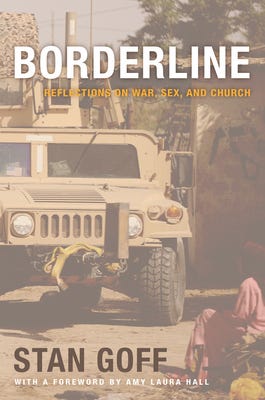
Sherry and I had decamped to Costa Rica for a year between 2010-2011, where I wore the pages off of my copy of The Hauerwas Reader, which is still tattered on my bookshelf. During that sabbatical, and poring over Stanley’s provocative theses, I fell upon the idea of resurrecting Sex & War, this time from my new point of view as Christian. When we returned to the United States, I shot a proposal off to Wipf and Stock Publishers in Oregon, which was met enthusiastically by editor Charlie Collier, himself having been profoundly shaped by the Work of Hauerwas. I became a hermit in our own home for many months then, gathering work on philosophy and theology as well as church history, then putting together hundreds of thousands of words in an initial draft. Between Charlie and me, I took a (necessary) machete to the text, the final result of which was still a lengthy tome, but it now at least weighed less than a cinder block. During the writing, I discovered something called disgust psychology via a fine little book called Unclean by Richard Beck, which emphasized the protean nature of boundaries. I couldn’t get that out of my head, and for the rest of the time I was writing and rewriting I attended to the policing of various boundaries, both literal and figurative. This conceit became so prominent that it gave me the title—Borderline; which gave my copy editor Jacob Martin a terminal Madonna earworm while he labored through the text. (Amy Laura Hall, also on the Duke faculty, generously wrote the Foreword, and later taught the book to one of her conflict-and-peace studies classes.)
And thus was born the book, off the presses in 2015, before we could know the shit-storm that was coming with a comb-over and a spay tan.
To say the book was not a big seller is an understatement. Not the topic that was likely to inspire most readers to pay the hefty price of $54—academic books, right?—with so much other interesting stuff to pursue. (For the record, I am not an academic, but I played one for the book.) I tried to work out what I was paid for all my books once, and it came to less than one cent an hour ← a probable overestimate. Some shit is a labor of love or it’s no labor at all.
Now, however—or perhaps I’m wishcasting—after a decade of angry phallic politics and the blue ribbon mess it’s created, maybe . . . just maybe . . . I can convince a few people—those who aren’t yet choosing between food and electricity—to give the book a chance. This is a scary wish for a writer. I now disagree with some things I said, though the main thesis stands, and other things I’d modify substantially. I want you to buy the book, but at the same time it’s like one of those dreams where you’re out in public and discover you forgot to put on your clothes.
As a teaser—and since Don brought up Marshall Brown—I’m going to give you the second full chapter, after I list the Table of Contents.
Thanks for listening.
Contents
Foreword by Amy Laura Hall | vii
Preface | vii
Acknowledgments | vii
1 Introduction | 1
2 My Acquaintance with a Christian Soldier and Serial rapist | 8
3 Forest Troop | 28
4 Body Counts | 32
5 Ontology of the Witch Hunt | 42
6 Ecologies of Power | 47
7 The Rise of the Lawyers | 54
8 Misbegotten Man | 63
9 Eros and War | 71
10 Practice Makes Perfect | 77
11 The Masculine Fortress | 86
12 Torture and Redemption | 92
13 The Pope’s Army | 100
14 Sleepwalking | 111
15 Genealogy | 119
16 Bodies and Objects | 126
17 Contagious Prefix | 139
18 Just, Civil, and Total War—Sanctification of State | 150
19 A Bodyguard of lies: Girl Story and Boy Story | 176
20 origin Myths | 205
21 Paradox of Domination | 230
22 Disgust, Transgression, and Sex | 251
23 Respectability | 261
24 Progress and Fear of the Feminine | 271
25 Shell Shock | 289
26 Nation, Race, and Hygiene | 299
27 The Art of Depression | 313
28 Homos and Harlots | 328
29 Second World War | 340
30 Bombs, Babies, and ’Burbs | 356
31 The Herd | 376
32 Taboo | 386
33 Consent | 390
34 Clarifications | 398
Bibliography | 417
Index of Names | 437
Index of Biblical References | 445
____
Chapter 2
My Acquaintance with a Christian Soldier and Serial Rapist
Men’s interest in patriarchy is condensed in hegemonic masculinity and is defended by all the cultural machinery that exalts hegemonic masculinity. It is institutionalized in the state; enforced by violence, intimidation and ridicule in the lives of straight men . . . and enforced by violence against women and gay men.
—R. W. Connell
Once children have been indoctrinated into the expectations of a dominator society, they may never outgrow the need to locate all evil outside themselves. Even as adults they tend to scapegoat others for all that is wrong in the world. They continue to depend on group identification and the upholding of social norms for a sense of well-being.
—Walter Wink
Testing, Testing
In the spring of 1981, at the age of twenty-nine, I volunteered for the Selection and Assessment Course for 1st Special Forces Operational Detachment—Delta, a.k.a. “Delta Force.” I was working as an interim platoon sergeant at 2nd Ranger Battalion in Ft. Lewis, Washington, outside Tacoma. Onto an already demanding physical training program conducted each morning and augmented by the nature of Rangering, I had added evening three-mile runs with a fifty-pound rucksack on my back and two five-pound ankle weights over my boots.
When I arrived in Camp Dawson, West Virginia, in March, separated completely there from the world of women, there was spring snow on the ground. Heavy-bodied whitetail deer grazed on the airfield at dusk. The surface of the Cheat River crawled kaleidoscopically between the blue-gray mountains of a leafless Appalachia. There was no shouting by the cadre, who were in civilian clothes with relaxed grooming standards, nothing like the shorn, shaved, starched, and shouting cadre of most military schools. In fact, there was a quiet, icy distance about them. Verbal instructions were monosyllabic and studiously without affect. Instructions and a schedule were silently posted each morning on an easel-mounted chalkboard inside the double front doors of the brick barracks. The whole environment was designed to break with all markers of familiarity we might know from our regular army units and our lives. We spent hours idle in the billets for the first three days, left to wonder whether we were already being observed, and what exactly the cadre might be “assessing” in each of us. The unit was highly secretive, as were the performance standards for Selection and Assessment, and therefore steeped in a mystique that grew fat on hints and rumors. The only standard we had for performance, in a course we all knew would select only around 20 percent of those who came, was to “do the best you can.” Save nothing. Do not pace yourself. Give everything and see what happens. Man stuff.
One day, we took an eight-hour battery of standardized psychological tests. We were exhausted by penciling in the bubbles, answering (a) strongly agree, (b) agree, (c) don’t know, (d) disagree, or (e) strongly disagree, in response to statements like “I have black, tarry stools,” “I like tall women,” “It disgusts me to put a worm on a hook,” and “For the most part, people understand me.”
After supper, we returned to the barracks, where we were instructed to report to formation with forty-five-pound rucksacks at eight that same evening. With perfect precision, at exactly eight o’clock, as we stood in formation exhaling vapor into the night chill, the selection cadre rolled up with eight covered military pickups and parked them exactly the same distance apart; a driver climbed out of each and stood in front of the formation. In turn, each driver called out the roster numbers of his passengers and we mounted up. They zipped the covers closed around us without another word, blinding us to our surroundings, and the convoy pulled out of Camp Dawson. The only sensation left inside the canvas enclosures was that of switching direction and climbing, then descending, then climbing again . . . for around forty-five minutes. Then we stopped. The zippers were opened, and we dismounted into more snow on a high gravel road in a thick hardwood forest. Our names were called. We each replied, “Here.”
Sergeant Major Cheney, looking like a lost hunter in the dark with his down vest and cowboy hat, directed each of us to tie an activated plastic chemical light (“chemlite”) to our rucksacks, and told us not to use flash lights except in a medical emergency. He instructed us to follow the markers and signs on the gravel road, and to go until we were told to stop. Understood? Yes, we said in unison. Then go!
We all burst down the road like top-heavy marathoners. Within moments, we could hear the first grunts as men careened onto the patches of ice and crashed. Everyone fell, a lot. No one knew how far we would go, but the rumor was almost twenty miles. Chemlites marked the route. The chemlites would partially blind us, making the dark darker between them. Within minutes, I was bathed in sweat. The downslope became the upslope, then down again, as we tore like half-blind sasquatches through the West Virginia mountains.
I had always been a moderate starter, warming up and gradually pouring on speed to burn through the end of runs and ruck marches. I don’t know exactly when I started to notice that I was gradually passing exhausted men. First there was one, then another, then a pair here and there. I would hear their feet scuffing in front of me and my own feet scuffing up behind them. I had emptied both one-quart canteens within an hour and could already feel the effects of dehydration. But I kept reeling in the next man. At some point I calculated that I must be among the front-runners. Passing was merciless. We were instructed from the beginning to conduct the course as a “singleton.” Unless someone was in immediate danger of losing life or limb, we were not to assist or encourage . . . or even speak.
I had learned well from the Army, especially in Vietnam and in the Rangers, how to be both in my body and out of it, over it, above it, commanding it like an abusive father commands a cowed and obedient son. My boots were soaked from the snow patches, my socks wet, my feet macerated and swelling in the boots. My shoulders screamed at the sharpening pinch of the ruck straps. My leg muscles quivered. My throat burned with panting in the icy air. And I passed more men.
At the end of the event, I stumbled into Camp Dawson, still half-running and on the verge of exhaustion, eighteen miles total, and reported in to two cadre members who recorded my arrival on a clipboard and instructed me to go to the barracks. When I went into the barracks, there were only two men, and it was obvious they’d arrived not long before. I was third out of almost sixty men, and I felt triumphant.
I sipped water and let the exhaustion overtake me. I showered in my wet clothes to wash them, threw them into a dryer, treated two blisters, and enjoyed watching more men arrive through the night. Our first physical test had passed. I was among the chosen. One candidate—that’s what we were called, candidates—staggered in, having remembered me pass him in a moment of supreme exhaustion, and said good-naturedly, “Goff, you’re a fucking animal.” I waved it away, secretly satisfied. In the military, nothing matters so much as recognition and reputation. Securing them can be a career in itself.
At around three that morning, however, I had unfamiliar sensations in my thighs. When I tried to get up and walk to the bathroom, it was blindingly apparent that I had gone beyond pushing myself and had transgressed the real boundaries of my own quadriceps. I was not strained, I was injured. I went out the following day for collective training to prepare us for the rest of the course. We ended up walking almost seven more miles, and the pain in my quads, just above my knees, was so severe by the end of the day that climbing stairs made my face sweat.
Rather than make a big production of it, I quietly packed my gear in the dark barracks that night and painfully dragged it over to the cadre Charge of Quarters in the headquarters building. He moved me into a holding barracks out of sight of the rest of the candidates, had me eat in the mess hall after they were gone, and put me on a plane back to Tacoma two days later. I was on physically restricted duty for more than six weeks afterward with two torn quadriceps.
Outwardly, I was fatalistic. Inwardly, I felt like a failure. Somehow, I had not adequately prepared myself.
Later that year, I reenlisted with a promise to be reassigned to the Jungle Operations Training Center in Fort Sherman, Panama. My marriage was psychotic—and our daughter, Élan, was our hostage. Panama would be the geographic cure. (Yeah, right.) It didn’t work, of course. In fact, things got a lot worse. My career was going very well, however, because I volunteered for twice the time that any other school cadre did to endure the harsh conditions of the jungle with the training battalions. In my professional life, the recognition and reputation were nothing but up. I was almost an icon at work. But at home there was an atmosphere of toxic history and recrimination that none of us knew how to escape. When the Delta recruiters came back in 1982, I had already made up my mind. I wanted to attend the next Selection and Assessment Course. I wanted to do it again.
My preparation this time became maniacal. I carried twice what any one else did to the field, and I stayed in the field, sleeping in the jungle, four days a week. I reeked so badly when I came in that I had to undress on the porch so I wouldn’t foul the house. On days I was in from the field, I would catch a ride to Gatun locks on the canal, eight miles from home, and run back . . . not jog, run. Six-and-a-half-minute miles, my lungs trying to burst out of my chest as I sprinted the last half mile. I swam with the barracudas in laps around the lagoon. I pushed and jerked the weights in the non-air conditioned gym, gulping down four and five gallons of water a day.
My fellow Jungle School cadre looked at me like I was an alien. The more insane my household became—where Élan (“Laney”), then just six, was forced to witness our madness—the more obsessed I became with out doing everyone in everything. Not only did I run faster and farther, carry more weight, and stay longer in the field, but my classes were more animated and effective, my preparations more detailed, my evaluations more precise, my command of the doctrine and my tactical acumen more studiously developed than anyone else’s. It looked like courage or will or endurance or commitment, but at bottom it was fear and obsession.
When I showed up at Camp Dawson again in March 1982, I had never been so single-mindedly committed to anything. All choices had been foreclosed, my mind made up. Regardless of the outcomes, I would not quit. If the quadriceps failed, if the back failed, if the feet failed, then they would fail. If I was carried off in an ambulance or fished out of a strip mine, so be it; but there would be no quitting. My mind would overcome my body. There was far more at stake than episodic escape from my marriage. This was Delta Force! The highest priority unit in the army, the masculine pinnacle from which you could look down at the other elites, down on the Ranger tabs and Green Berets, this was where you would be exposed to the darkest skills of power projection. This was the secret world into which one could disappear and reemerge with recognition and reputation that was carried on whispers and hints. And inside the man, there was a little boy who was scaling the treacherous wall of his own self-doubt.
For a month, the course progressed. The actual selection phase lasted for around two weeks, during which each person, alone, would navigate overland with map and compass from point to designated point, using no roads, never knowing how far he would go each day, or when he was at his last rendezvous point (RV). Some days we would go merely seven or eight miles, other days as many as twenty-five miles. Each night, we would be directed to a camp near our last RV; the following morning we would begin anew. Each day, there were fewer of us. Men fell behind the (unknown) time standards, or they became injured, or they quit. At night in the camps, the cadre forbade us to talk about the course, but we would quietly try to compare who’d been seen, who had disappeared, or, as we said, who had been “carried away by the Black Chinook.”
We had all heard the rumor about the final movement: a forty-mile trek that finalized the physical portion of the course. One night, we were all collected together at one camp. There were only about twenty-five of us left of the original sixty. The cadre handed out new flashlight batteries, and checked our HF emergency transponders. Be prepared to move out at mid night, they said. Everyone pretended to sleep.
At five-minute intervals, beginning at midnight, we were given our RV coordinates, released, and told this time we could use the roads. I was released at around 1:30 a.m., with a rucksack that weighed fifty-five pounds before I added the water, all according to instruction. We were also hand carrying simulated M-16s made of metal rods and hard rubber that weighed around eight pounds apiece.
At each RV, the rucksack was weighed. I had passed four RVs and covered about thirteen miles when i pulled into an RV not far from Bear Mountain. The scale showed my rucksack weighing fifty-four pounds—one pound light. I assured the cadre member that it had weighed out correctly, and at fifty-six to fifty-seven pounds at each previous RV. One of the two cadre instructed me to open the rucksack, then placed a large flat rock in it.
“Don’t lose this,” he said. It took my rucksack weight to sixty-four pounds. I was still angry miles later—not about the weight, but at believing I was the victim of bad scales, and about the delay—when I failed to compass check a turn in Bear Mountain Trail and followed a sign instead. Forty-five minutes later, I realized I had been ascending when I should have been descending. I checked my map. I had gone three miles the wrong way up Bear Mountain Trail.
Damn, damn, damn, damn, damn! Three miles out, three miles back, a six-mile detour that would lose me at least seventy-eight minutes! I jogged back down Bear Mountain Trail until I passed the point where I’d made the wrong turn, telling myself the whole time that I had just failed selection on a stupid rookie error after all this shit. But the prime directive kicked in. Don’t rest. don’t think. don’t quit.
I continued downhill alongside a turbulent mountain stream that had drowned a candidate one year earlier, and I noticed that my feet began to ache—not the usual ruck march ache, but something that felt like the bones were trying to push through the flesh. Don’t quit.
I hit an RV at a swinging bridge where I blathered manically about a wrong turn to the taciturn faces of the two cadre who looked ominously at their watches. I crossed a highway near Parsons, West Virginia, then tried to take a shortcut off-road through a mountain laurel thicket that chewed me up and spit me out onto an RV at the top of a mountain. Two cadre were listening to the radio, and Alberto Salazar had just finished the Boston Marathon in under two hours and nine minutes. While my rucksack was being weighed, I remarked on Salazar’s time, and heard the first humor from anyone in the Delta Selection cadre.
Don Feeney, a cadre member, said, “He just did in two hours what it took you all day to do.” Ha, ha. If that was the twenty-six-mile point, I had gone thirty-two because of my little six-mile detour on Bear Mountain. He had just told me, without realizing it, that I had fourteen miles to go.
At the top of a large flat mountain nearby, there was a huge shallow swamp sitting in the miles-wide dish, perhaps an ancient volcanic crater. Through the middle of that swamp, a swamp that was not designated a swamp on the maps we used, is a soggy path called Plantation Trail. To this day I don’t know how long that trail is, but I remember that it soaked my feet with every step and transformed the sensation of the bones trying to stick through the flesh into a bright-hot pain that made every step like a hammer slamming into an anvil that vibrated from my feet all the way into my childhood memories.
In a kind of delirium, I slogged across Plantation Trail with an Emmylou Harris song in my head. It was about a millworker, and the lyrics went, “Me and my machine, for the rest of the morning, for the rest of the afternoon, for the rest of my life.” In my head, the song became, “Me and my RV, for the rest of the morning, for the rest of the afternoon, for the rest of my life.” By the time I stepped onto dry ground from Plantation Trail, I was singing my new song aloud to drown out the messages from my feet and back. “Don’t quit” was no longer a brave self-challenge; it was just a monotonous noise like a cardiac monitor in an ICU.
Staggering down some gravel road at dusk, the pain in my feet had merged with the pain in my shoulders and back. I had become pain. My only purpose in life had become to chip-chip one silently screaming foot in front of the other. I almost walked through the next RV with my head down.
Captain James Knight and Sergeant Major Don Cheney stopped me and said I would be allowed to use my flashlight for the rest of the course, and that they wanted to check the batteries. No, I told them. My flashlight was fine; but if i removed my rucksack long enough to get out the flashlight, I was afraid my muscles would freeze up and I wouldn’t be able to shoulder it again. Cheney glowered angrily and ordered me to give up the rucksack. I was arguing with him when Knight smiled and shook my hand. I was then sure that I was having a mental breakdown. What was this stupid smile about?
“Congratulations,” said Knight. “You just completed the endurance march.” I had walked forty-six miles.
“Will you let me have that rucksack now?” asked Cheney. I hit the quick release and let the ruck drop to the ground. My shoulders surged with relief.
“Sergeant Goff,” said Knight, “would you like a beer?”
“Sir,” i said, “I’d suck your dick for a beer.”
MY MENTOR
Fourteen of us made it. Terry Gilden, an old associate from 2nd ranger Battalion, had finished with stress fractures in both shins. He wanted it. He would be killed in Beirut in two years
*
Nancy Hartsock has said that the desire to overcome the body is closely related to a loathing of the body. The ability to ignore feelings, to not feel, is closely associated with what Mab Segrest calls “the anesthesia of power.” What does this say, then, when we attend to a central truth of the Christian faith, that God became flesh, and in so doing sanctified flesh? Christian psychologist Richard Beck, in his book Unclean, says that the fleshy body reminds us of death. We are humiliated by our flesh.
Hartsock:
In pornography, feeling is conquered by projecting emotions onto the victim who is humiliated by bodily appetites, by reducing the women to the status of a feeling body, and in “snuff” films to a literal corpse. . . . Thus, sensuality and bodily concerns, [an] aspect of Eros, take representative form. They become entangled with and point toward death . . . the death of feeling as well as the death of the body. . . . The denial of the body is in part due to the fact that it is a reminder of mortality and therefore of death. . . . Knowledge of the body is knowledge of death.
Eros develops as the fusion of emotion and symbol that overwrites our activity in the world. That connection is sexualized early and deeply; and the sexuality of it is constructed as “unequal complementarity,” in Jessica Benjamin’s use—a unity of opposites at the expense of mutuality. In a society where military practice becomes central to the stability of that society’s hierarchies, that demutualized complementarity is armed and dangerous. Bodies matter.
*
At Delta, I finished what was called the Operator’s Training Course (OTC) and was assigned to B Squadron, now well known to military aficionados who have read Eric Haney’s book Inside Delta Force: The Story of America’s Elite Counterterrorist Unit. Haney was eventually my team leader there. My first assignment was to Tommy Corbett’s team of assaulters—people who specialized in close-quarter battle inside buildings, aircraft, trains, and buses. One member of the team was a man named Marshall Brown.
Marshall adopted me. He was small and wiry like me, and like me he had a great deal of nervous energy. We were very compatible that way. Marshall was one of the most dedicated—one might even say obsessive— “operators” in Delta. He received a lot of recognition, had a good reputation. A very fast medium-distance runner, he practiced his every skill religiously and was one of the finest pistol marksmen and “practical” shooters in the unit. A former Golden Knight freefall parachutist, he had participated in the failed raid in Iran in 1979.
Marshall would take me to the McKellars Lodge pistol range at Ft. Bragg on the weekends with ammunition from the unit, where he would drill me mercilessly and coach me on the fine points of pistol shooting on the match-quality .45 caliber Colts that were standard issue in the unit. Between shooting on the job and Marshall’s weekend sessions, it was not unusual for me to fire 2,500 rounds of pistol ammunition a week. Marshall was showing me his peculiar intensity, an intensity that was highly valued in the unit.
Marshall was single and lived in a trailer. He had his own personal pistols at home. Marshall went to International Practical Shooting Confederation (IPSC) competitions every chance he got, and he practiced dry firing, quick draw, magazine change, and position changes when he was at home. He also practiced his lock-picking, his climbing, and his various surreptitious entry techniques. He read his OTC manual constantly to stay abreast of his tradecraft and explosives.
When I first came to the team, he took me aside and told me, “This unit is at war. never forget that.”
Marshall was a Texan. I didn’t know it at the time, but he was raised by an emotionally abusive father who set standards for his behavior to which he could never measure up. His mother was also subject to the despotism of the father, and by some accounts she never intervened (in what, I’ve never learned). This is partly speculation, but it seems like the Army was a place where Marshall could work hard to earn the accolades he’d never received from his father, a place where the rules were clearly spelled out and if you really understood them and didn’t violate them, you wouldn’t get into trouble. Those who know little about the military do not understand the value of this kind of bureaucratic consistency for anyone who has suffered from capricious domestic power—and that includes women who have suffered from capricious domestic power.
Marshall enjoyed a good practical joke, and would often place Vaseline under doorknobs, turn windshield washer nozzles to squirt people riding on the passenger side of his car, and reach into the shower when your eyes were closed against the cascading shampoo and switch off the hot water. He was playful despite his weird intensity. Practical jokes are often little displays of cruelty, but that’s not what we saw. We all had a cruel streak. It’s a man thing, substitution for and inoculation against direct affection.
Marshall was always seeking new training opportunities. One time he and I had asked to design a field-training exercise and were riding dirt bikes to look over our training area. We were buzzing over a fire trail, and I had fallen behind him, so I rolled back the accelerator to catch up. When I rounded a turn, Marshall was straddling the bike perpendicular to a deep erosion ditch. For me, it was too late. My bike dove into the ditch and the front wheel fell short of the far side, launching me over the handlebars to land face-first on the other side. The next thing I remember is looking up at an alarmed Marshall calling my name over and over again. My mouth was full of clay. My neck was throbbing. While I sat up and scooped the clay off my lower teeth, Marshall told me that I landed directly on my face, while the rest of me traveled over my head. He though my neck was broken and was sure I had been killed. When he had calmed down, he remarked that it was a good thing we did our strength training and that it had probably saved my life.
I have had problems ever since with periodic spasms in my neck.
When we were finished with the day or deployed, Delta would drink. Delta drank a lot. Our punishment for poor marksmanship or other training errors was to buy the squadron a case of beer. The other favored pastime was marital infidelity, most operators being married men with mortgages. Marshall was not married, didn’t womanize (as far as anyone knew), and when he drank with us, it would be an hour or so at a time, nursing maybe half a beer, after which he would quietly retire and leave us to our debaucheries.
There were exceptions to this whoopee-tendency, of course: a couple of very religious men, including William “Jerry” Boykin, a retired general now who gained infamy with his very public 2003 pronouncement that Muslims don’t worship a “real God.” Jerry unsuccessfully pressured most of the rest of us to attend right-wing prayer breakfasts. A few gave in.
Marshall was most concerned with his physical edge, and seemed frankly to be rather shy on the subject of sex. Sex was everywhere at Delta, though. And Delta Force in those days had the biggest collections of porno graphic videos I have ever seen, hundreds of them.
One of the most odious tasks in the military is Charge of Quarters, or staff duty. That’s a rotating duty where you stay awake all night by a telephone. At Delta it was no different, and every three or four weeks or so one could expect to be put on staff duty for twenty-four slow-moving hours of wakefulness. In Delta, however, because it was closed to the public, behind gates with surveillance cameras and buzzers, the men could keep themselves awake by watching these pornographic videos, one after another, all night long. The joke around the unit was that the wives were asking why their husbands were always so horny when they finished staff duty.
The wives, of course, had no idea that they were themselves then being used as masturbation aids while we thought about the films. I watched them, too, whacking off like a monkey in the privacy of the army’s top-secret unit headquarters. I have no idea if Marshall watched the pornographic videos. Marshall was squeamish about the subject of sex in conversation.
At any rate, our teams were reorganized, and my contact with Marshall became less constant. Marshall had fallen under the thrall of a slightly loony Delta physician who was experimenting on us with performance-enhancing diets and quack cures. Marshall would show up at your table at lunch and point to the sugar jar, saying, “That’s white poison.”
At some point in 1985, Marshall joined a church, one that promoted a kind of macho Christianity. He’d been hanging out more and more with Lance Fennick, an ex-Ranger who was a church member and who attended Boykin’s killers-for-Christ prayer breakfasts. One day, Marshall and I got into an argument when I said, in whatever context it was, that it’s better to tell your daughter about birth control than not. He launched into a tirade about how that was giving her permission to sin.
I was an irresponsible parent, but it had nothing to do with Marshall’s outburst.
In 1987, Marshall got married and left the unit.
“I HAVE TO DO THIS”
We were psychologically tested during Selection. We were administered the aforementioned battery of diagnostic assistance tests, with names like Thematic Apperception Test, Minnesota Multiphasic Personality Inventory, and the like. The day after the “forty(-six) miler,” we were queued up to have a conversation with the unit psychologist who had reviewed our answers as to whether we had black tarry stools, liked tall women, minded putting worms on hooks, or felt that people understood us. As we understood it, delta did not want to train a member to become a proficient sniper, then learn one day that one of its members was sitting in a public tower picking off random “targets,” as the ex-Marine Charles Whitman had on the campus of the University of Texas at Austin in 1966. At that point, I wasn’t questioning what kind of psychologist works for a unit like Delta, or what might be wrong with him. We had a pleasant interview during which I intrigued him with my knowledge of Sartre and Camus; I manipulated him. He gave me a pass. This psychologist was eventually fired during his own sex scandal, as was a subsequent commander of Delta.
The psychological evaluation didn’t screen out crooks, because almost the entire unit became embroiled in the fraud scheme that threw us into the crisis that contributed to my expulsion in December 1986. We were dummying up rent receipts all over the world, after the State Department paid our rent, and collecting the reimbursements from the army when we came home. It worked great until one guy had a crisis of conscience and exposed the whole unit. The officers probably knew, but didn’t want to acknowledge that they knew.
Apparently, these psychological evaluations didn’t screen out rapists either.
In 1988, an investigation began when two women were attacked in Raleigh, apparently by the same man, a stranger. He climbed in through their second-story windows, hooded and dressed in black. He ordered them to silence with a knife held at their throats, covered their faces, then raped them. During the rapes, he apologized, telling them that he didn’t want to hurt them and that “I have to do this.”
On June 11, 1989, in Cranston, Rhode Island, Marshall Brown was taken into custody and charged with the rapes of two Rhode Island women. The rapist had used the same modus operandi as in the north Carolina attack. While in custody, Marshall was deferential to the police, calling them by their ranks and observing a scrupulous courtesy. Police described him as soft-spoken. He even spoke approvingly of the professionalism of the arrests and complimented one officer on his handcuffing technique. He had been arrested for prowling in Fayetteville, North Carolina, earlier that May, whereupon he had forfeited his bond for a dismissal of the charge.
Marshall went to work in jail, studying the patterns of the Federal Marshals who transported him to and from court, and making friends with an impressionable twenty-year-old inmate named Frederick Heon. Marshall stayed in shape in jail, using his exercise periods to run. On July 30, he was cuffed to another prisoner in the back of a Federal Marshal van and driven to Providence to attend his hearing. When the back door opened, Marshall, who had picked open his handcuffs, walked with the escorting marshal and his fellow inmate for a few steps, then sprang past the startled Federal Marshals and ran like an Olympic athlete up the street and out of sight. None of the Marshals was fit enough to pursue Marshall, and he got clean away. “Simplicity” is a Principle of War.
Heon was out on bail and had rented a car, per Marshall’s instructions. He was waiting at an appointed rendezvous point and drove Marshall to the Connecticut state line. Heon then went to a church where he was told he’d find money, which wasn’t there. Three days later, Marshall was caught in a stolen car and rearrested. Marshall told the police about Heon’s assistance, and Heon was taken back to jail for a parole violation. Marshall had burglarized a house fifteen miles outside of Providence for food and credit cards, and was camping in a pine grove nearby. He stole the car in the same neighborhood. Now back in custody, he admitted to nine rapes in Rhode Island, Texas, Arizona, and North Carolina.
Marshall had been attending the navy version of a sergeants-major academy in Norfolk when he was caught the first time. His wife, Michelle, who was taking care of their young son, was stunned.
I can’t pretend to understand Marshall Brown, even after spending many hours with him and going on one combat operation with him. I have heard the statement that rape is not sex, it is an exercise of power, but I don’t buy it. Rape is violent power, but it is sexual. Rape is sex, violent sex. Sex is routinely practiced, portrayed, and understood as a form of aggression and power. This is recognized in our everyday speech, even while it is denied by many policy-makers and by liberal academics; and it is denied in the ridiculous statement that “rape is not about sex, but power.”
One of Marshall’s in-laws spoke with me many years later and said that Marshall told him that he felt he had to use his skills somehow or he’d begin to lose them. Marshall saw the rapes as a training opportunity, at some level, and therefore the women as training aids.
Marshall, even as he was violating these thoroughly terrified women with a knife held to their throats, and arousing himself to an orgasm in the process, was apologizing and explaining to them: “I have to do this.” Marshall had jumped out of airplanes a thousand times, was a proficient technical climber, and had been in combat. It wasn’t some generic rush he needed, but transgression.
Hartsock has said that “without the boundary to violate, the thrill of transgression would disappear.”
Marshall’s criminality was not in spite of his religious conversion, his squeamishness about sex, or his uptight WASP upbringing in East Texas. It was an outcome of all those things, but also of a masculinity defined by a culture of rape, and a man who had made a career of pursuing that masculinity. The transgressions of his career—invasions of other countries, for example, or killing—were legally sanctioned. Why should it surprise anyone that he crossed the fuzzy line between legal and social sanction? He lived on that line. I lived on that line.
*
“We live in a culture that condones and celebrates rape,” says bell hooks. Catharine MacKinnon says that “male and female are created through the eroticization of dominance and submission. The man/woman difference and the dominance/submission dynamic define each other. This is the social meaning of sex and the distinctly feminist account of gender inequality.” Robert Jensen says, “Rape is illegal, but the sexual ethic that underlies rape is woven into the fabric of the culture.” A culture that defines the male as a sexual aggressor, the do-er, the taker, the subject, and the female as the done-to, the taken-from, and the object, is a culture that has defined the parameters of rape and normalized them. The only rape that is illegal is the kind that Marshall committed. The definition is narrow, and the bar of legal proof is very, very high. Rape has to be understood simultaneously as both social and personal, because social control is exercised through individuals, and with individual bodies.
“The defense of injustice in gender relations constantly appeals to difference,” says R. W. Connell, “to a masculine/feminine opposition defining one place for female bodies and another place for male. But this is never ‘difference’ in a purely logical sense.” Difference is felt in the body. We have all been trained in what we find erotically arousing, for example, and that training is embedded in a culture where gender does not merely constitute difference. That difference is used to justify hierarchy, domination, and conquest. Eros is culturally trained. Masculinity as institution and ideology posits a subject-object duality between Man and the other (be that other woman, lesser man, colony, or nature), and defines masculine practice as conquest, often even of one’s own body—like my own experience with delta selection and a host of other military “pain-schools.”
In the military, the exercise of professional sadomasochism in preparation for the violence of warfare is often sexualized in our vernacular and disguised as humor. Allusions to pseudo-Victorian naughtiness are common. When I told a captain I would fellate him for a beer, I was playing at being a whore—a transgression that was allowed and understood as just play because I had already, by virtue of my membership in the fraternity of blood called special operations, and by walking forty-six miles, displayed my masculine bona fides. Without the imaginary female whore or the imaginary homosexual, and my proof of masculinity, my humorous assent to a beer would not have been properly understood.
“There is a surprising degree of consensus that hostility and domination, as opposed to intimacy and physical pleasure, are central to sexual excitement,” writes Nancy Hartsock.
Most pornography conventions that are marketed to males involve fetishization of body parts or types, one form of objectification, and the humiliation and degradation of the objectified female by her own purported (and performed) insatiability, her enslavement to desire (simulated for male audiences). Hostility, expressed as the desire to see the female-other degraded and humiliated, is eroticized. it is about power, yes, but it is also emphatically about sex.
Those who dealt with Marshall from the time he was arrested remarked how polite he was throughout the whole process, how observant and supportive of social conventions. Implicit in these remarks was the idea that rape—and in this case, serial rape—is aberrant in this society. But rape is not seen as fundamentally aberrant in this society, it is seen as excess, as crossing a line, and at times as provoked excess (as in warfare). Hidden within the open public discourse about rape are exclusively male assumptions, and in this space rape is routinely portrayed as understandable and even at times desirable. Many people see prison rape, for example, as an appropriate and just form of extrajudicial punishment (“He had it coming”).
Socially, rape serves as an extrajudicial instrument of social control. Bell hooks says that “rape of women by men is a ritual that daily perpetuates and maintains sexist oppression and exploitation.” And in the same way, the exercise of male prerogative in rape and the exercise of military prerogative in killing carries with it a transgressive thrill that is socially sanctioned (against designated enemies, against Abu Ghraib prisoners, against “fallen” women, against convicts who “have it coming”). [Recent revelations of Israelis using rape against Palestinian detainees further confirms this.] This is the fusion of the subjective experience of desire and violence with the socially instrumental and eroticized violence of rape.
Inga Muscio, in describing the traumatic and illuminating discovery that her mother was raped at the age of nine, concludes that “rape . . . viewed merely as a crime . . . is the fundamental, primal, most destructive way to seize and maintain control in a patriarchal society”—little realizing as she wrote, I’d wager, that a military principle of strategy against an enemy uses the same language: “Seize and maintain the initiative.” A friend of mine [De Clarke] wrote me once,
The language reveals this at every turn. Men—in the “man talk” they speak in all male environments and increasingly in general discourse, even when women or children are present—often use metaphors of rape (male-male rape, for example) to indicate aggression, anger, submission, domination. Just bend over . . . we really took it in the shorts that time . . . check out the Web site today, Juan Cole just ripped Goldstein a new ass . . . I’ve got a hard-on for that SOB . . . he just rolled over for it . . . he thinks I’m his bitch . . . did you hear him reaming that guy out . . . and of course, the routine uses of “to fuck” as in “fuck you,” “we are so fucked,” “that’s fucked,” plus the pejoratives applied to the “submissive/receptive” role, as in . . . he’s such a scumbag (recipient for sperm) . . . that sucks . . . what a cocksucker . . . and so on. The very texture of the vernacular expresses everything any sociologist could want to know about the association of sex and aggression, sex and ranking, etc.—and then every mawkish pop song rambles on about (hetero)sex being exactly equal to and definitive of love, tra la la. it’s a wonder we don’t drop in our tracks from terminal cognitive dissonance.
Marshall did not appear to be abnormal because he was not ab-normal. He was, if anything, hyper-normal, as a male, going above and beyond the call of duty (expected of commandos) to preserve social stability. MacKinnon says that the implication that rape is psychopathological serves as a smokescreen by validating the notion that rape is not about sex—because if it is about sex, then “sexuality” itself comes under review as a construction of power. This is exactly why both MacKinnon and her late colleague, Andrea Dworkin, were vilified by both the right and the left. People don’t want to go there. “Rape becomes something a rapist does, as if he were a separate species. But no personality disorder distinguishes most rapists from normal men,” says MacKinnon.
Marshall Brown served in a profession with a constant subtext of coercion, and in a field within that profession (Delta Force/Special Operations) where we were expected to work outside the rules, behind the scenes, in the shadows, employing a host of very specialized skills, to “preserve a way of life.” The expectation of us was that we would go “above and beyond the call of duty,” or we wouldn’t have suffered the kind of extreme physical trials we accepted in selection just to qualify for a chance to be in the unit. And for that, we were, in the traditional military mind, entitled.
His outrage at my suggestion that my daughter might be given information about birth control, his affinity for a killer-Christian Americanism, his commitment to take profound risks on behalf of maintaining a social order, are all perfectly consistent with the manner in which he carried out these rapes. With the same sangfroid that accompanied his acceptance of the collateral damage that would have resulted had the 1979 Iranian rescue mission succeeded, Marshall Brown accepted the psychological wreckage that he left scattered around each of his rape victims.
“Rape,” writes Muscio, “makes you wonder if there’s a safe place.” And that’s the point, isn’t it? If you don’t want to be raped by a man, you need the protection of a man. It’s the psychosexual protection racket—and Marshall was an enforcer.
Maria Mies writes about feminist anti-rape campaigns in Bombay and Delhi, where activists were astonished to discover that as women came to the cities from the countryside, where feminist activists assumed rape was a backward feudal vestige, like dowry murders, the frequency of rape exploded. The fastest-growing group of perpetrators was the police. These feminists were slow to associate the increasing number of rapes with the increasing independence and political agency of women. Rape punishes women who get out of their places. This is often displayed as a “playful” theme in pornography.
Rape has been massively expanded in modernity with its gender destabilizations. Ivan Illich, repeating Mies’s assertion that modern rape has a particular character that responds to gender destabilizations, writes, “American women now fear . . . rape as the supreme physical expression of modern sexism.” This phenomenon need not be a conscious strategy by the actual perpetrators. it fits within our social imaginary.
When Marshall Brown became a serial rapist in 1988 (we think), the institution with which he identified absolutely, the military, was undergoing a series of significant transformations with regard to women. In 1973, when I was taking my first break in service, women constituted 1.6 percent of the United States armed forces. When Marshall and I participated in the invasion of Grenada in 1983, the ensuing occupation included 170 Army women. In 1987, a woman graduated first in her class from the Naval Academy. By 1989, when Marshall was first arrested—and three years after Lissa Young graduated from West Point as the first female deputy Commander of the Corps of Cadets—the percentage of women in the armed forces had leapt to 10.8 percent. Marshall, with his East Texas upbringing, could hardly have missed this, or the fact that 30 percent of these women were African American. By the time Marshall was arrested, 59 percent of the army’s occupational specialties were open to women (that’s not the same as 59 percent of the individual positions in the armed forces). Women were being rated as test pilots. Lissa Young, whom I knew from my time as a teacher at West Point, was flying Chinook helicopters—a radical incursion into the male domain.
With this new influx of military women came another dynamic: fraternization, as the military calls it. Men and women in the military were interacting socially, dating, having sex, and getting married. The male-male and female-female liaisons remained as much as possible under the official radar. But among these “heterosexual” pairings, there were significantly higher numbers of interracial relationships than in the civilian sector. The most frequent “new” combination among those in uniform was black male/ white female. Marshall was sure to notice that, too. In fact, it was a constant subject of conversation among white male troops, many of whom expressed outrage at this black male infiltration and white female “betrayal.” Resentment was directed at the black men, but with lynching not an option, that same fierce, sullen rage was redirected at the white women, who were referred to as “zebra-women” and “mudsharks.”
When Kimberle Crenshaw wrote “Demarginalizing the Intersection of Race and Sex,” she noted that a “singular focus on rape as a manifestation of male power over female sexuality tends to eclipse the use of rape as a weapon of racial terror,” pointing to black women’s virtually “unprotected” status. In the same essay describing the mixture of white and male social power, she shows how white men attempt “to regulate the sexuality of white women.”
White-nationalist masculinity is profoundly threatened by a perceived inability to control the “sexuality” of white women, creating what Connell calls “sexual vertigo.” This recombinant mixture of sexual and racial construction that obliges white men to both “control” and “protect white womanhood” is ignited as violence against both women and black men. The bogeyman of the potent black satyr raping the white woman has accompanied virtually every call in the United States for anti-black pogroms. It is hardly coincidental that assertions of black social agency have been met with expanded outbreaks of racial terror, or that rape was projected onto black men by white men; and it is likewise not a coincidence that police rapes increased in Bombay when women began organizing politically.
Connell says that “violence is part of a system of domination, but is at the same time a measure of its imperfection. A thoroughly legitimate hierarchy would have less need to intimidate. The scale of contemporary violence points to crisis tendencies in the modern gender order.”
When Marshall Brown began his career as a serial rapist, there were myriad influences on his “target selection.” Marshall went through Special Forces training at Camp Mackall, where a sign read, “Rule #1: There are no rules. Rule #2: obey the first rule.” Marshall was the commando—root word command—who follows orders without question within established hierarchies. He was committed in his role as the colonizer’s paladin, with its admixture of violent conquest and “civilization” to be imposed outside those disciplinary restraints. He policed boundaries, and he also, using his status as one who belonged inside the defensive male perimeter, transgressed them.
I knew Marshall Brown. He could not be reduced to some other species called rapist and slid into the appropriate drawer. Among other things, he was an exceptional soldier.
###
The result you are looking for, and for which I once looked, is not possible.
I love your book full spectrum disorder! I read it as I was getting out of the army almost a decade ago and it was hugely impactful. A question for you though: I know you identify as a pacifist but I cannot see any way other than the use of violence to ever actually challenge the power of the ruling class. Theyve demonstrated how entrenched they are and I do not see any viable alternatives to creating social change. So what do you see as the alternative that will actually stand a chance at producing results?