
What is fetishism?
big hat tip to Alf


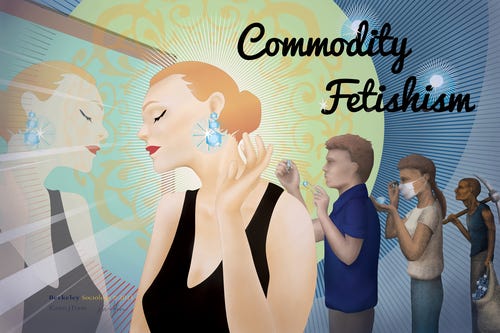
The first association of the word “fetishism” tends to be something sexual. As fascinating as that may be, it’s not what this post is about.
A commodity is therefore a mysterious thing, simply because in it the social character of men’s labour appears to them as an objective character stamped upon the product of that labour; because the relation of the producers to the sum total of their own labour is presented to them as a social relation, existing not between themselves, but between the products of their labour. This is the reason why the products of labour become commodities, social things whose qualities are at the same time perceptible and imperceptible by the senses. In the same way the light from an object is perceived by us not as the subjective excitation of our optic nerve, but as the objective form of something outside the eye itself. But, in the act of seeing, there is at all events, an actual passage of light from one thing to another, from the external object to the eye. There is a physical relation between physical things. But it is different with commodities. There, the existence of the things quâ commodities, and the value relation between the products of labour which stamps them as commodities, have absolutely no connection with their physical properties and with the material relations arising therefrom. There it is a definite social relation between men, that assumes, in their eyes, the fantastic form of a relation between things. In order, therefore, to find an analogy, we must have recourse to the mist-enveloped regions of the religious world. In that world the productions of the human brain appear as independent beings endowed with life, and entering into relation both with one another and the human race. So it is in the world of commodities with the products of men’s hands. This I call the Fetishism which attaches itself to the products of labour, so soon as they are produced as commodities, and which is therefore inseparable from the production of commodities. (Karl Marx, Capital, Volume I, Part 1, Chapter 1, Section 4)
fetish /fĕt′ĭsh/ — An object that is believed to have magical or spiritual powers, especially such an object associated with animistic or shamanistic religious practices.
In Marx, what he was describing was the way a commodity—say, that new pair of tennie-runners you see at Shoe Carnival—presents itself to you as an independent entity, while the social relations of the production process, embodied in the commodity, remain invisible.


It’s important not to be confused. Marx wasn’t putting down religion or spiritual beliefs (nor was he doing so when he called religion “the opium of the people”). His critique wasn’t aimed at the religious, but at economists. How can you sneer at the tribesman with his animal masks and mojo sticks, he was saying, when you turn around and say shit like, “Money grows.”
Since Marx first articulated this metaphor, it’s proven to have tremendous potential for nuance, expansion, and elaboration. It wasn’t an especially accessible idea to everyday people to start with—something obvious in one respect (of course people make shoes in factories) that nonetheless has a host of far less obvious implications—and no doubt some unnecessary confusions. Which is not to say that it’s unimportant, just some academic hobby horse . . . or (ahem) fetish. Alf Hornborg boiled down the Marxian definition to “the mystification of unequal relations of social exchange through the attribution of autonomous agency or productivity to certain kinds of material objects.”
Mystification is another member of the Marxian vocabulary. Encyclopedia-dot-com says:
Mystification: The obfuscatory dimension of human reason has been a subject of Western philosophical investigation since Aristotle, and the term mystification has been deployed in various ways to explain how deception, disguise, and dissimulation play a role in driving human behavior.
William Pietz, in the opening lines of The Problem of the Fetish, writes:
“Fetish” has always been a word of sinister pedigree. Discursively promiscuous and theoretically suggestive, it has always been a word with a past, forever becoming “an embarrassment” to disciplines in the human sciences that seek to contain and control its sense. Yet anthropologists of primitive religion, sociologists of political economy, psychiatrists of sexual deviance, and philosophers of modernist aesthetics have never ceased using the term, even as they testify to its conceptual doubtfulness and referential uncertainty. It seems this word’s usage is always somewhat “indiscriminate,” always threatening to slide, as in Merleau-Ponty’s tentative proposition, into an impossibly general theory. Yet it is precisely in the surprising history of this word as a comprehensive theoretical term indispensable to such crucial thinkers as Comte, Marx, and Freud that the real interdisciplinary interest of “fetish” lies.
Anthropologist Roy Ellen wrote “Fetishism” in 1988. From the Abstract:
The concept of fetishism in anthropology, Marxism and psychology is examined as a particular case of the interplay between theories of cognition and collective representations. Classificatory end-products to which the word ‘fetish’ has been applied cannot be understood simply as special kinds of objects, or defined in terms of their generic functional attributes. Neither do they reflect a particular mental condition. Rather, they reveal a variable combination of three underlying features of categorisation and representation characteristic of all thought. These are concretisation, animation or anthropomorphisation, conflation of signifier with signified, and an ambiguous relationship of control between person and object. All lie on a processual continuum which begins with the identification of categories, relationships and phenomena, and proceeds via reification and iconification to their personification. In this sequence what we might loosely describe as ‘fetishisation’ appears with a shift from the balanced simultaneity of signifier and signified towards ‘the thing in itself’. [emphasis added]
Well, that clears up pretty much everything.
So . . . now we’ve added concretisation, animation/anthropomorphisation, signifier-signified (semiotics, including iconofication), and reification. Damn.
We’ll save reification for the deep-tissue massage later, but concretization means treating an abstraction as if it were an actual tangible thing, and he lists concretization alongside animation/anthropomorphisation, signified-signifier conflation, and some kind of ambiguity as characteristic of fetishization—criteria by which we can know fetishism when we see it. Hornborg sketches Ellen out in The Power of the Machine:
Ellen argues that the varieties of fetishism addressed by the analytic traditions that he reviews share four “underlying cognitive processes”: (1) concretization (the reification of an abstraction and its representation as a material object), (2) animation (the attribution to such an object of qualities of living organisms), (3) conflation (an ambiguity as to whether the object itself, or what it signifies, is the “active causative agent”), and (4) ambiguous power relations (an ambiguity s to whether the object is controlled by people or people by an object). (PM, Hornborg, 142)
Fetishism itself can fall into that fourth category—something created by people that rather takes control of their thoughts—though Ellen is thinking in Marxian terms, the easiest example for everyday people of which is probably how we make things (digital technology, for example) that then come to exercise more control over us than we do over them. Fetishism works like that on our process of reasoning.
Every form of thought influences our process of reasoning, of course, but what we’re concerned with here is how fetishism mystifies—how it “obfuscates, deceives, disguises, and dissimulates.”
Fetishism displaces our beliefs.
Remember, this “ambiguous power relation” identifies fetishism in conjunction with the other three criteria. In Fetishism and Imagination: Dickens, Melville, Conrad, David Simpson says, “fetishism occurs when the mind ceases to realize that it has itself created the outward images or things to which is subsequently posit itself as in some sort of subservient relation.”
Signifier/signified are terms of art for the study of signs: semiotics. In my back yard grows a large sugar maple tree. You can not see the actual tree as you read that sentence. The tree is represented by the words (symbols) “sugar maple tree.” The tree is what has been signified . . . it is the signified. The term of signification, sugar maple tree, is the signifier in this casual sentence. A photograph of the tree is also a photographic signifier. A painting of the tree is an aesthetic signifier. The scientific term Acer saccharum signifies the genus and species to which the tree belongs, situating this tree among all like trees and within a botanical taxonomy. A deaf person might sign (signify) the tree with manual gestures. Apart from these symbolic representations, an iconic sign is, say, a Canadian flag, where a maple leaf signifies not a maple tree but a nation-state. Yep, signs can be indexical, iconic, or symbolic. (I wrote a whole book, by the way—Mammon’s Ecology, inspired and instructed by the work of Alf Hornborg—that explains money’s special and especially destructive power in being an “empty sign,” a sign with no referent.
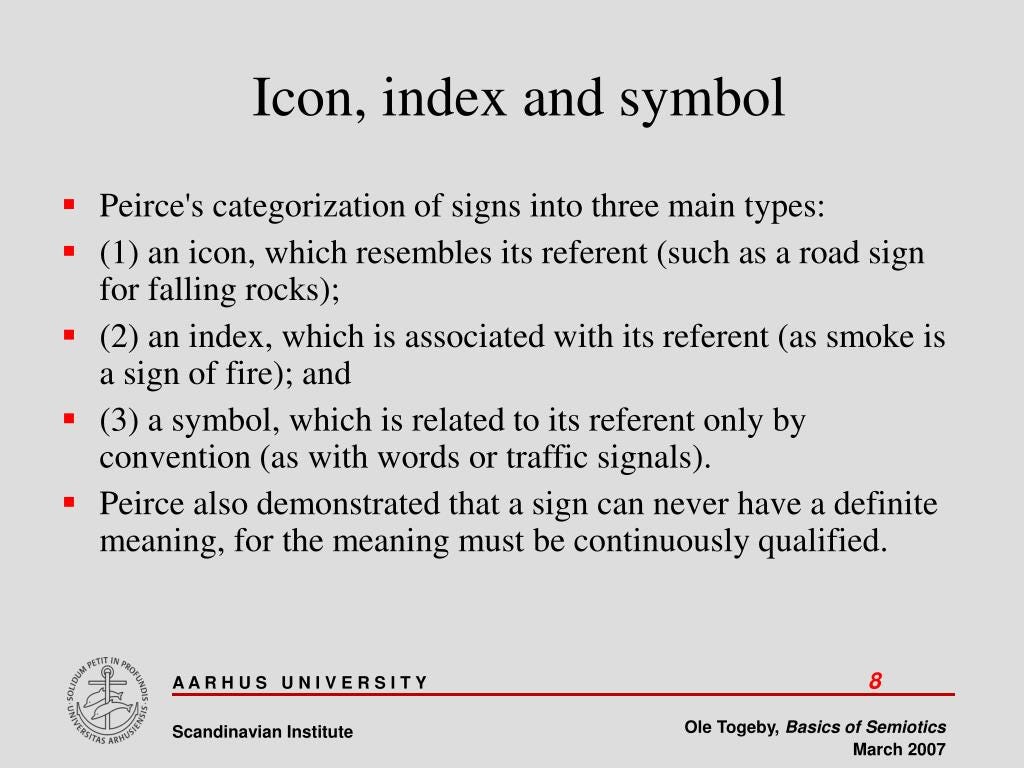
Ellen says one criterion for fetishism is conflation of the signified and the signifier: an ambiguity as to whether the object itself, or what it signifies, is the “active causative agent.” (WTF?)
Okay, we gotta sneak up on this thing.
Back when we talked about reification, we said one measure of it is concretization, or “treating an abstraction as if it were an actual tangible thing.” In fact, reification has undergone its own elaborations and expansions, mostly, but not exclusively, by Marxists. Simplicable has a pretty cool set of examples for these:
Reification is a fallacy that results from treating an abstraction as a concrete thing. This is associated with taking ideas too far until they become rigid and oppressive. A concrete thing is undeniable and measurable, treating your abstract thoughts in the same way is technically illogical.
Nine forms of reification:
Personification—Treating an abstraction as a person such as “nature is kind.”
Objectification—Abstractions as objects such as “he lost his mind.”
Substantialization—Assigning physical properties to abstractions such as “freedom is hard.”
Metonymic reification—Substituting an abstraction for something that is real. For example, referring to a government as “the people.”
Anthropomorphic reification—Assigning human characteristics to non-human things. For example, “the thunder is angry.”
Agency reification—Treating abstractions as if they have agency such as motivation. For example, “the market wants to go down.”
Temporal reification—Treating time as a normal physical thing such as “give me my time back.”
Causal reification—Pretending that abstractions caused something that they could not have caused. For example, “art drove him mad.”
Measurement reification—Pretending that abstractions such as happiness or intelligence can be measured with accuracy.
(In creative discourse, metaphors are wondrous things that sometimes trade in aesthetic reification, but they aren’t mystification in the sense of deceptions.)
Thorne took off his heavy leather jacket, turned to drape it across the back of the chair. It had been freezing when he’d stepped out of his flat an hour and a half earlier, but he’d begin to sweat after ten minutes in the Becke House, where most of the windows had been painted shut and all the thermostats seemed permanently set to ‘Saharan.’ Outside, wind sang against the glass. November was just getting into its stride, brisk and short-tempered, and from Brigstocke’s office Thorne could see leaves swirling furiously and the flat roofs of the buildings opposite. (Mark Billingham, from Death Message)
^^^ Reifications galore, but that’s some kick-ass composition there.
Reification can treat people like objects (objectification), or it can treat objects as people (or agents, subjectification). Going back to Ellen now, the conflation of the signifier (subject) and signified (object) perhaps makes more sense. Conflation of subject and object.
Which raises another question: is fetishism, in its from as reification, indexical, iconic, or symbolic? When Marx articulates the “fetishism of the commodity,” the commodity is separated from its own genesis in a set of (class) social relations, the shoes presenting themselves at Shoe Carnival in a pretty package—a signifier (of several kinds—status, functionality, etc.) with no socio-genetic signified. (These semioticians can get carried away sometimes.) Ellen, on the other hand, is dealing with fetishism from the point of view of an anthropologist—ergo his fascination with semiotics—the collapse of the indexical (signifier to signified) into the iconic (iconofication ^^^).

David Simpson’s concerns with fetishism are aesthetic/literary.
The Marxian/Lacanian Slavoj Žižek tries to understand fetishism from a psychoanalytic perspective.
Looking through the prism of Lacan and Marx, then, Zizek brands us as fetishists in practice, not in theory; he posits that we do not know or we misrecognize the fact that in our social reality itself, in [our] social activity in the act of commodity exchange [we] are guided by the fetishistic illusion. Amidst this discussion on ideology, Zizek highlights one of the most significant differences between Marx and Lacan:
“In the predominant Marxist perspective the ideological gaze is a partial gaze overlooking the totality of social relations, whereas in the Lacanian perspective ideology rather designates a totality set on effacing the traces of its own impossibility.”
This difference corresponds to the one that distinguishes the Marxian from the Freudian notion of fetishism: In the former, a fetish conceals the positive network of social relations, whereas in the latter a fetish conceals the lack (castration) around which the symbolic network is articulated.
—Molly Clemons
Now that I’ve sufficiently confused readers, I’ll close with a somewhat lengthy direct quote from my mentor, Alf Hornborg, on the subject about which he wrote and which inspired my book, Mammon’s Ecology—the fetishization of money:
The sequence from the pre-modern through the modern to the post-modern can be traced in the evolution of the money sign, and it corresponds to the spectrum of interpretations ranging from realist to nominalist theories of money. The former posits an intrinsic meaning or value in money, whereas the latter denies it. The movement toward semiotic abstraction . . . can be described in different terms . . . To begin with, gold signified exchange value. The signification was indexical to the extent that value was perceived as an essential quality of gold. With time, paper money came to signify gold. The ambiguities surrounding the value of paper money have generated, in the past century [published in 2001], various crises and negotiations concerning the relation between money and gold, until the gold standard was abandoned in 1971. Presently, electronic money can be said to signify paper money [he hadn’t seen crypto yet]. We are thus faced with a chain of signified-signifier relations in which increasingly abstract signifiers tend to eclipse their more tangible predecessors, and in which the connection to the original and most concrete signified (gold) has dissolved. (Power of the Machine, 164-5)
So glad I could clear all this up.

Peace.