
Dating apps
a septuagenarian weighs in

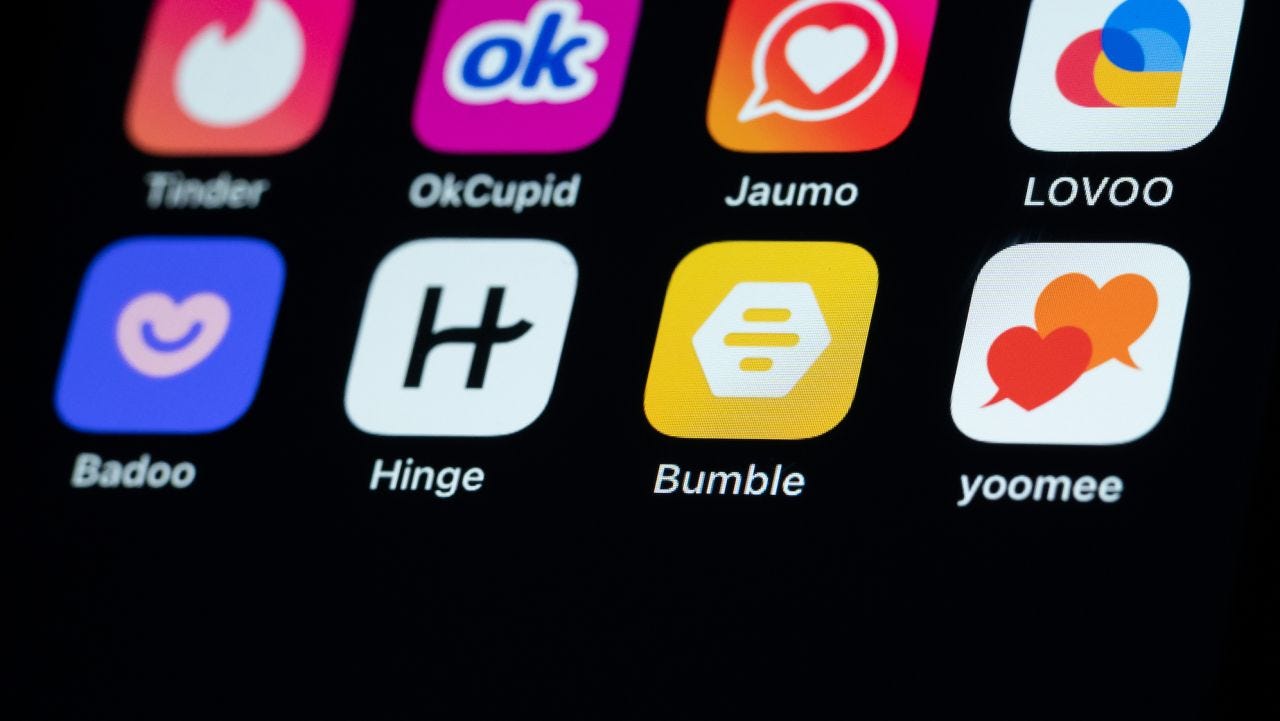
Speaking now directly from my ass in several respects, because I have never used a dating app. Sherry and I were married in 1992, well before these demonic systems were created.
So how can I make such a harsh judgement of a thing I’ve never used? Well, in the same way that I can judge the merits of smoking formaldehyde, another thing I haven’t tried and never will. I know what formaldehyde is. It’s embalming fluid, which should be enough. I spent a couple of weeks during the Anatomy and Physiology portion of my Phase II Special Forces (Medical) Qualification Course in the cadaver locker at Fort Sam Houston eating Tylenol and aspirin like M&Ms to treat the epic headaches that shit gave us after messing around all day with preserved body parts (and one whole cadaver we’d named Edith). I also know that formaldehyde is used as a fumigant. Like fucking bug spray, okay, and I’m not smoking bug spray either, even if it were to psychedelicize me for a couple of hours.
Some things you have to forego—or ought to—even if they offer some immediate gratification, because the very nature of doing or using those things is such that it’s likely to lead to shit consequences in exchange for that immediate gratification.
Things I know about the dating apps I’ve never used (and wouldn’t even were I forty years young and single):
(1) Right out of the gate . . . it’s anonymous. You have no idea who it is you’re dating. This is not a problem only for the obvious worst case scenario, that you’re about to hook up with someone who fantasizes about you at the wrong end of an icepick. In olden years, you started out with some context and familiarity. My first exposure to Sherry was when she was managing medical records in a Fort Bragg clinic. I was a detachment medic in 7th SF Group, and I had to review those records periodically and check them out for deployments. The first time I met her, she’d just cursed out an obnoxious co-worker. Context. We chatted. More context. There’s a longer story here, but we met three more times in this work setting before I we had an actual date—dinner and a movie . . . banal, perhaps, unoriginal . . . but yet more context.
(2) You’re already in a competition to get noticed. “Pick me!” Not an auspicious beginning. It’s degrading on the one hand, and it incentivizes self-misrepresentations—false advertising. Before you’ve even met, both of you are—what’s that archaic word?—bullshitting one another in a manner that’s bound to disappoint by and by, because neither party can live up to the idealized ad they’ve cooked up to get picked. I don’t know of anyone who’s posted a profile, like, “thirty-year-old failed academic slob with an affinity for opioids, chronic constipation, a dead-end job, mommy issues, and an online library of revenge porn.” The same guy will say something like, “30-year-old man, who enjoys classical music, the gym, long walks in the forest, French cuisine, rom-coms, and browsing in used book stores.” Responding to the ad is her—alcoholic 26-year-old borderline personality with daddy issues who carries a Glock in her purse, or “23-year-old seeking companionship and possible romance; loves Disney films, chess, and men who know where they’re going in life.”
(3) Pictures. Look, there’s already a problem afoot when what someone looks like is the prime criterion. In fact, this—absent any other criteria—is just about the worst way to gain any semi-accurate first assessment of someone’s character. In some cases, it’s an inverted criterion. When someone has obviously gone to insane lengths to perfect his or her appearance, you are far more likely to be in the presence of narcissism or neurotic superficiality. Adequate hygiene and baseline grooming is “well adjusted,” but a looks-obsession—or even more problematic, a “hotness” obsession—does not augur well for a relationship built on mutual respect and friendship, much less coupling. Maybe I’m a dinosaur, but while “looks” might be an initial attractant—and even here you may be responding to manufactured fetishes—it still seems to me that personality and character are the real substance one should be looking for in a “relationship.” The very thing people lie about when putting up their ads.
What about polyamory? you may ask. My old-man answer: you people are batshit crazy. One-on-one is already challenging in the best of circumstances, but if you want rapidly recurrent psychotic drama in your life, yeah . . . let’s put three or four or five of you in the same domicile exchanging body fluids. I’ll sit on the sideline here and take notes.
(4) What if one is just looking for a hookup? you may ask. To which I’ll say, yeah . . . that’s been around for a long time. Back in the day I did some of that myself. And I’m ashamed. Treating people as objects is bad. I shouldn’t even have to explain this, but we live in a time when this is no longer obvious. The next argument I anticipate is that it’s okay to objectify another person if both “consenting adults” agree to be mutually objectified. The counter-argument is in an earlier article called “Transactionalism and consent.” Reiterating: treating people like objects is bad. If you think a little bit harder than usual on this, you’ll realize that objectifying human beings accounts for 99.9 percent of the worst shit in the world.
Also, refer back to anonymity. That hookup might be your ice pick angel . . . or your next fulminating case of chlamydia.
(4b) Next to “looks,” “good” sex is the second most unreliable criterion upon which to envision long-term coupling. I say this to the more inexperienced. Nature and consciousness have colluded to make lots of babies by investing sex with ecstatic states—transient to be sure, but recurrent. That ooo-ahhhh can be easily confused for love (and it can achieve transcendence when combined with genuine love), but sex is never merely a matter of appetites. It’s freighted with all manner of sociology, psychology, and power. People can have “good sex” with very disturbed, even dangerous, people; and sexual pink-clouding can blind them to those disturbances until it’s too late and you realize you’re in a “relationship” punctuated by psychotic breaks. (We won’t even enter the morass of what are the criteria for “good sex,” and what are the psychologies that underwrite how to “get there.”)
(5) Dating apps are just another form of digital colonization. My last article addressed this more thoroughly (“Uwe Pörksen’s modular words”); but by that I mean that we’re surrendering ourselves to yet more digital dependency. Digital dependency (or technofeudalism) is real, and it’s fucking dangerous, and it’s fucking dehumanizing, and it’s making us stupid and fucking infantile . . . so yeah, there’s that. We’ve already discussed how the promise of convenience and compatibility is undermined at the outset by the indwelling arms race of digital dating. But the algorithmization of our lives in general is already robbing us of the skills and practices required for being with others, just as as surely as it’s making college students who use AI to cheat though school and can’t find their own asses with a map and a radar, and its turned the body politic into an infernal network of ideological silos. You want to bring this into your most (potentially) intimate personal relations?
It’s just a goddamn shame that we’ve arrived at a point in history where people call person-to-person relativity “meatspace,” like it’s a fucking exception to nature. I used to think I’d tell my granddaughters that the worst place to meet a future mate is in a bar. Nowadays, it’s a lesser evil.
Around 30 percent of contemporary new couples in the US now meet through a dating app. Overall, the long term success of said meetups is 2.5 percent. In between these statistics are all sorts of qualification. More people cohabit than marry now, though most cohabitants see their cohabitation as a step toward marriage—like a test drive. Four out of ten of those first-time marriages fail. People get better at failing, so the divorce rate for second marriages is around six out of ten.
A lot of this is expectations. And propaganda that shapes expectations. You know what no advertisement—the chief propaganda of our age—will ever suggest? Acceptance. Old 12-step adage: Lower your expectations and elevate your acceptance. Pretty good advice, based on my own seven and a half decades of experience.
What people now call a “relationship” (another plastic word) should be . . . should be . . . a covenant. Like a friendship! Marriage vows throw in those words “for better or worse.” The state wants a marriage contract. The vows are suggestive of a covenant. Contract disembodies an agreement from its other social contexts and validates it only before the officers of law. The distinction between contract (a modern notion) and covenant (a notion reaching back to the origins of the Hebrews) is that a contract is predicated on suspicion. It places limits on the obligations spelled out, whereas a covenant is based on love or family, and it implies open-ended mutual loyalty and obligation. I’m not implying some trad-patriarchal bullshit. If your boyfriend or husband (or girlfriend or wife) is violent or a degenerate gambler or a philanderer or whatever, by all means, pack your shit and go. But any couple who has demonstrated staying power is going to tell you—unless they’re in a mutual bullshit pact—that the shine wears off, the pink cloud dissipates, and the real challenge is compromise and acceptance. Think of them as roots that anchor you against storms. ← That right there is how a covenant works.
The root problem, methinks, is selfishness—which is a sly form of bondage (not the “adult”-dating kind). I mean, think about that parenthetical remark. “Adult” doesn’t mean maturity, taking responsibility, being accountable, exercising self-control . . . no, it means being of legal age to “do what you want.” My theory—based on some experience—is that “relationships” fail most frequently because people go into them “seeking” something for themselves. This is so widely accepted—this self-centeredness—that many will react with, “Of course, I’m looking for something for myself. Why else would I want this?”
That’s all I have to say about that. (The rest I’ve said elsewhere.)
Peace.
Am a Gen Z female, have avoided the dating app curse so far. For me there's not much temptation to use them and never has been, but my generation has rapidly become more and more asocial in reality, and our relationships are being increasingly mediated via technology. Even if one doesn't use the apps it's very common for young couples to film each other, photograph each other, or share intimate memories to social media rather than being present in the moment enjoying each other. There's a still a few of us holdouts knocking around for now, but the state of family and gender relations currently is certainly a bleak cultural moment.
Stan, you’ve nailed it with this one. (In my comparatively inexperienced opinion, anyways)
As we rapidly approach our fifth anniversary, I can definitely say that my husband and I really hit our stride once we fully embodied the ‘compromise and acceptance’ lesson, and learned what being a supportive partner really asks of us.
I’ve lived it all - hookup culture, dating, online dating, a couple attempts at premarital cohabitation, and now a successful monogamous marriage. I’m of the mind that if one is curious about any of those experiences they should try it at least once. You’ll never convince someone that one night stands are usually more empty and alienating than enticing and romantic until they have a few underwhelming encounters themselves. Same with telling someone that tinder etc are complete garbage- you’ll understand it quickly after a few swipes.
To me, the most intimate connection a person can have is to share their time and company with people who see them exactly as they are (warts and all, for the old adage) and decisively choose them anyways. In a romantic context, this knowing typically permeates the deepest. It’s hard to get that in a bumble chat window or a bar, but it’s fully impossible unless you’re willing to be seen as you are by someone who is able to do the same.