
Hyperbolic headlines, panic, and sobriety

Back in 1994, I was the “team daddy” (senior operations and intelligence sergeant) for ODA 354—an A-Detachment (“A-team”) in 3rd Special Forces Group that specialized in free-fall parachute operations (which we never used in any actual op). 3rd Group’s areas of operational responsibility were Sub-Saharan Africa and the Caribbean. The most common language the Group was trained in was French, and my second language was Spanish which was why I’d previously been assigned to 7th Special Forces Group with a AOR in Latin America. As luck would have it, when some computer in Northern Virginia decided to slot me with 3rd Group—against my will, I might add—I was made the senior non-commissioned officer for the one non-Francophone team in my company that specialized in Spanish. Our target folders were all for Cuba, and ODA-354 spent considerable time in working and training in Puerto Rico and the Dominican Republic.
There had been an American-planned coup d’etat in Haiti in 1991 to depose the populist President Jean-Bertrand Aristide—who’d been elected in a landslide against the US-backed Marc Bazin. (Bad Haitians! Bad Haitians!)
The coup had soured over the next three years under the brutal regime of Haitian Armed Forces (FAHD) General Raoul Cédras and Chief of National Police (PNH) Michel François . . . to the point where the Clinton administration felt compelled to return Aristide in some manageable form to Haiti before popular insurrections could spread any further.
In August of that year, our detachment along with most of 3rd Special Forces Group were staged in Guantanamo Bay for a proposed invasion to unseat the very government the US had installed only three years prior. As an intel sergeant who’s anticipated this operation for several months, I’d undertaken a furious study of Haiti well before we left. Which led me to doubt virtually every intel briefing we received prior to the deployment, including one that featured some creepy evangelical preacher who told the boys that Haitians were devil worshipers who would disable you with “powders” when they shook your hand—he’d seen The Serpent and the Rainbow one too many times, I suspect.
I had a couple of subordinates, nonetheless, who took this bullshit to heart and began to fret about “voodoo” curses and powders and poisons. Added to that were typical medical briefings—about which I was also skeptical, having been a medic throughout Latin America—that were designed to instill a fear of touching Haitians, eating local food, in fact doing anything that might take one out of the perimeter. Like they’d never been in the tropics before . . . Haiti and Haitians were somehow carrying more virulent strains of everything than their neighbors in the DR.
Then came the ops briefs, in which all were led to believe that Cedras’ armed forces were laying in wait for us to put up a fierce scuffle—something I also doubted based on my own research, but in operations it’s always best to err on the side of not underestimating one’s potential foes (as we’d done in Grenada before they shot the shit out of us, and as we’d done again in Somalia . . . as Trump and Hegseth have now done with Iran).
I had two guys on the team—this is a Special Forces A-Team mind you, and I hate to burst anyone’s bubble—who put the powders and germs and black people with guns together in a kind of panic soup, and they started mouthing off about it.
“Oh why, oh why should we risk our lives for the sake of some Caribbean shithole! Oh woe is fucking me!”
I guess the past several years of serial adultery deployments to the Dominican Republic (on the same damn island) hadn’t sufficiently prepared a couple of these fellas for what they saw as danger and hardship . . . let me just say, what we were facing was hardly some great danger or terrible hardship. (The greatest hardship ended up being all the bullshit all troops are inevitably put through by deployment preparations.)
At any rate, I had a pat reaction to panic in those days.
It pissed me the fuck off.
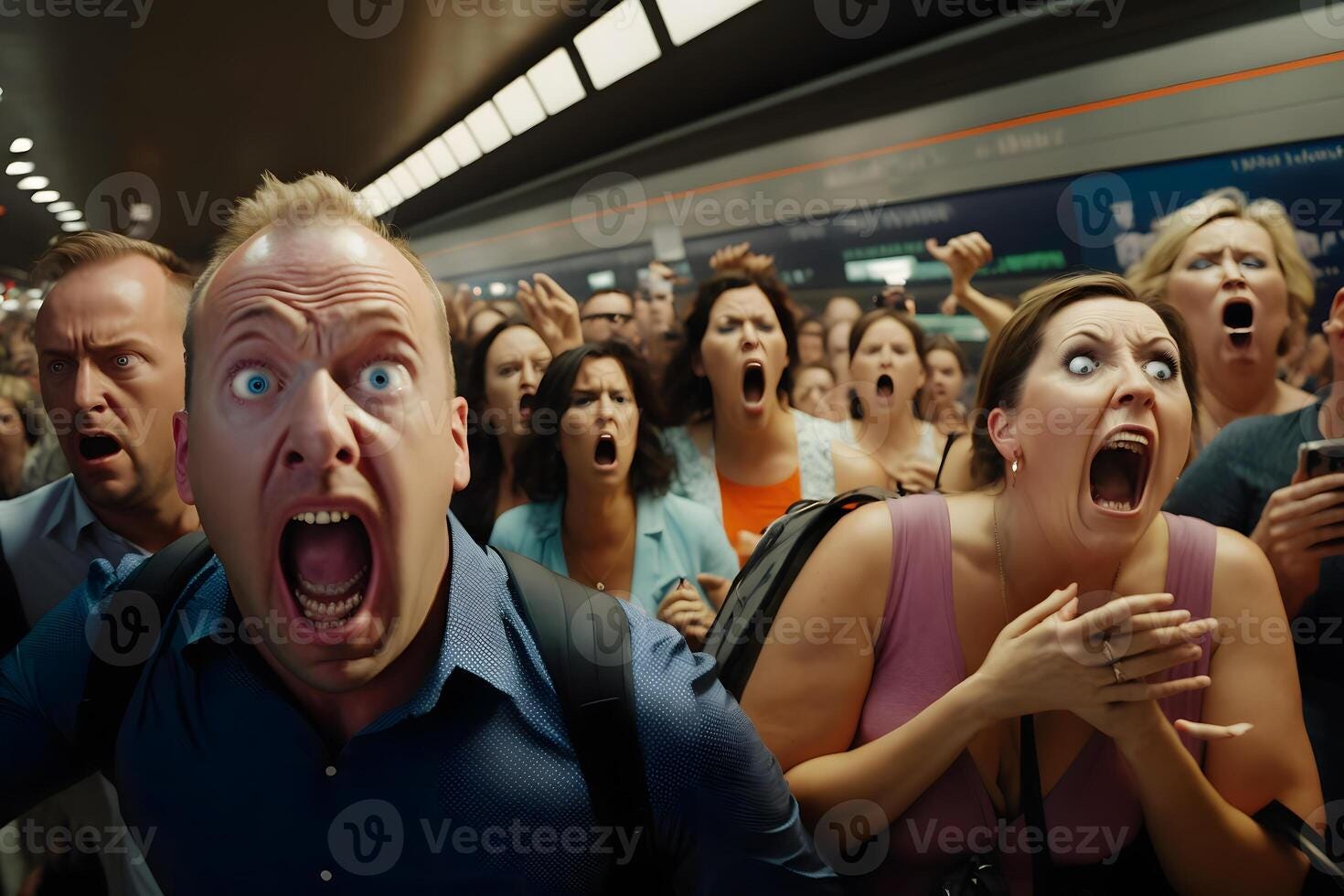
There is no more dangerous a person in one’s unit, especially in the case of actual conditions of extremity, than people who panic. They overreact, they make stupid mistakes, they pull attention toward themselves and away from the problem at hand, and they infect others with their amygdalasia.
In reality, the more critical any given situation is, the more it demands sobriety. And so I had a harsh reaction to the fear-mongering on the team—something along the lines of “Put a lid on that shit, you Chicken Little motherfuckers”—which didn’t enhance my already flagging popularity.
Okay, story over.
Flash forward to today and something called the attention economy. Readers are familiar with its etiology in technofeudal content creation (like this article).
We’ve been placed in a Hobbesian competition for clicks that’s the metastatic version of the fear-mongering which has been around since time immemorial. The looming danger, the enemy at the gates, the falling sky . . . if you want attention, jazz everyone up on this shit, and rather than step back from it, some strange human death instinct kicks in that makes Very Bad News a flame to us, the moths. Not only are we pulled back toward it again and again, but we recruit fellow panickeers along the way. Panic becomes, like conflict and scandal and dope, a social bonding agent.
The metastasis of this phenomenon by digital platforms is turning people into enemies because it’s turning problems—real or imagined—into panics.
I’m not trying to underplay the many legitimate concerns we all have about our lives and the world more generally. Some are momentous. I’m saying that concern is best managed by sobriety. Don’t overstate, don’t understate, don’t jump to conclusions, find the real in its Goldilocks golden mean somewhere between a pink sky and utter doom.
Overstatement risks over-reaction.
Understatement risks under-reaction.
Before we let someone else cook us up a terrifying conclusion, maybe check out the ingredients.
Sobriety is taking the time to assess an actual situation, as dispassionately as we can, then taking account of what we realistically can and cannot do. Sobriety is accepting our own lack of either omniscience and omnipotence without being paralyzed by the reality that we aren’t in control . . . and remembering that the control others have, even the most powerful, likewise has real limits. This is a first step at staying off that emotional Super-Nitro roller coaster.
The bonus is that it leaves us far less susceptible to mass manipulation.
I’m one of those people who tries to keep abreast of current events—sans pop culture and fads where I can evade them. I’m far from alone in this. Unfortunately, I don’t have seeing-stones planted around the world for direct observation, so, like you, I have to rely on “sources.” We all know what a rat’s nest this can be, especially in our present Baudrillarian shithouse, where we’re bombarded not only with simulacra but tsunamis of intentional disinformation. And I’m not chucking stones across the parapet here at any particular political tendency—all of them are on the same fucking game.
It’s like there’s a war for attention fought with hyperbolic headlines, each tendency giving its own account of why the sky is falling. As if our culture hadn’t been neurotic enough!
There is plenty written about the knock-on effects of capitalism, but among them I think we should more prominently include mass neurosis. I mean, we all know how products are sold with insecurity—are my teeth off-putting? do I have a ring around my collar? will I get cancer for lack of fiber? Current events, the news, the many ostensible interpreters . . . these are commodities, too, peddled in a competitive market. And just like dental bleaches and air fresheners and nutritional supplements, the peddlers can improve their market share by boosting our anxieties, milking them, then carrying home the cream.
So and so LOSES IT! Such and such MELTDOWN! XYX is FURIOUS! Everything is FALLING APART! Yada-yada BACKFIRES! THE END of whatever! I’m not taking these all-caps hyperventilations from the bad people, but from some of the outlets appealing to my own political leftishness. Y’all, you’re acting just like the capitalists. You’re not informing, you’re marketing.
You know what’s non-competitive in this milieu? Sobriety.
The truth is—and this draws us into the deeps of psychoanalysis—we get off on strong emotions; and when our lives have been flattened and disenchanted, feeling strongly about anything can become an addiction. We get caught in that cycle. After each refractory period, we have to chase another orgasm, another meth bump, another turn, crest, and fall along the Super-Nitro.
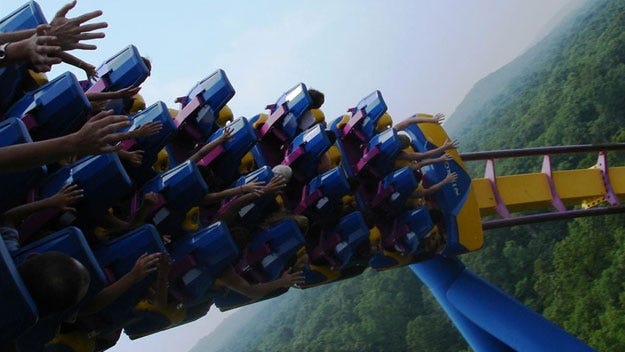
There’s a mysterious pleasure hiding behind certain forms of misery and fear; and I’m not talking about the kind of fear and misery experienced by people in actual conditions of extremity. I’m talking about most metropolitan people who experience extremity only vicariously.
Likewise, I’m not discounting all the reasons many of us have to feel anxious these days. Our world really is, in many respects, destabilizing right now. We’re in debt. The walls seem slowly to be closing in. We’re unsure how we’ll adapt or even if we can. In some sense, perhaps we’re entering the panic cycle as a way of getting out in front of things. We believe that fear is our only preparation. Reciprocally, if we fail to fear, we’ll be annihilated.
I know of people who get pissed when you refuse not their concerns, but their panicky reaction. The level of panic becomes synonymous with the intensity of virtue.
We’re living in the whimper, and we need the bang. The drama! Because the whimper is tedious, drenched in pointlessness and ennui. Carrot—hidden pleasure. Sticks—meaninglessness and imaginary annihilation. And so we’re in some sense predisposed.
Sobriety, on the other hand, makes disciplinary demands upon us—emotional and intellectual. It demands a certain rigor. Sobriety is not sexy. Sobriety is not fun. Sobriety is not saleable. It’s saving graces, though, are (1) of a calm and efficacious perspective and (2) you are far less likely to react in ways that make things worse.
Peace.
You, sir, are responsible for this post. (-;
Damn good shit, Stan.